For the AI computing power industry chain, Bury's latest move serves more as a medium-term tail risk warning.
Zhitong Finance APP has learned that Michael Burry, known as the 'Big Short,' has been posting apocalyptic and pessimistic commentary on his Substack subscription platform. Amid sustained global capital inflows into AI computing infrastructure themes, he has taken significant short positions in popular AI-related technology stocks. Burry, the real-life figure behind the movie 'The Big Short,' has recently intensified his short-selling activities, with a clear focus on crowded trades tied to AI computing infrastructure and the capital expenditure cycle of AI semiconductors. For instance, he has expressed bearish positions on NVIDIA, Tesla, Micron Technology, Applied Materials, and the iShares Semiconductor ETF through put options or short positions.
On Thursday, Eastern Time, Michael Burry disclosed his latest portfolio adjustments, increasing several existing holdings while further expanding bearish bets on semiconductor stocks linked to artificial intelligence computing infrastructure and software companies focused on AI application platforms.
 Burry’s increased short exposure to the AI investment theme serves as a warning to investors not to mistake a sharp oversold rebound for a completed trend reversal in the AI computing supply chain. Citadel, the hedge fund giant led by Wall Street billionaire Ken Griffin, struck a deal with Situational Awareness—a fledgling hedge fund mired in collapse—which helped trigger a long-overdue, exuberant ‘irrational bullish’ super rally across global AI computing-themed equities, particularly semiconductor stocks closely tied to AI computing capabilities.
South Korea’s KOSPI Composite Index, home to two global memory chip giants—SK Hynix and Samsung Electronics—plunged sharply over three consecutive trading sessions before staging a record-breaking 18% surge on Friday. Taiwan’s benchmark equity index, heavily weighted by Taiwan Semiconductor—the world’s dominant foundry controlling nearly all AI chip manufacturing capacity—rose 8%. Japan’s Nikkei 225, which includes leading AI computing supply chain firms such as Kioxia, Tokyo Electron, and Advantest, also gained 4%. On Thursday, the widely watched U.S. semiconductor bellwether—the Philadelphia Semiconductor Index, often regarded as the global semiconductor barometer—posted its largest single-day gain since April 2025.
The 'Big Short' is simultaneously buying consumer and gaming stocks while hunting AI names
According to Stocktwits, citing Burry’s paid Substack post, he increased stakes in gaming giants DraftKings (DKNG.US) and Flutter Entertainment (FLUT.US), added to positions in Zoetis (ZTS.US) and Lululemon Athletica (LULU.US), and further expanded his put option position on 'AI chip super-dominator' NVIDIA (NVDA.US), along with short positions in DRAM/NAND memory leader Micron Technology (MU.US) and the iShares Semiconductor ETF (SOXX.US). His short positions in Tesla (TSLA.US) and Palantir Technologies (PLTR.US) remained unchanged.
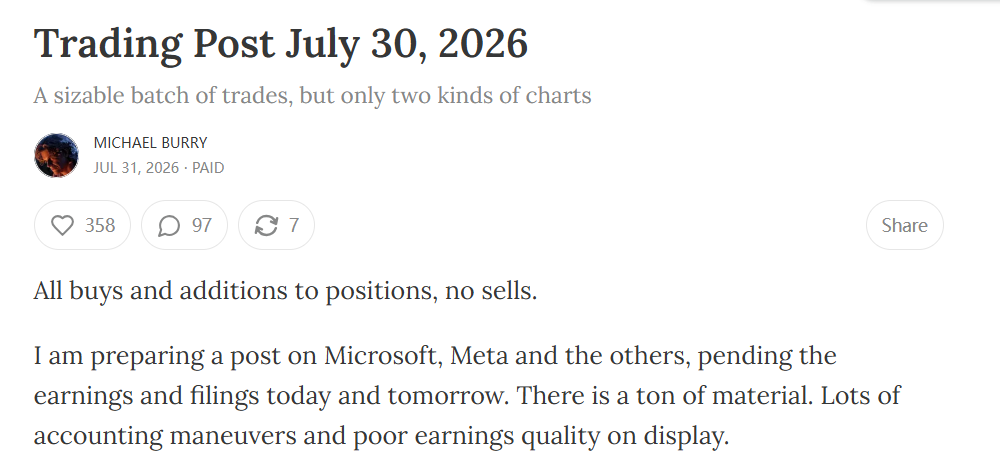
“All actions were buys and additions—no sales were made,” Burry stated on Substack.
It is understood that he added to DraftKings at approximately $23.40 per share, noting both it and Flutter as 'significant positions.' Burry also substantially increased his stake in Zoetis at around $76 per share, describing it as a 'full position.' Similarly, he significantly added to Canadian-based athletic apparel leader Lululemon Athletica at roughly $118 per share, also labeling it a full position.
“Like the two aforementioned stocks, this represents a major bottoming/consolidation opportunity following an extended period of decline,” Burry wrote.
In explaining his rationale for these additions, Burry stated that these recent trades reflect 'a transfer of shares into stronger hands,' and he believes the risk associated with these three purchases has been 'substantially mitigated' at current prices, especially for long-term-oriented investors.
Regarding options-based bearish trades, Burry increased his position in QQQ put options expiring on January 15, 2027, with strike prices in the high $500 range (i.e., put options on the Nasdaq-100 Index ETF). He also added to his NVIDIA put options expiring on December 18, 2026, with strike prices in the historically low $100–$125 range.
Additionally, Burry expanded his short position in Micron Technology (MU.US), the U.S. memory chip leader, at around $880 per share, and increased his short position in the iShares Semiconductor ETF (SOXX), which tracks the Philadelphia Semiconductor Index, at approximately $506 per share. The July 30 disclosure specifically separated 'QQQ puts,' 'NVIDIA puts,' 'Micron short position,' and 'SOXX short position,' indicating that Burry is not solely using options to express his bearish views; rather, he is employing long-dated put options on NVIDIA and the Nasdaq index while directly shorting Micron and certain semiconductor holdings.
Burry Pours Cold Water on the U.S. Semiconductor Rally
The title of Burry’s Substack post published on July 30 was 'Trading Post July 30, 2026.' In the body of the post, he not only wrote, 'All actions were buys and additions—no sells,' but also explicitly stated: 'To save time, let’s summarize the trades executed today.' Therefore, this disclosure does not merely reflect positions accumulated over several prior days reported on Thursday; rather, Burry himself described the following transactions as having been executed or augmented on July 30.
These same-day transactions include:
Adding to QQQ put options expiring on January 15, 2027, with strike prices in the high $500 range;
Adding to NVIDIA put options expiring on December 18, 2026, with strike prices in the low $100 range;
Expanding a direct short position in Micron around $880 per share;
Expanding a short position in SOXX around $506 per share.
According to the explicit wording in Burry’s July 30 Substack post, these incremental short positions in NVIDIA, QQQ, Micron, and SOXX were executed on Thursday, U.S. time—not merely disclosed then as previously completed trades. However, since these are self-reported by the investor, public filings can only confirm the trade date, direction, and approximate price levels; they cannot independently verify the exact execution time, position size, or total net short exposure.
Berry chose to further increase his short exposure on the day of the rebound, indicating that his trade was not predicated on the assumption that 'AI orders would vanish immediately next quarter,' but rather on the view that the market has overestimated the full-cycle profits, free cash flow, and residual asset value ultimately realizable from this round of capital expenditure. Since autumn 2025, Berry’s core bearish thesis on the AI investment theme has centered on three key arguments: 'technological lifespan is shorter than accounting lifespan,' 'capital expenditure growth has outpaced verifiable AI monetization,' and 'even genuine technological revolutions can generate supply-side bubbles.'
Berry’s public short position on AI began in autumn 2025. Scion’s 13F filing as of Q3 2025 showed the firm held put options equivalent to 1 million shares of NVIDIA and 5 million shares of Palantir; however, the reported nominal values of $187 million and $912 million corresponded to the underlying stocks, not the actual capital deployed. Berry later clarified that the Palantir trade involved purchasing 50,000 put contracts at a premium of $1.84 per contract, amounting to a total premium cost of approximately $9.2 million. In November 2025, he further argued that major cloud providers’ extension of depreciation periods for servers and networking equipment could result in cumulative under-reporting of roughly $176 billion in depreciation expenses between 2026 and 2028, thereby inflating profits related to AI investments.
In 2026, he progressively escalated his targeted shorts into a broader, sector-wide and index-level short strategy: in April–May, he added put options on NVIDIA, QQQ, SOXX, and Oracle, and initiated a direct short position in Palantir; by end-May, he rolled over his QQQ and SOXX options and increased risk capital allocation; on June 30, he established a direct short in NVIDIA at approximately $198.09 per share, while also shorting Applied Materials and SOXX, and added Tesla and Caterpillar to his cyclical short portfolio; on July 2, he shorted Micron Technology at around $1,051.87 per share; on July 17, he further increased NVIDIA put options and halved his Oracle position after it had become excessively profitable; and on July 30, amid a strong semiconductor sector rebound, he again added to his short positions in NVIDIA, Micron, SOXX, and QQQ.
For the AI computing infrastructure supply chain, Berry’s latest additions function more as a medium-term tail-risk warning than as an urgent, short-term sell signal for Friday trading. His use of deep out-of-the-money, long-dated options suggests he is betting on a nonlinear downward revision in valuation and earnings expectations over the coming months—not on consecutive daily declines in NVIDIA, Micron, or SOXX. At the same time, far out-of-the-money put options are highly sensitive to timing, volatility, and entry point; even if the directional call proves correct, entering too early could result in the complete loss of the option premium.
Editor/Deng