
Reports indicate that after SpaceX's rocky debut, OpenAI is considering delaying its IPO until 2027.
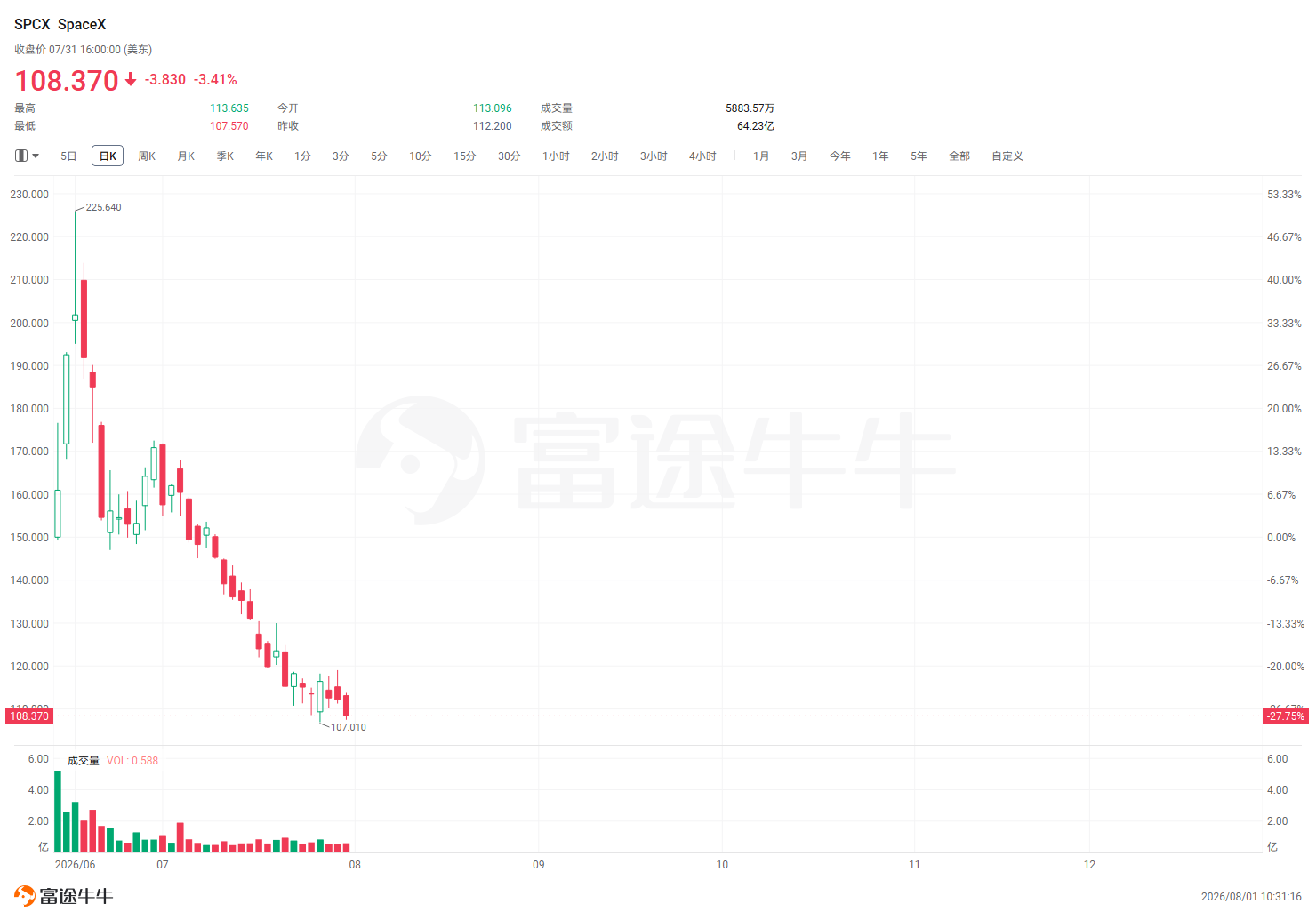
The euphoria over the 'largest IPO in history' lasted less than two weeks, $SpaceX (SPCX.US)$ The plunge from a peak of $225 to $108 is triggering a profound crisis of confidence across the AI capital markets. According to multiple informed sources, OpenAI, the developer of ChatGPT, has significantly scaled back its initial ambition of going public as early as this fall and now clearly favors delaying its IPO until 2027. Behind this postponement lies a direct clash between CEO Sam Altman’s insistence on a minimum $1 trillion valuation and the harsh realities of the current market.
SpaceX’s Cautionary Tale: The Euphoria at $225 and the Sobering Reality at $108
On June 12, SpaceX listed on Nasdaq at an issue price of $135 per share, achieving a market capitalization exceeding $1.77 trillion on its first trading day and setting a record for the largest IPO in U.S. stock market history. Retail investor subscriptions surpassed $100 billion, with the market initially viewing it as the perfect embodiment of dual narratives—AI and space economy.
 However, the euphoria lasted less than two weeks. On June 23, SpaceX shares plummeted by approximately 16% in a single day. On July 15, the stock price fell below its $135 issue price for the first time. As of the close on July 28, SpaceX shares stood at $116.41, representing a cumulative decline of 48.4% from their all-time high of $225.64—nearly halving in value. By the close on Friday, July 31, the price had further dropped to $108, erasing more than $1.2 trillion in market value from its peak.
This sharp decline has directly dampened sentiment toward OpenAI’s IPO plans. Bankers advising OpenAI have explicitly warned that recent volatility in tech stocks and SpaceX’s significant post-listing price drop could severely undermine retail investors’ enthusiasm for OpenAI’s offering. A source familiar with the matter revealed that, in discussions over the past week, OpenAI’s advisers candidly told the company that retail investors might show little interest in its shares.
Fidelity Securities wrote in a recent report that OpenAI’s anchored valuation is “closer to $700–800 billion than to $1 trillion.”
The $1 Trillion Obsession: Altman’s ‘Red Line’ and Advisers’ Dilemma
OpenAI’s valuation dilemma lies at the heart of the decision to delay its IPO. In March 2026, OpenAI completed a $122 billion funding round, reaching a post-money valuation of $852 billion—making it the world’s most valuable private technology company. Yet this milestone still falls far short of Altman’s expectations. According to informed sources, Altman has been pressing his team of bankers and lawyers to find ways to push the company’s IPO valuation to $1 trillion.
Altman’s advisers have presented him with two options: first, to postpone the IPO until 2027 to await improved market conditions and allow the company’s financial performance to better align with the $1 trillion valuation target; second, to proceed with a listing before the end of 2026 but accept a lower valuation. A person who has spoken with Altman said that when advisers outlined these choices, Altman stated unequivocally that any plan reducing the valuation below $1 trillion would be “unworkable.”
Meanwhile, OpenAI's financial condition is also testing investors' patience. The company reported a net loss of as much as $38.5 billion last year, primarily due to massive expenditures on computing infrastructure, R&D, and organizational restructuring. According to The Information, OpenAI burned through $3.7 billion in cash in the first quarter of 2026—more than half of its $5.7 billion in revenue for the same period. The company projects it will invest $600 billion in computing and hardware by 2030.
Anthropic Jumps Ahead: A Silent Challenge with a $965 Billion Valuation
While OpenAI hesitates, its biggest rival, Anthropic, is racing full speed toward the public markets. At the end of May this year, Anthropic closed a $65 billion Series H funding round, pushing its post-money valuation to $965 billion—surpassing OpenAI’s $852 billion valuation. On June 1, Anthropic became the first to confidentially file an IPO application with the SEC. On July 15, media reports indicated that Anthropic is accelerating its IPO plans, with underwriting banks already arranging meetings between management and potential investors. The company could go public as early as October this year. Anthropic has selected Morgan Stanley, Goldman Sachs, and JPMorgan as lead underwriters.
According to informed sources, several of OpenAI’s major investors have privately expressed concern in recent months about the company’s rapid cash burn relative to its growth, while other investors have hedged their bets on OpenAI by allocating capital to Anthropic. Anthropic is speeding up its planned fall IPO and has already begun meeting with potential investors, emphasizing the competitive edge it maintains over the maker of ChatGPT. OpenAI, which initially aimed to beat Anthropic to market, may now have to wait until next year.
Market Context: The AI Sector Cools Collectively as the IPO Window Narrows
OpenAI’s delay is not an isolated case. Analysts note that IPOs originally scheduled for the second half of 2026 by large-model companies may be postponed to the first half of 2027 due to declining market risk appetite and uncertainty in liquidity conditions. This shift in timing means the company’s highly anticipated listing will be significantly delayed compared to earlier market expectations of a fall debut this year.
OpenAI confidentially submitted its S-1 filing to the SEC on June 8. In its statement at the time, the company said, “We have not yet decided on our listing date and may need more time, as certain initiatives are easier to pursue as a private company. Filing IPO documents allows us the option to move more quickly into the public markets when it better aligns with the company’s interests.”
The most straightforward interpretation of the 2027 timeline is this: OpenAI can afford to wait. By delaying its IPO, the company can continue expanding usage, refining pricing, and establishing a more stable mix of consumer products, enterprise tools, and infrastructure partnerships before subjecting itself to the quarterly discipline of public markets. According to recent reports, OpenAI’s annualized recurring revenue in July already exceeded its total for the entire second quarter.
Editor/lambor