
Morgan Stanley has upgraded its rating on South Korean equities to "overweight," with a target level of 9,000 for the KOSPI index—implying 36% upside potential from current levels. The KOSPI’s forward price-to-earnings ratio has fallen to 5.7x, reaching a historic low. Hedge funds have completed approximately 75% of their deleveraging, and leveraged ETF assets have shrunk by 70% from their peak, significantly improving the market’s positioning structure. Capital management developments, HBM4 pricing dynamics, and the iPhone 18 launch cycle represent the three key catalysts for the next phase of gains in South Korean equities.
Morgan Stanley has upgraded its rating on South Korean equities to "overweight," citing that the recent sharp deleveraging process is nearing completion, $Korea Composite Index (.KOSPI.KR)$ and valuations have fallen to historically low levels, offering investors a more attractive entry point.
According to Feng Trading Desk, in its latest Asia emerging market equity strategy report, Morgan Stanley set a KOSPI target of 9,000 points, implying approximately 36% upside from current levels. The report noted that the KOSPI’s 12-month forward price-to-earnings (P/E) ratio has dropped to 5.7x, below its previous historical lows, and fully reflects market pessimism regarding whether memory-driven earnings can be sustained into 2026.
 Morgan Stanley notes that the recent KOSPI correction—down 39%—was primarily a technical adjustment rather than a reflection of deteriorating fundamentals. With approximately 75% of hedge fund deleveraging already completed, $Samsung Electronics (005930.KR)$ and $SK hynix (SKHY.US)$ the assets under management of related leveraged ETFs have shrunk by roughly 70% from their peak, significantly improving the market’s positioning structure. Meanwhile, the report identifies three key semiconductor-related catalysts as the core drivers for the next phase of gains in South Korean equities.
Deleveraging Nears Completion; Market Positioning Becomes Cleaner
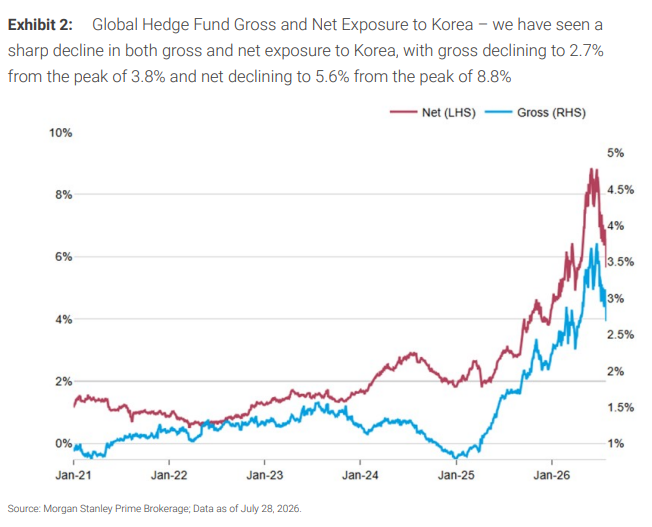
Data from Morgan Stanley Prime Brokerage show that Asian hedge funds have completed approximately 75% of their deleveraging process. Global hedge funds’ gross exposure to Korea has declined from a peak of 3.8% to 2.7%, a 28% reduction; net exposure has fallen from 8.8% to 5.6%, down 36%.
Meanwhile, assets under management (AUM) in leveraged ETFs linked to Samsung Electronics and SK hynix have plunged from a June peak of approximately USD 40 billion to around USD 11.8 billion, a decline of about 70%. The short gamma position in Samsung/SK hynix leveraged ETFs has also retreated from an extreme level of USD 867 million at the end of June to USD 288 million, a 67% drop.
Morgan Stanley’s Korea Capitulation Index has fallen to -2.53, its lowest level since 2008 (excluding readings of -3.1 during the European debt crisis and the COVID-19 pandemic). The report notes that historically, within 30 trading days after KOSPI realized volatility peaks, the market typically rebounds by 10% to 30%.
At the retail investor level, margin financing balances have declined 14% from their June peak, representing a roughly 30% reversion toward the post-2020 average—though absolute levels remain elevated. The report suggests that renewed foreign inflows will be the primary driver for further upside in Korean equities, although market volatility is expected to stay elevated in the near term.
Valuations Fall Below Historical Lows Despite Strong Earnings Growth Outlook
The KOSPI’s current 12-month forward P/E ratio stands at 5.7x, placing it at the 2nd percentile over the past decade—already below previous historical lows. Excluding Samsung Electronics and SK hynix, the KOSPI’s forward P/E ratio is 10.8x, down approximately 27% from its recent peak of 14.8x.
From a profit growth perspective, the market’s consensus expectation is for MSCI Korea’s earnings per share (EPS) to surge by 312% in 2026. More notably, consensus forecasts still project a compound annual EPS growth rate of approximately 20% for 2027–2028, surpassing the corresponding projections for both the U.S. and India.
Morgan Stanley believes that at current valuation levels, the market has already fully priced in a scenario of a significant decline in memory profitability. Even if memory earnings consolidate over the next two years, South Korean equities are still expected to deliver excess returns relative to emerging markets.
Three key catalysts for chip stocks: capital management, HBM4 pricing, and the iPhone cycle
In a report, Shawn Kim, Head of Asia Technology Research at Morgan Stanley, highlighted three near-term catalysts for South Korean semiconductor stocks.
First, capital expenditure. Capital management initiatives by Samsung Electronics and SK hynix are viewed as the most important near-term catalyst. The market is awaiting specific announcements from both companies regarding their 'value creation' plans and capital return strategies. Although the timing remains uncertain, the anticipation itself constitutes a potential catalyst.
Second, HBM4 pricing. Samsung Electronics recently indicated that HBM4 will account for approximately 60% of its total HBM sales by the end of next year. If HBM4 pricing reaches the market’s expectation of over USD 3 per gigabit (Gb), it would provide a positive catalyst for overall DRAM pricing in 2026–2027.
Third, the iPhone 18 launch cycle. Mobile devices still represent 30%–40% of global DRAM demand and 25%–30% of NAND demand. According to feedback from South Korean Apple supply chain partners such as LG Innotek, Apple is optimistic about the iPhone 18 cycle, with projected shipment growth of 5%–10% year-over-year. The iPhone 18 is scheduled for release in September, with initial models limited to the Pro series (including Pro, Pro Max, and a foldable variant). Strong sales performance would positively benefit Samsung Electronics and SK hynix.
Want to select stocks or get a stock diagnosis? Curious about the opportunities and risks in your portfolio? For all your investment questions,Just ask Futubull AI!

Editor/KOKO