
As the second-quarter 2026 earnings season draws to a close, global investors are undergoing a reassessment: the artificial intelligence (AI) narrative is far from over, but the era of indiscriminate gains—where even mediocre players soared on market hype—is gone. Faced with companies’ massive, real-dollar investments, the market is now voting with its feet, sharply distinguishing between 'cash burners' and 'cash generators.' Nevertheless, some major Wall Street institutions, led by Goldman Sachs, argue that the current volatility in AI-related stocks does not signal the start of a market collapse; rather, it represents a healthy consolidation within a long-term bull market underpinned by robust earnings.
From a macro perspective, this earnings season has not dampened market optimism; instead, it has delivered what may be one of the strongest performance reports ever recorded.
According to Goldman Sachs’ data as of July 31, among S&P 500 Index (.SPX.US) constituents that have reported results—representing roughly two-thirds of the index’s total market capitalization—64% posted earnings that exceeded Wall Street expectations by at least one standard deviation, reflecting an unusually high-quality earnings beat. $S&P 500 Index (.SPX.US)$ Goldman Sachs estimates that excluding the exceptionally large investment gains reported by a few technology giants, the S&P 500’s aggregate earnings grew by approximately 26% year-over-year; including those gains, the overall growth rate surged to 45%. Even the more representative median earnings growth among constituents reached 12%, significantly higher than the 9% analysts had forecast at the beginning of the quarter.
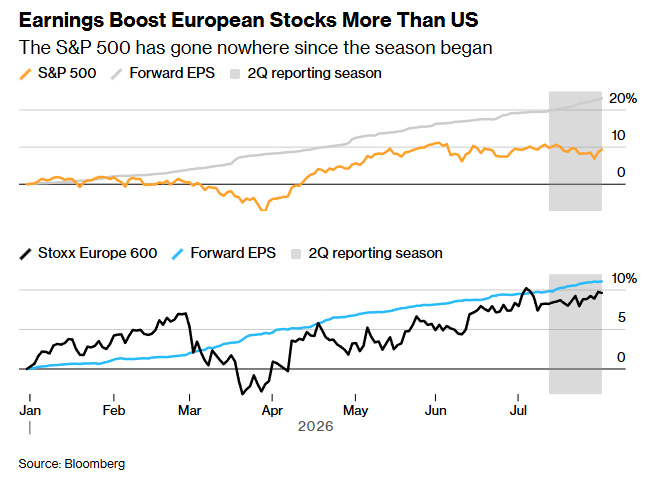
 Data from other research institutions show similarly strong momentum, suggesting that S&P 500 companies’ second-quarter earnings per share (EPS) likely rose by 29% year-over-year—the highest level since the post-crisis recovery years.
This robust earnings backdrop is not unique to the United States. After nearly two years of flat earnings growth, constituents of the STOXX Europe 600 Index saw profits jump 19% year-over-year this quarter. This has made European equities one of the bright spots of the earnings season, with the STOXX 600 Index rising 1.3% against the broader market trend since mid-July and briefly touching a record high.
The AI trade is no longer 'one-size-fits-all': spending is punished, while fiscal discipline is rewarded.
Despite the overall earnings strength, equity investors received an unusually harsh lesson this quarter: not all AI-themed stocks can passively enjoy valuation premiums. Capital is now subjecting AI spending strategies to extremely rigorous scrutiny.
This divergence is most evident in the performance of large-cap technology stocks. Meta Platforms, $Meta Platforms (META.US)$ Its stock price plunged 8% after releasing its earnings report, as its revenue guidance disappointed investors and free cash flow hit a multi-year low—both pointing directly to its ballooning AI-related expenditures. $Alphabet-C (GOOG.US)$ Parent company Alphabet also faced market punishment for signaling its intention to continue expanding capital expenditures.
In contrast, $Microsoft (MSFT.US)$ saw its shares surge 16% in a single day, adding nearly $500 billion to its market capitalization. The catalyst was the fastest cloud business growth in four years, coupled with an implicit reduction in its planned capital expenditure for the year. $Amazon (AMZN.US)$ also saw its stock jump 15% in a single day, as better-than-expected cloud revenue eased investor concerns about returns on its massive AI investments.
“Investors will eventually grow weary of endless spending by hyperscale companies,” commented Bob Lang, founder and chief options analyst at Explosive Options. “So it’s hardly surprising to see a company rewarded for choosing to pause and reassess.”
Violeta Todorova, senior research analyst at Leverage Shares, further noted: “Earnings have remained resilient, but investors are no longer willing to pay ever-higher valuations for large-cap tech firms. They’ve become more rational.”
Goldman Sachs: Soaring Spending Is Not a Warning Sign—Evidence of AI Returns Is Mounting
However, beneath the market’s sharp rewards and punishments, Goldman Sachs offers a starkly different interpretation: the AI investment race is not slowing down—it’s accelerating, and early signs of returns are emerging.
In a report, Goldman Sachs strategist Ben Snider noted that combined cloud revenue from the three hyperscale cloud providers—Alphabet, Amazon, and Microsoft—surged 48% year-over-year this quarter, accelerating further from the previous quarter’s 39% growth. This has prompted analysts to race to raise their forecasts for future capital expenditures. Goldman Sachs now expects annual capital spending by hyperscalers to exceed $1 trillion by 2027, over $100 billion higher than its forecast at the start of earnings season.
Such massive spending does not come without cost. Data shows that the top five hyperscalers collectively incurred $182 billion in capital expenditures in the second quarter, while generating only approximately $5 billion in free cash flow during the same period. To bridge this substantial gap, they raised roughly $101 billion this quarter through debt and equity financing combined.
Goldman Sachs does not view this as a warning sign. On the contrary, the firm believes it reflects growing confidence that AI-related investments are already generating sufficiently strong revenue growth to justify continued expansion. Analysts’ current projections indicate that even as capital expenditures continue to rise, cloud service providers are still expected to deliver faster revenue growth over the next two years.
Snider wrote that investors’ central question has shifted from whether AI spending is excessive to whether profitability can continue to justify such outlays. According to his estimates, AI infrastructure companies alone accounted for roughly one-third of the S&P 500’s earnings growth in the second quarter, and this share could rise to more than half between the second half of 2026 and 2027. $NVIDIA (NVDA.US)$ 、 $Broadcom (AVGO.US)$ The aforementioned cloud giants remain the largest contributors to this trend.
The volatility is essentially a 'clearing' of crowded trades, not a collapse.
Regarding the recent sharp pullback in AI-related stocks, Goldman Sachs views it as a familiar replay of historical patterns rather than the prelude to a crash.
Snider pointed out that the current sharp volatility closely resembles past episodes following excessive crowding in momentum-factor trades. In those scenarios, markets typically experienced an initial phase of intense deleveraging and position unwinding, followed by consolidation and eventual resumption of the long-term uptrend. Goldman Sachs notes that hedge funds and ETF investors have already significantly reduced leverage, a development that should help dampen future volatility.
“Investors should not mistake the recent turbulence in AI stocks for the beginning of a broader market collapse,” emphasized Snider. “Unless corporate earnings themselves begin to deteriorate, the current broad-based bull market remains firmly grounded in rising corporate profits—not merely speculative fervor.”
The boom is spreading, with European and value-oriented sectors quietly taking the lead.
Notably, the forces underpinning the market are broadening beyond a handful of AI winners, providing a stronger cushion for the current bull market.
Goldman Sachs emphasized that the S&P 500 Equal Weight Index—a measure of market breadth—has continued to rise alongside steadily improving earnings expectations, indicating that broader corporate fundamentals remain healthy even after excluding the outsized contributions from a few mega-cap tech firms.
From a sector perspective, financials, energy, and healthcare are among the segments with the highest proportion of companies in the U.S. and European markets surpassing earnings expectations this quarter. Wall Street has grown increasingly optimistic: Citi’s U.S. Earnings Revision Index has recorded net upward revisions for 15 consecutive weeks—the longest streak since 2022—and the number of European analysts raising earnings forecasts has reached its highest level since 2021. Goldman Sachs noted that consensus expectations for S&P 500 earnings in 2027 have been revised upward by approximately 1% since the start of the quarter, with energy and financial firms receiving the largest upgrades.
Europe, in particular, has attracted substantial capital flows during this cycle. Amelie Derambure, Senior Multi-Asset Portfolio Manager at Amundi—the largest asset manager in Europe—revealed: “We reduced our U.S. exposure ahead of earnings season and shifted part of our positions into Europe. We were uneasy about the excessive concentration and weight in AI-related themes and anticipated that Europe would deliver on its elevated earnings expectations—and it has.”
Underlying concerns remain: the test of margins and 'AI fatigue'
Despite the seemingly robust engine of earnings growth, vulnerabilities are equally evident.
Goldman Sachs has keenly observed that while most companies have effectively absorbed higher tariff and energy costs, analysts have begun downgrading margin forecasts for many firms, signaling that input cost pressures remain a risk hanging over corporate profitability. This suggests that even if top-line revenue remains healthy, profit erosion from rising costs could put even the most optimistic AI narratives to the test.
Meanwhile, market tolerance for ‘heavy investment without visible profits’ is rapidly narrowing. Ken Mahoney, CEO of Mahoney Asset Management, stated: ‘Initially, solid results weren’t good enough for many investors. Now, after significant pullbacks in numerous individual stocks, we’re closely watching whether they can stabilize here and establish higher lows.’
Editor/KOKO