
① Over the past few months, investors have been anxious about how big tech companies will generate returns from their massive AI investments; ② Now, cloud computing appears to be emerging as the 'ultimate answer.'
Cailian Press, August 3 (Editor: Xiaoxiang) — Over the past few months, investors have been anxious about how big tech companies will generate returns from their massive AI investments.
Now, cloud computing appears to be emerging as the 'ultimate answer.'
 $Amazon (AMZN.US)$ 、 $Microsoft (MSFT.US)$ and Alphabet's $Alphabet-C (GOOG.US)$ both operate cloud computing businesses, which are experiencing rapid growth amid the artificial intelligence boom. Their latest financial reports show that clients—including AI labs and large enterprises—are racing to lease chips and computing infrastructure from them, to the point where constraints on business expansion stem not from market demand but from production capacity limits.
Unlike previous monetization strategies with uncertain paths—such as chatbot advertising or model subscriptions—the cloud computing business model has already been thoroughly validated by the market and is easy to understand:
These tech giants purchase or lease data centers and computing equipment and then rent them out through their cloud businesses, recovering their costs within a few years. Although this is a capital-intensive business, it offers extremely high margins: Amazon’s cloud unit, AWS, reported an operating margin of 39% for the second quarter last Thursday.
Amazon CEO Andy Jassy is currently seeking to position AWS as the 'perfect' blend of resilience and explosive growth potential. He disclosed that the company typically recoups its investment in computing capacity in less than three years on average, and most of its AI-related computing contracts with clients span more than five years.
This means the latter half of these long-term contracts generates pure profit—essentially a 'cash cow.' 'The resulting revenue, free cash flow, and return on invested capital are extremely attractive,' Jassy stated.
Wall Street's 'Enlightenment'
Although this phase of heavy spending on computing capacity has pushed Amazon’s free cash flow into negative territory, markets have grown highly sensitive to the massive outlays by hyperscale cloud providers—so much so that any sign of cash outflow can trigger immediate sell-offs.
However, more Wall Street professionals seemed to finally grasp the point last week:
As long as they have a cloud computing business capable of steadily absorbing profits as a backstop, tech giants’ massive spending on AI is entirely justifiable.
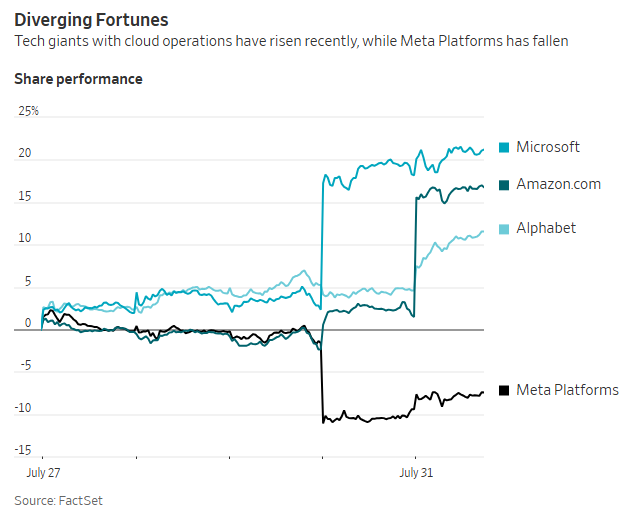
After AWS reported a stunning 37% year-over-year revenue increase for the quarter—far exceeding analysts’ expectations of 31%—Amazon’s stock surged sharply on Friday. Microsoft similarly experienced a capital market rally on Wednesday, as its Azure cloud business posted an above-expected 43% growth, driving a significant jump in its share price. Together, these two companies saw their combined market capitalization surge by approximately $950 billion following their earnings releases.
Although Alphabet, Google’s parent company, briefly suffered a sell-off last month after substantially raising its full-year capital expenditure guidance, the market’s concerns were quickly soothed by the standout performance of its cloud business, which posted an 82% revenue surge. The stock rebounded by about 10% over the past week, fully recouping its earlier losses.
AI may well be the single most important driver behind cloud computing growth—enterprises and AI developers require greater computing power, and renting computational resources via the cloud is both straightforward and often the fastest solution. Large-scale deals with major clients are also fueling revenue and backlog growth—for example, the 10-year contract worth over $100 billion that AWS signed with Anthropic in April this year.
But even before the AI boom, another trend had already been quietly unfolding.
Enterprises are shifting more of their computing workloads to the cloud and reducing reliance on in-house infrastructure. A Piper Sandler survey of IT executives conducted in June indicated they expect their spending to rise by roughly 5% this year. Most respondents plan to increase investments in cloud computing, while relatively few intend to boost spending on owned computing equipment.
A New Moon Rises from the 'Cloud' River
Given these two powerful trends, it is easy to understand why Jassy stated last Thursday that AWS could ultimately grow into a $1 trillion annual revenue business—even if that figure sounds implausible today. According to FactSet data, analysts project AWS’s revenue will reach approximately $170 billion this year.
Other companies are also seeking to capture a substantial share of this rapidly expanding market.
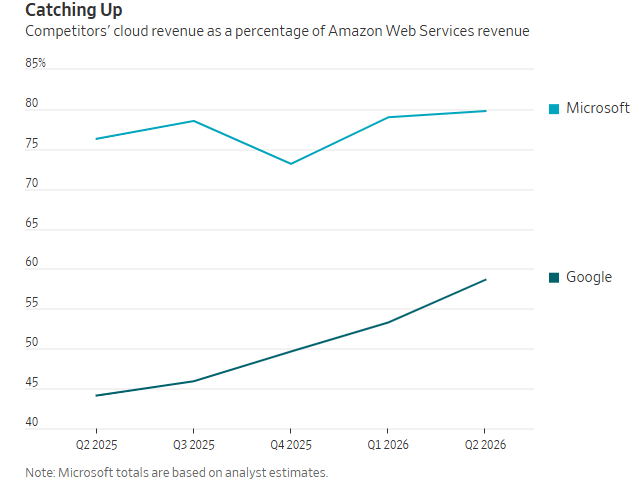
For some time, Microsoft and Google have been growing their cloud businesses faster than Amazon, posing a tangible threat to AWS’s dominant position in an industry it virtually pioneered two decades ago. If their growth rates continue to outpace AWS’s, it is not difficult to foresee them overtaking this larger rival by the end of the decade.
Of course, should the AI bubble burst, none of these companies would be spared—should major buyers of AI computing capacity such as Anthropic and OpenAI run into trouble, substantial contracts could be renegotiated and backlogs reduced.
However, for cloud computing giants, there remains a fallback option: at the very least, they can revert to the time-tested business models that sustained their growth before the rise of AI.
However, for pure-play AI companies lacking the protective moat of a cloud business, there is no fallback—nowhere more evident than in the case of $Meta Platforms (META.US)$ . The social media giant saw its share price drop by approximately 5% after reporting earnings on Wednesday and slightly raising the midpoint of its 2026 capital expenditure guidance range.
Although Zuckerberg stated on Wednesday that Meta is considering building its own cloud computing business, it may inevitably find itself struggling to catch up from a distant third place against the entrenched dominance of the big three cloud providers.
It could be said that last week, Wall Street finally found the crucial yardstick it needed to distinguish the ultimate winners from the losers in the AI race.
Editor/KOKO