
U.S. equities endured a brutal July, with technology stocks leading the decline (the Nasdaq fell 3.2%). Although a rebound occurred toward month-end, Goldman Sachs believes it was primarily driven by short-covering, and thus lacks a solid foundation.
Resurgent inflation concerns, elevated interest rates pressuring tech valuations, and significant deleveraging in leveraged ETFs have intensified structural market volatility, and further confirmation from nonfarm payroll data and interest rate direction will be needed to gauge the market’s next move.
Wall Street has just endured its most brutal market stretch in months. Technology stocks led the decline, bond yields surged, and oil prices swung violently—multiple pressures converging to plunge investors into deep anxiety: has the worst for markets already passed?
 In July,$Nasdaq Composite Index (.IXIC.US)$it declined by 3.2% cumulatively, marking its worst monthly performance since March this year;$S&P 500 Index (.SPX.US)$edged down 0.1%, while only$Dow Jones Industrial Average (.DJI.US)$registered a modest monthly gain of 0.3%.
Meanwhile, although the technical rebound over the final two days of the month offered temporary relief, Brian Garrett, Goldman Sachs’ top derivatives trader, warned that last week’s buying was largely 'gross down'—a compression of short positions through short-covering—rather than genuine long-position building. This critical distinction implies that the market’s stabilization remains fragile.
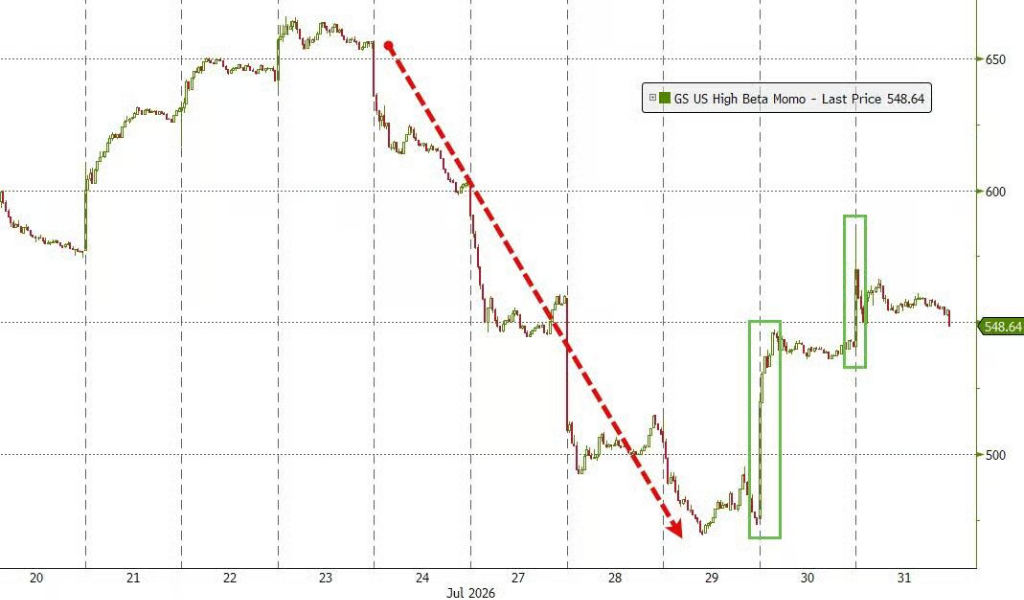
Resurgent inflation, uncertain rate outlook, and doubts about the sustainability of AI-related capital expenditures constitute a triple constraint weighing on tech stocks. Garrett explicitly stated that this week’s nonfarm payroll data and interest rate trajectory will serve as a crucial test to determine whether the recent rebound reflects a genuine return of demand or merely a round of position unwinding.
Inflation Returns to Center Stage in Market Narratives
Callie Cox, Chief Market Strategist at Ritholtz Wealth Management, believes investors must brace for heightened market volatility—inflation has once again become the dominant force driving broad market trends.
"I'm not saying a decline is certain, but the current environment is complex enough, and we're facing too many elevated indicators. Even if the market turns upward, the path to recovery is unlikely to be smooth," Cox told MarketWatch. "Inflation is now the biggest risk facing equity portfolios, and at the same time, economic growth lacks resilience heading into year-end."
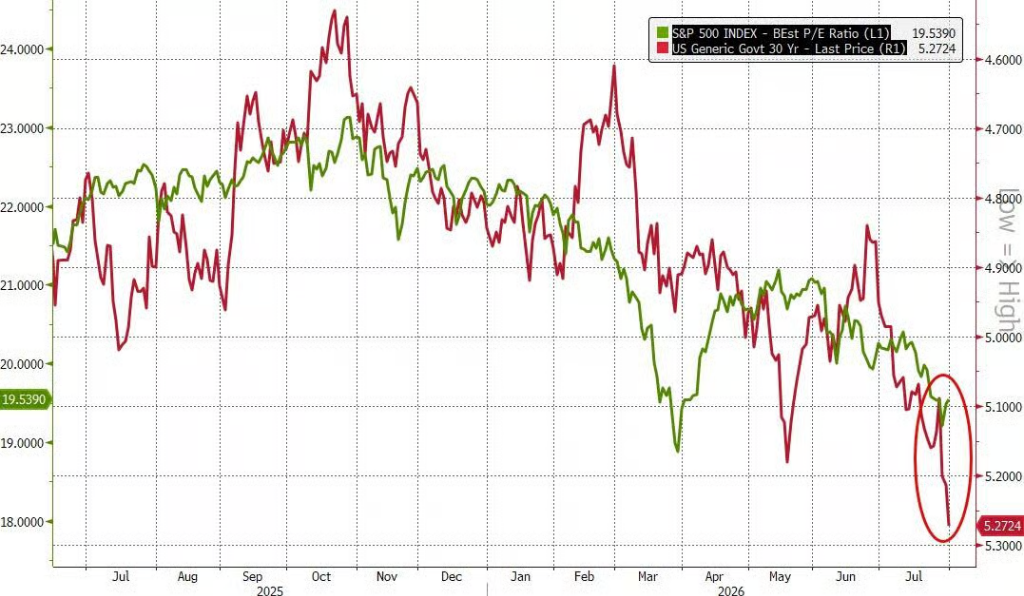
Recent data indicate that inflation showed signs of cooling at least through June, with both the latest Consumer Price Index (CPI) and Personal Consumption Expenditures (PCE) readings declining. However, the renewed surge in oil prices in July puts this progress at risk of reversal. Cox noted that the current drivers of inflation are fundamentally different from the 2022 price crisis, which was fueled by supply chain disruptions and massive fiscal stimulus. Nevertheless, after nearly four years of a strong bull market rally, uncertainty around interest rates and inflationary pressures have risen high enough to 'continuously unsettle' stock prices.
AI-driven cost pressures transmit to tech stocks
Inflation risks stem not only from energy prices; the AI investment boom itself is generating new cost pressures. Brian Kersmanc, portfolio manager at GQG Partners, pointed out that key inputs such as memory chips—consumed heavily by data centers and AI infrastructure—are seeing sustained price increases. Companies may ultimately pass these costs on to customers, further fueling inflation.
"Inflation is largely driven by sentiment," said Kersmanc:
"If people believe inflation is coming, they will spend and act accordingly. The longer inflation persists, the more it tends to become self-reinforcing."
This dynamic is especially perilous for valuation-rich, rate-sensitive sectors—particularly semiconductor stocks—whose projected revenues and profits are heavily weighted toward the distant future. When discount rates rise due to higher interest rates, the present value of those future cash flows shrinks significantly.
However, Kersmanc also highlighted a countervailing positive effect: high interest rates not only compress valuations but also dampen companies’ willingness and capacity to make capital expenditures. "From this perspective, inflation might actually benefit hyperscale cloud providers more, as the market’s primary concern right now is their overly aggressive capital spending," he said.
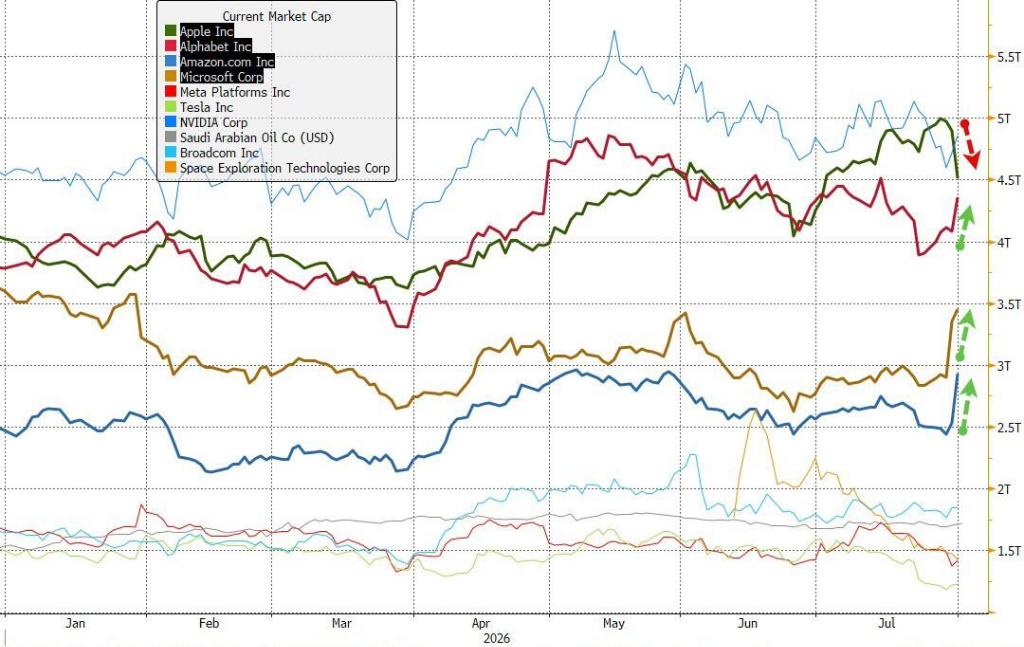
Data from Goldman Sachs corroborate this divergence: last week’s earnings season for mega-cap tech stocks triggered starkly divergent market reactions—Apple lost approximately $50 billion in market value in a single day, and Meta fell nearly 8%; meanwhile, Amazon and Microsoft both surged more than 15%, with Microsoft setting a record for the largest single-day increase in market capitalization ever (about $550 billion).
Beneath the surface calm of the broader market, undercurrents are stirring
The overall market's weak performance in July masked profound structural rotations beneath the surface.
According to FactSet data, the S&P 500 Equal Weight Index—which excludes the influence of market capitalization weighting—actually rose by 1.3% in July, while the market-cap-weighted S&P 500 Index declined by 0.1% over the same period. Of the S&P 500’s 11 sectors, seven posted positive returns in July, with only Information Technology, Industrials, Materials, and Utilities ending lower.
Jay Hatfield, CEO and Chief Investment Officer at Infrastructure Capital Advisors, attributed this phenomenon to the persistent shadow of geopolitical risks: "With the looming threat of war, all the market can do is rotate." He also warned that hedge funds’ deleveraging process may not yet be complete, and the resulting selling pressure could continue to generate volatility.
Goldman Sachs data further corroborates this view: last week, long-position unwinding in tech stocks peaked on Tuesday, marking the largest three-day sell-off on record according to Goldman Sachs, followed by signs of repositioning on Friday. Such a shift—from historic-scale selling to initial recovery within the same week—underscores the extreme difficulty of navigating current market conditions.
Doubts linger over the authenticity of the rebound; key thresholds remain to be breached.
Even though markets staged a noticeable rebound over the weekend, Brian Garrett of Goldman Sachs explicitly advised caution. He noted that last week’s net buying volume was the largest since November 2020, but it was primarily driven by short-covering rather than fresh long positioning—the ratio between the two in derivatives markets was approximately 2:1. This suggests the recent rally resembles a technical correction following position liquidation, rather than a trend-driven move fueled by new buying interest.
From a market structure perspective, the S&P 500 had closed below its 50-day moving average for six consecutive trading days. Trend-following CTA strategies in U.S. markets still show mildly negative signals, with critical support levels at 7,445 and 7,215 points, respectively. Meanwhile, global leveraged ETF assets have plunged by approximately $60 billion (a 28% decline) since June, with net effective exposure shrinking even more dramatically by around $170 billion—this massive forced deleveraging remains a latent risk to market structure.
Garrett currently favors positioning under the assumption that the systemic deleveraging cycle is nearing its end—strategies include betting on declining volatility and purchasing three-month upside call options on the S&P 500, reflecting a view of a 'slow grind higher.' However, he emphasized that this outlook hinges critically on whether this week’s nonfarm payroll data, along with confirmation from interest rates and corporate earnings, can validate Friday’s rebound.
Editor/melody