
AI is driving surging demand for optical interconnects, and indium phosphide (InP)—an irreplaceable light-emitting material—may now be constraining the expansion of computing power. Lumentum’s CEO stated that the company currently operates five InP wafer fabs, yet its shipments still fall more than 30% short of customer demand. SemiAnalysis also noted that continuous-wave distributed feedback (CW DFB) InP lasers used in near-package optical interconnects are particularly in short supply.
Indium phosphide (InP) is emerging as the weakest link in the AI infrastructure expansion chain. As data centers experience an order-of-magnitude surge in demand for optical interconnects, this irreplaceable compound semiconductor material now faces a supply shortfall even more acute than that of memory.
Michael Hurlston, CEO of Lumentum, issued a clear warning at the RAISE Summit in Paris this month: the shortage of indium phosphide will surpass the crisis currently unfolding in the memory market. He stated that Lumentum currently operates five InP wafer fabs, yet its shipments still fall over 30% short of customer demand—a gap that has widened further compared to the previous quarter. "I believe even the two of us combined cannot meet the demand NVIDIA and other customers are placing on us," Hurlston said. "The InP shortage will be more severe than what we’re seeing in the memory market."
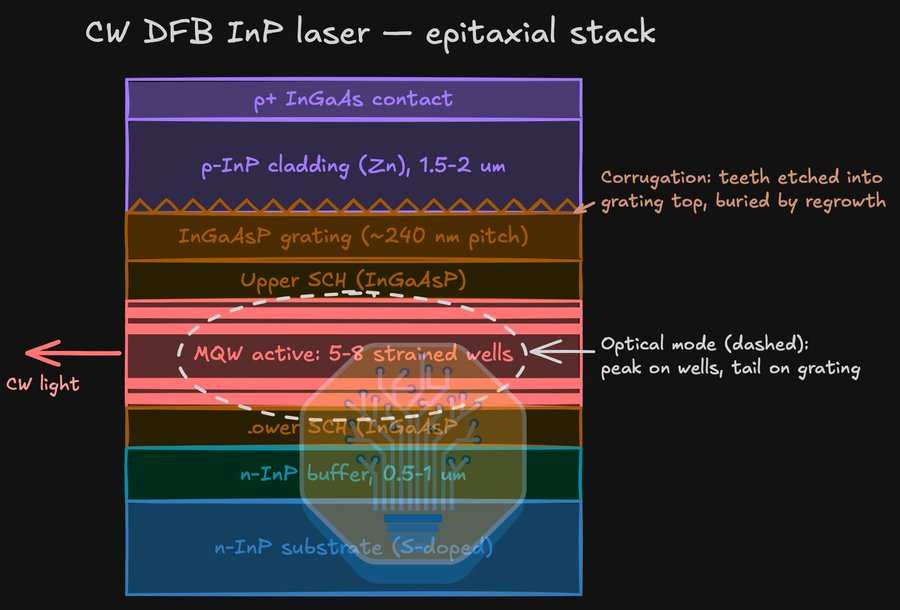
 Market research firm SemiAnalysis recently echoed similar concerns, highlighting that continuous-wave distributed feedback (CW DFB) InP lasers used in near-package optical interconnects are especially tight in supply. The industry largely remains stuck with 2- to 4-inch wafer sizes—far behind the 12-inch process standard for silicon-based CMOS—posing structural constraints on capacity expansion.
These warnings have drawn significant market attention. In March, NVIDIA invested $2 billion each in Lumentum and Coherent to secure supply from these two companies, which together account for the majority of global high-speed datacom laser capacity. Despite this, shares of the relevant companies have been heavily sold off over the past month—Lumentum (LITE) down 22.3%, Coherent (COHR) down 37.6%, substrate supplier AXT (AXTI) down 39.9%, and transceiver maker Applied Optoelectronics (AAOI) down 35.7%—a clear divergence between stock performance and underlying fundamentals.
Silicon photonics cannot bypass InP
The irreplaceability of InP stems from its fundamental physical properties. Silicon has an indirect bandgap, allowing it only to guide, split, and modulate light—but not emit it. In contrast, InP possesses a direct bandgap of approximately 1.34 electron volts, enabling highly efficient conversion of electrical energy into photons. Consequently, whether it’s NVIDIA, Broadcom, Marvell, or Cisco’s silicon photonics platforms, all require InP-based lasers as the light source within their packages.
The industry’s evolution from pluggable transceivers to co-packaged optics (CPO) changes the placement of the laser but does not remove it from the bill of materials. In fact, the shift toward CPO demands even more challenging-to-manufacture high-power continuous-wave (CW) light sources and external laser modules capable of driving multiple optical channels. Coherent’s collaboration agreement with NVIDIA specifically covers such high-power CW lasers, external laser source modules, and fiber array units.
NVIDIA claims its photonic switch reduces the number of lasers per port by a factor of four and improves power efficiency by 3.5x compared to equivalent pluggable solutions, while boosting network resilience tenfold. However, these savings are calculated on a per-port basis—and it is precisely the explosive growth in total port count that is driving demand steeply upward. The high-end Spectrum-X Photonics configuration supports 512 ports at 800 Gb/s each, delivering a total switching capacity of 400 Tb/s.
An order-of-magnitude leap in demand scale
Hurlston illustrated the intensity of this demand revolution with a stark comparison: telecom customers order lasers in the hundreds, whereas NVIDIA and hyperscale cloud providers order in the hundreds of millions. "Scaling from thousands of wafers to millions—on a non-silicon material—is by no means easy," he said.
Lumentum reported third-quarter fiscal year revenue of $808.4 million, a 90% year-over-year increase, with component business revenue reaching $533 million and pump laser shipments up 80% year-over-year. Nevertheless, the supply-demand gap continues to widen. During the earnings call, Hurlston stated that the imbalance has further expanded beyond the previously disclosed range of 25% to 30% to 'over 30%.' The supply tightness for pump lasers is 'even more severe than anticipated,' and core components are 'effectively sold out for the foreseeable future.' The company guided fourth-quarter revenue to a range of $960 million to $1.01 billion, with an expected operating margin of 35% to 36%.
Coherent also reported record quarterly revenue of $1.8 billion, up 21% year-over-year, with data center and communications business accounting for 75% of total revenue—up from approximately 41% a year earlier—and its order backlog extending into 2028. CEO Jim Anderson stated that equipment yields on the company’s 6-inch InP production line have surpassed those of traditional 3-inch lines. Internal capacity will double by the end of the June quarter, one quarter ahead of schedule, and will more than double again by the end of 2027.
Duration of the Shortage: A Key Difference from the Memory Crisis
The InP supply constraint stems not only from capacity limitations but also from structural constraints on raw materials and geopolitical risks. Indium, recovered as a byproduct of zinc smelting, cannot expand independently of zinc’s economic dynamics—regardless of how strong demand for lasers may be.
Despite persistent warning signs, market views remain divided on how long the shortage will last. LightCounting’s April 2026 market forecast indicates that current transceiver demand exceeds supply by approximately 30%, aligning with Lumentum’s figures. However, the firm also projects the shortage will ease by the end of 2026 and has revised down its growth forecast for Ethernet transceivers this year from 82% in 2025 to 65%. Coherent’s achievement of doubling capacity one quarter ahead of schedule points in the same direction.
A key distinction from the memory crisis is that the solution path for InP involves a wafer size migration already underway on production lines—with yields surpassing those of older process nodes—rather than the construction of entirely new fabs, which typically takes three years from scratch. This supports, to some extent, a relatively optimistic timeline. However, Hurlston’s warning also has a practical basis: his company’s valuation depends significantly on how long the shortage persists.
Editor/lambor