
Bargain hunters in U.S. equities should pay attention to market warning signals.
According to Zhitong Finance APP, after a month of severe volatility, the U.S. equity market now stands at a critical crossroads. On one hand, data from institutions such as JPMorgan indicate that the months-long deleveraging process in the technology sector is nearing its end, with leveraged ETFs, hedge fund net exposure, and CTA positions having significantly retreated from extreme levels. On the other hand, inflation concerns are resurfacing, the interest rate path remains highly uncertain, and doubts about the returns on AI-related capital expenditures have yet to dissipate.
Macro risks are now supplanting position unwinding as the primary driver of market pricing. Entering August, major Wall Street banks—including JPMorgan, Goldman Sachs, and Société Générale—have released a flurry of strategy reports, painting a complex picture characterized by 'deleveraging nearing completion, valuations resetting to reasonable levels, yet macro risks continuing to accumulate.'
 Deleveraging Nearing Completion: The Most Intense Selling Pressure in Tech Stocks Has Likely Passed
Over the past two months, global tech stocks have endured a 'perfect storm' driven by leveraged liquidations. In their latest report, JPMorgan strategists led by Nikolaos Panigirtzoglou noted that the most intense phase of deleveraging in the tech sector has likely concluded.
Data show that assets under management (AUM) in leveraged ETFs have declined from a peak of $50 billion to $17 billion; hedge funds’ net exposure to the tech sector has dropped from 5.0 standard deviations to 1.7 standard deviations; and CTA (Commodity Trading Advisor) positioning has fallen to the 39th percentile. In the Korean market, deleveraging via leveraged ETFs has largely been completed, and hedge funds have finished approximately 90% of their deleveraging process, bringing overall leverage levels back into a more reasonable range. JPMorgan believes that deleveraging in the technology and semiconductor sectors—including memory stocks—has progressed faster than previously anticipated, leaving very limited room for further deleveraging.
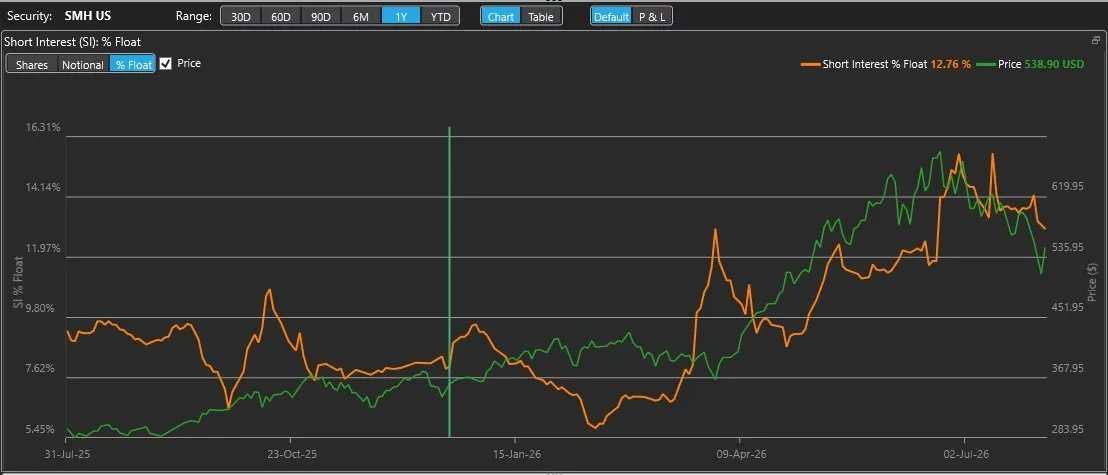
Goldman Sachs’ data corroborate this assessment. Global tech exposure has experienced its largest sell-off in over five years, with AUM in Korean equity leveraged ETFs declining from a June peak of $53 billion to $15 billion. Leveraged exposure to momentum factors among fundamental long/short clients has fallen to the 28th percentile of its range over the past year. 'Crowded trades have shifted from “everyone being on board” to a significant portion of participants having already exited—or even been forced out.'
Hedge fund positioning data provide three clear signals: the combined z-score of hedge fund holdings and factor performance across the entire market has fallen into a historically extreme low range; North American hedge funds have reduced positions over a five-day horizon equivalent to a 3-standard-deviation move, indicating that sustained large-scale selling has likely run its course. The memory sector is now entering a repricing window—current share prices imply only a one-year high-demand cycle; should the upcycle extend through mid-2027, valuations would fall below their historical averages.
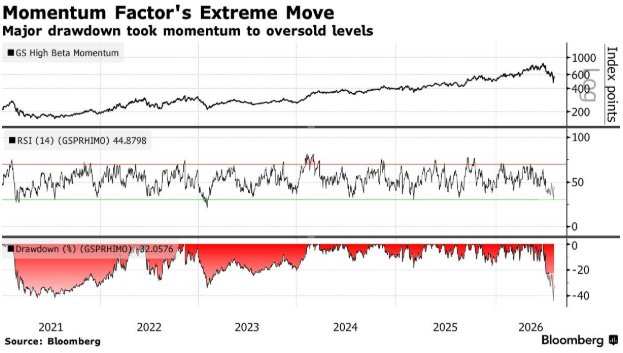
However, the conclusion of deleveraging does not guarantee smooth sailing ahead. Goldman Sachs’ top trading desk warns that although deleveraging is nearing completion, risks have not been fully cleared, and multiple key events will continue to weigh on the market. According to Goldman Sachs’ latest 'Flow of Funds' report, meaningful risk reduction has yet to be achieved, constrained by seasonal fund outflows and weak institutional appetite for taking aggressive positions, leaving U.S. equities lacking the necessary 'fuel' for upside momentum in August.
Valuation Reset and Earnings Support: S&P 500 Delivers Strongest Earnings Season in Five Years
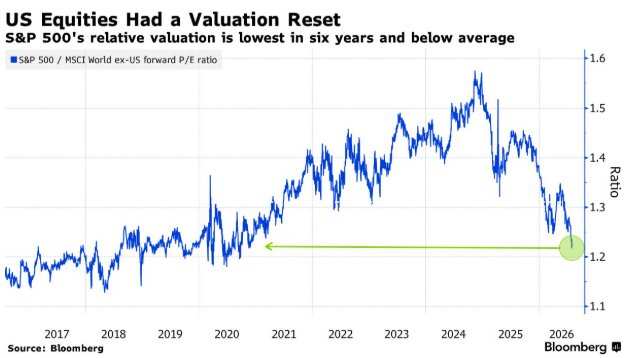
Alongside ongoing deleveraging, global equity valuations have undergone a significant reset. The valuation premium of U.S. equities relative to the rest of the world has narrowed to approximately 22%, the lowest level in over six years and well below the 31% ten-year average. Lori Calvasina, strategist at RBC Capital Markets, noted that valuations for the Nasdaq 100 Index, the S&P 500 Index, and the tech sector as a whole are beginning to appear 'reasonable' once again.
Meanwhile, the just-concluded second-quarter earnings season delivered what could be described as one of the strongest performances on record. According to FactSet data, S&P 500 companies are expected to report year-over-year earnings growth of 47.4% for the quarter—the most robust earnings growth in the past five years. Goldman Sachs data show that among constituents that have already reported results, 64% exceeded Wall Street expectations by at least one standard deviation.
AI infrastructure-related stocks contributed roughly one-third of the S&P 500’s EPS growth in Q2. Goldman Sachs estimates that excluding the unusually large investment gains from a few tech giants, the S&P 500’s aggregate earnings would have grown by approximately 26% year-over-year; including those gains, total earnings growth surged to 45%. Meanwhile, profits among STOXX Europe 600 constituents, after nearly two years of flat growth, jumped 19% year-over-year this quarter.
Macro risks are mounting: the 'Sword of Damocles' of inflation and interest rates
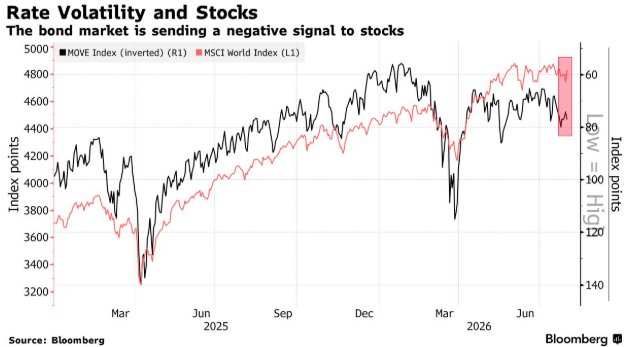
However, the glow of strong earnings has not dispelled macroeconomic concerns. Lee Coppersmith, a derivatives strategist at Goldman Sachs, warned that as earnings season ends, market attention will shift back to interest rates, inflation, and economic growth. Volatility in U.S. Treasuries has begun accelerating again, and real yields remain near cycle highs.
Inflationary pressures remain stubborn. The team led by Alain Bokobza, strategist at Société Générale, noted that the second round of U.S. tariffs, accelerated capital expenditure cycles related to AI and infrastructure, heightened oil price volatility, and persistently large fiscal deficits in advanced economies all suggest that market inflation expectations are 'significantly lower' than warranted. Société Générale expects core PCE inflation to stay above 3% this year and recommends allocating to TIPS, copper, and gold as inflation hedges.
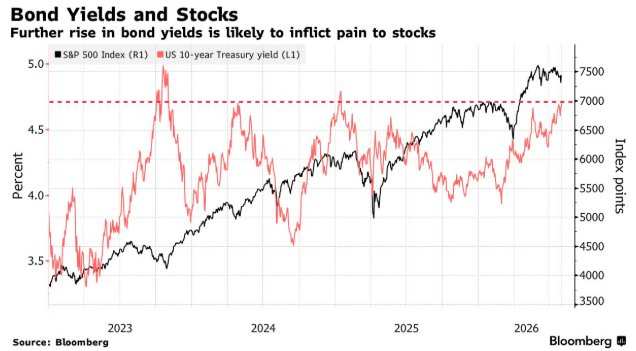
The U.S. Treasury market is already pricing in these concerns. The 10-year Treasury yield has climbed to around 4.74%, while the 30-year yield has breached 5.27%—reaching its highest level in nearly 19 years. JPMorgan has raised its forecast for the 10-year yield to 4.85% and its 30-year target to 5.40%. The steepening of the yield curve is historically rare—markets are effectively casting doubt on the Federal Reserve’s ability to anchor inflation at its 2% target.
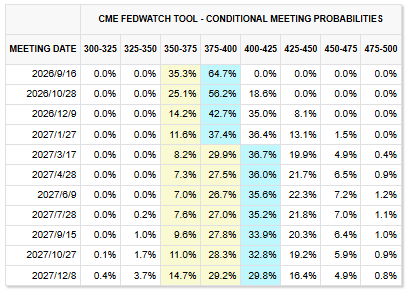
The Fed’s rate path remains highly uncertain. At the July 29 FOMC meeting, the committee voted 9–3 to hold rates steady, with three hawkish members dissenting in favor of a 25-basis-point hike. Market pricing for rate hikes in September–October is now extremely elevated, with implied probabilities totaling approximately 90%. Meanwhile, Robert Kaplan, Vice Chairman at Goldman Sachs and former President of the Dallas Fed, recently issued a clear warning: if incoming inflation data fail to cool, the Fed could resume rate hikes as early as autumn—and such tightening would likely consist of a series of two or three consecutive moves rather than a single action.
A shift in investment strategy: from 'momentum chasing' to 'value diversification'
Against a backdrop where deleveraging is nearing completion, valuations have reset, yet macro risks continue to accumulate, Wall Street strategists are sketching a new investment roadmap. JPMorgan emphasizes that the storage sector is entering a repricing window, where positioning is no longer the primary driver—fundamentals and valuation will determine direction.
From market-cap weighting to equal weighting: the S&P 500 Equal Weight Index rose 1.3% in July, while the market-cap-weighted S&P 500 declined 0.1% over the same period. Goldman Sachs notes that the equal-weighted S&P 500, the low-volatility S&P 500, and the S&P 500 excluding AI-related stocks all hit record highs in the final week of July. This signals that market gains are broadening beyond a narrow group of mega-cap leaders to encompass a wider range of sectors.
Société Générale recommends going long the S&P 500 Equal Weight Index and U.S. inflation-protected securities, while shorting 10-year U.S. Treasuries. Strategists note that the second round of U.S. tariffs, accelerating AI and infrastructure capital expenditure cycles, heightened oil price volatility, and persistently large fiscal deficits in advanced economies all suggest that current market inflation expectations are significantly lower than warranted. Société Générale strategist Manish Kabra stated that nine sectors have achieved double-digit earnings growth, with small-cap industrial EPS rising by as much as 30%. He remains bullish on bank stocks, anticipating a rebound in the second half of 2026, and also recommends exposure to industrials, utilities, and materials, as well as the 'reshoring to U.S. production' theme.
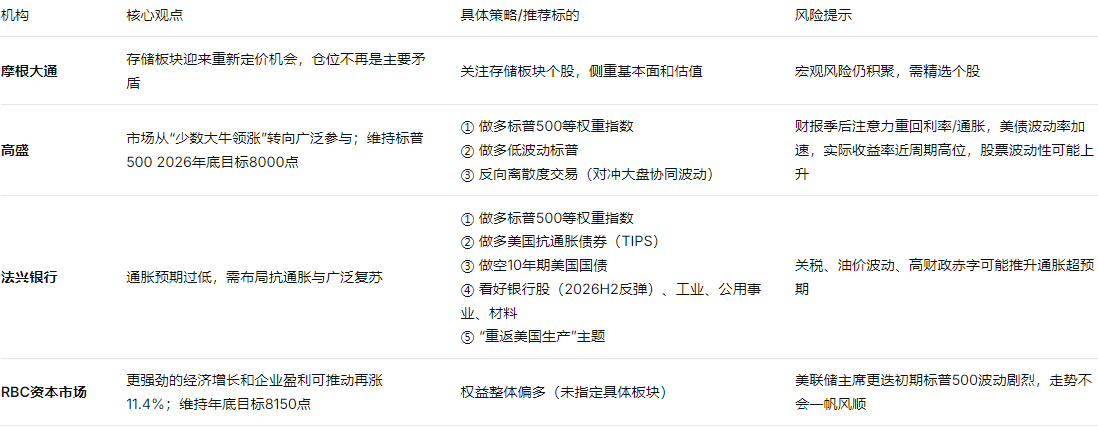
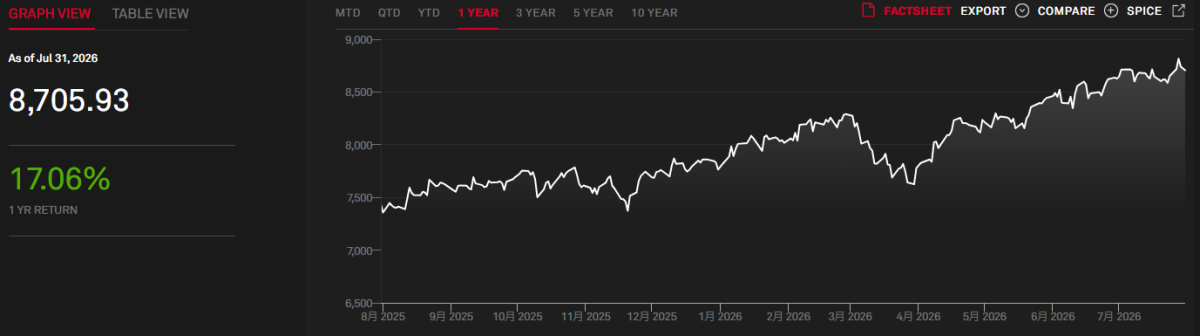
RBC Capital Markets maintains its year-end S&P 500 target at 8,150, arguing that stronger economic growth and corporate earnings could drive the market up another 11.4%. However, strategist Lori Calvasina also cautioned that the S&P 500 typically experiences high volatility during the early phase of a Federal Reserve chair transition, noting that 'the path for equities will not be smooth sailing.'
Goldman Sachs maintains its S&P 500 year-end 2026 target at 8,000, implying approximately 8% upside potential. However, Goldman Sachs traders warned that as macro uncertainty persists, the likelihood of a 'high-correlation event' is rising. Traders are hedging against synchronized market-wide volatility—so-called 'reverse dispersion trades' have been identified by Goldman Sachs as one of the optimal strategies for navigating current market conditions.
Coppersmith noted that with earnings season now concluded, market attention will shift back to interest rates, inflation, and economic growth. 'U.S. Treasury volatility has begun accelerating again, real yields remain near cycle highs, and historically, equity volatility rarely stays structurally compressed under such conditions.'
Tony Pasquariello, head of Goldman Sachs’ hedge fund business, observed that over the past month, 'a sledgehammer has smashed through consensus positioning,' forcing a cooldown in the most crowded, intuitive, and easily leveraged trades—but the risk has not disappeared.
Editor/Deng