① New York Fed President Williams expressed optimism about easing inflationary pressures, stating that the current monetary policy stance is 'well positioned' and supportive of the Federal Reserve's decision last week to hold the federal funds rate steady; ② Williams believes energy prices and trade tariffs have peaked, and the impact of high-inflation drivers will diminish. He emphasized that monetary policy should not be held hostage by markets, expressed optimism about the prospects of AI, and stated he is not concerned about associated financial stability risks.
John Williams, President of the Federal Reserve Bank of New York, stated that he remains optimistic that U.S. inflationary pressures are gradually easing.
However, he also noted that if inflation fails to ease as expected, the Federal Reserve will not hesitate to raise interest rates to ensure price pressures return to target levels.
 In an interview, Williams stated that if energy prices and trade tariffs have indeed peaked and the economy continues to remain resilient, then “some of the key factors that have driven inflation higher over the past year and a half will noticeably weaken, and the disinflationary forces we’ve already observed will reassert themselves.”
He said, “Frankly, I am closely watching the core inflation data over the coming months—whether it aligns with the trend of inflation moving toward 2% and truly embarks on a sustained disinflation path that would allow us to consistently achieve our 2% inflation target by 2028.”
“In my personal forecast, inflation will begin to decline in the second half of this year and fall further next year,” Williams reiterated, adding that the current monetary policy stance is “well positioned” to bring inflation back to target.
However, he also noted: “If the economic trajectory fails to bring inflation back to 2%, then taking action to realign the economy onto a path consistent with achieving our 2% inflation target would absolutely be appropriate.”
Supporting last week’s decision to hold rates steady
Currently, the U.S. inflation rate remains significantly above the 2% target and has been above or below this level for more than five consecutive years.
Last week, the Federal Open Market Committee (FOMC) decided to maintain the target range for the federal funds rate at 3.50% to 3.75%. Williams stated he “strongly” supported this decision.
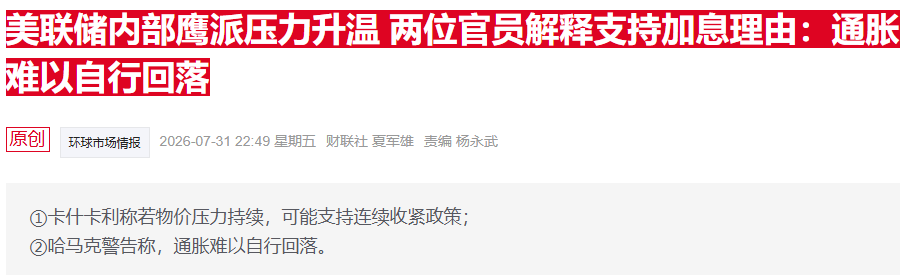
It should be noted that three Federal Reserve officials voted against the decision at this meeting. In a statement released last Friday, they said the Fed needs to raise short-term borrowing costs further to bring down inflation.
Beth Hammack, President of the Federal Reserve Bank of Cleveland, stated: 'Inflation has persistently remained above 2% for more than five years, and I do not believe it will return to our target on its own.'
Meanwhile, as investors worry that inflationary pressures will persist, yields on long-term U.S. Treasury securities have continued to rise, and interest rate futures markets have already priced in a higher probability of another rate hike by year-end.
Williams acknowledged that the economic outlook remains highly uncertain and that the renewed escalation of conflict in the Middle East makes it difficult to predict when energy prices will decline. However, he emphasized that improvements could come very quickly once the situation is resolved and shipping returns to normal.
He said, 'Based at least on my current baseline forecast, I do not believe the Middle East conflict will continue to drive persistent upward pressure on inflation in the second half of this year or next year. Of course, this assessment could change as the situation evolves.'
Monetary policy will not be held hostage by markets
When asked whether the Federal Reserve would adjust its policy in response to market expectations, Williams responded unequivocally: 'Absolutely not.'
However, he added that the Fed closely monitors developments in financial markets, saying, 'We must always conduct our own independent analysis, carry out the necessary research, and comprehensively assess all factors affecting the economy and its outlook.'
Financial markets are also adjusting to the communication style of new Federal Reserve Chair Kevin Warsh. Warsh has gradually deemphasized so-called 'forward guidance,' refraining from clearly signaling the future path of policy in advance.
Bullish on AI prospects, unconcerned about financial stability risks
Regarding artificial intelligence (AI), Williams said he remains optimistic about AI’s development prospects and believes the recent volatility in the AI sector is not surprising.
He said, 'Asset price volatility is inherently characteristic of highly innovative and rapidly evolving industries, and we have seen similar situations in the past.'
On the risks that corporate borrowing to invest in AI and related businesses might pose, Williams noted that current corporate leverage levels are far from those seen two decades ago, which contributed to the global financial crisis.
He said, 'Most of these companies are highly profitable, so I am not particularly concerned that current leverage levels pose a threat to financial stability.'