
① UBS Group forecasts that by 2027, U.S. investment in AI computing capacity could account for approximately 3% of economic output, with tech giants’ financing needs continuing to grow rapidly; ② community concerns over electricity prices, water resources, and land use are intensifying, leading to 75 projects being blocked or delayed in the first quarter; ③ states may tighten approvals and tax incentives and require developers to bear the costs of new grid, water supply, and other infrastructure.
Cailian Press, August 3 (Editor: Xia Junxiong) — Despite the ongoing boom in artificial intelligence (AI) investment, data centers are shifting from being “star projects” eagerly courted by local governments to becoming focal points of political and public policy debate in the United States.
In its latest report, UBS Group noted that while U.S. AI data center construction is unlikely to halt, growing local resident concerns over electricity prices, water usage, and land occupation—alongside state-level reassessments of permitting processes, tax incentives, and infrastructure cost allocation—will compel the industry to adapt its development approach.

 AI investment continues to accelerate
UBS Group expects that by 2027, U.S. investment in AI computing capacity could reach approximately 3% of domestic economic output, with a significant portion allocated to data centers and related infrastructure. The report assumes that neither capital market financing channels nor end-user demand for AI will become major constraints on investment.
Large technology companies are raising funds through a variety of instruments, including investment-grade bonds, high-yield debt, bank loans, private markets, and project financing. Bond issuance by hyperscale cloud providers such as Amazon, Alphabet, Meta, Microsoft, and Oracle is projected to exceed USD 250 billion in 2026—more than double the 2025 level and over ten times the 2024 amount.
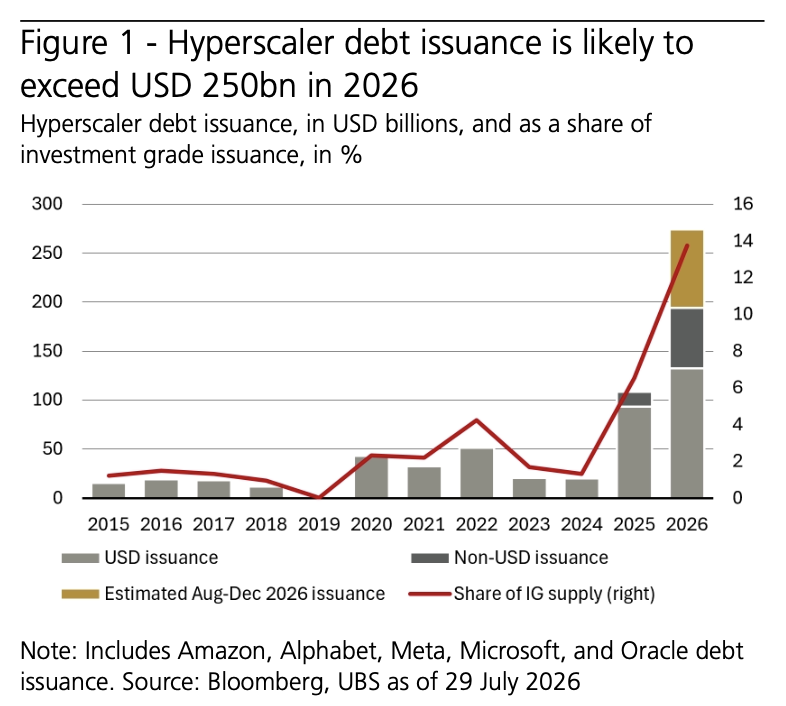
(Bond issuance by tech giants such as Amazon, Alphabet, Meta, Microsoft, and Oracle is expected to surpass USD 250 billion in 2026, accounting for approximately 14% of total U.S. investment-grade bond issuance.)
Credit spreads on tech company bonds have widened recently, but UBS Group attributes this primarily to market absorption of increased bond supply rather than a material deterioration in credit quality. Meanwhile, enterprises adopting AI are racing to enhance efficiency and profitability to justify their substantial technology expenditures.
The United States still holds a dominant position in global AI infrastructure
Hyperscale data centers typically house at least 5,000 servers, occupying hundreds of thousands to millions of square feet, with power demands ranging from tens to hundreds of megawatts. Some newly planned campuses are designed for power capacities exceeding 1,000 megawatts—equivalent to the electricity consumption of a mid-sized city like Pittsburgh or roughly 750,000 U.S. households.
The United States currently has approximately 580 hyperscale data centers in operation, with an additional 437 in the planning or construction phase. Texas, California, Virginia, Georgia, and Ohio are the primary hubs.
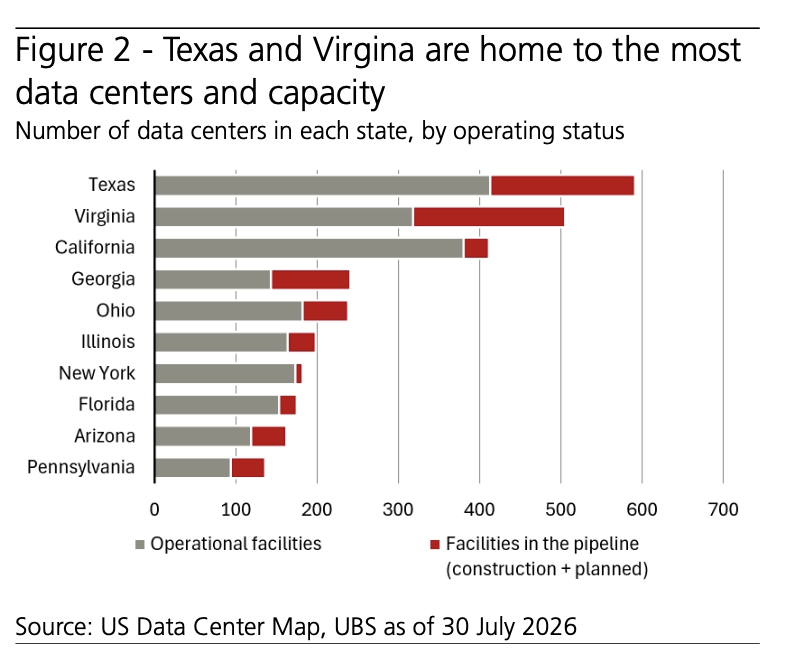
(U.S. data centers are primarily concentrated in Texas, Virginia, and California, with Texas ranking first nationwide in total data center capacity—including facilities under construction and in planning.)
As of the fourth quarter of 2025, the top five U.S. hyperscale cloud service providers accounted for approximately 71% of global cumulative AI computing capacity, up from 63% in the first quarter of 2024, underscoring the United States’ continued dominance in the global AI infrastructure race.
Why has opposition escalated so rapidly?
Data centers, once widely viewed by local governments as symbols of capital investment and economic development, are increasingly becoming focal points of community conflict.
A 2026 Gallup survey found that 71% of Americans oppose the construction of AI data centers in their local communities, with opposition spanning Democrats, Republicans, and independent voters alike.
Another survey by Reuters and Ipsos revealed that 77% of Americans are concerned that AI will drive up electricity prices. Public concerns primarily center on high consumption of power and water resources, land use, air and noise pollution, and the potential impact of AI on employment and lifestyles.
UBS Group notes that data centers face significantly greater local resistance than semiconductor fabs with comparable power demands. This is because fabs are typically associated with manufacturing reshoring, national security, and industrial policy, whereas data centers are increasingly perceived as symbols of automation, job displacement, and resource depletion.
A deeper issue lies in the localized nature of data center costs: residents may bear higher electricity prices, construction disruptions, and resource strain, while the productivity gains, industrial competitiveness, and strategic national benefits generated by AI are distributed nationwide and remain largely imperceptible to local communities. It is precisely this misalignment—'localized costs versus nationalized benefits'—that intensifies community opposition.
Power constraints and cost allocation have become central regulatory issues.
The Electric Power Research Institute (EPRI) estimates that AI data centers will add 56 to 132 gigawatts (GW) of electricity demand by 2030. The total capacity of the U.S. power system is approximately 1,200 GW, which appears sufficient in aggregate; however, new generation facilities, transmission lines, and equipment supply all face challenges such as lengthy permitting timelines and production bottlenecks.
UBS Group forecasts that U.S. data center electricity demand will reach 90 GW by 2030—nearly double current levels. This projection already accounts for constraints related to power generation equipment, transmission, grid interconnection, and permitting, making it relatively conservative compared with some data center project plans.
Electricity pricing is also a highly sensitive political issue. In November of this year, the United States will hold gubernatorial elections in 36 states, and whether residents should bear the cost of expanding the grid for data centers could directly influence local politics. Since retail electricity rates, land-use planning, construction permits, water policies, and tax incentives are primarily determined by state and local governments, regulatory pressure will also be concentrated at the local level.
In the first quarter of 2026, local groups in the United States have already blocked or delayed 75 data center projects, representing approximately $130 billion in planned investment—an amount equivalent to the total number of affected projects throughout 2025.
The economic returns from tax incentives are being questioned.
McKinsey estimates that global data center capital investment could reach $7 trillion by 2030. Currently, more than 70% of U.S. states offer tax incentives to data centers, including sales tax exemptions, tax abatements, and payments in lieu of taxes (PILOTs).
However, the employment generated by data centers is primarily concentrated in the construction phase; once operational, these facilities require relatively few long-term positions. This has led an increasing number of local governments to question whether forgoing substantial tax revenues delivers sufficient long-term economic returns.
UBS Group argues that, given large technology companies’ ample financing capacity, continuing to provide unconditional tax incentives at the local level may be both inefficient and politically risky.
Compared with tax reductions, a more viable approach would be to require developers to bear the full incremental costs of substations, transmission lines, and water infrastructure, and to make direct investments in schools or other community projects so that residents can see tangible benefits.
Experience from certain states shows that large data centers do not necessarily raise residential electricity bills. If corporate customers shoulder a greater share of the power system’s fixed costs, residential bills could even decline. However, electricity rate protections can only alleviate part of the tension; concerns over water resources, land use, environmental impact, and job-related anxieties will persist.
Moratoriums and State-Level Regulatory Developments
New York State has imposed a one-year moratorium on new data centers consuming more than 50 megawatts of electricity and mandated the development of a comprehensive regulatory framework.
Maine also proposed a pause on large-scale projects, but the governor ultimately vetoed it.
Several other states are examining similar restrictions, while many more are leaning toward conditional regulatory approaches, including environmental assessments, heightened approval standards, and requirements for developers to bear the full cost of public infrastructure.
UBS Group believes the current moratoriums are primarily intended to buy time for establishing long-term rules rather than representing a wholesale rejection of AI infrastructure. However, if policy clarity is significantly delayed, projects may relocate to states with more abundant power and water resources, lower population density, and clearer permitting regimes.
Consequently, regulation may ultimately reshape the geographic footprint of data centers in the United States: regions with ample resources and the ability to rapidly expand power supply will attract more projects, whereas densely populated areas with strained grids or strong community opposition may lose investment opportunities.
The report also noted that if local policies severely delay construction, the federal government could intervene on grounds of global AI competitiveness and national security.
Editor/Deng