
Analysts noted that unless the Federal Reserve restarts its rate-cutting cycle or the Bank of Japan further raises interest rates, the U.S.-Japan interest rate differential is unlikely to narrow, making it difficult for the yen to achieve meaningful and sustained appreciation.
The United States and Japan jointly intervened in the foreign exchange market, driving a sharp weekly rebound in the yen; however, market reactions suggest that this costly move may struggle to fundamentally reverse the yen's downward trend.
According to prior Reuters reporting, Trump confirmed at a cabinet meeting that the U.S. participated in the intervention, describing it as "a signal of friendship."
 Japan’s Ministry of Finance subsequently confirmed on Monday that it had coordinated with the U.S. Treasury Department to push the yen up from its 40-year low of ¥164 per dollar last week to ¥156.8, marking a nearly 5% gain for the week. The scale of this intervention is estimated to exceed $50 billion.
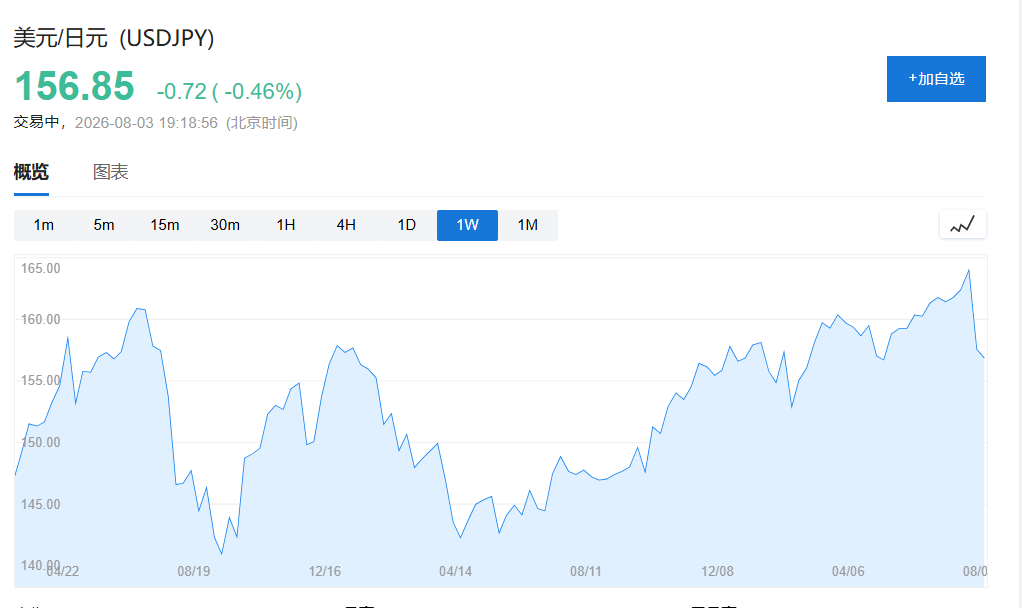
However, the market response was less enthusiastic than expected. Even after this sharp rally, the yen merely returned to its May trading levels, leaving its year-to-date gain against the dollar virtually flat. Compared with the Bank of Japan’s solo intervention in the same period of 2024—which lifted the yen from 161 to 141, a 12% increase—the impact of this latest action appears significantly weaker.
Multiple foreign exchange strategists and economists have pointed directly to the core issue: as long as the interest rate differential between the U.S. and Japan remains unchanged, any intervention will only address symptoms rather than root causes.
Record-breaking intervention scale, but questionable effectiveness
This joint intervention marks one of the largest coordinated actions to date between the United States and Japan.
Reuters reporters photographed a to-do list on Treasury Secretary Scott Bessent’s desk containing a single item: "Buy $5–10 billion in yen." According to the Financial Times, citing informed sources, the Federal Reserve Bank of New York executed part of this operation by selling euros to purchase yen.
Notably, Japan’s previous interventions typically involved selling off portions of its approximately $1.1 trillion holdings of U.S. Treasuries. However, with yields on 30-year U.S. Treasury bonds now approaching their highest level in nearly two decades, this approach would be unfavorable for the U.S. bond market and has somewhat constrained the operational scope of such interventions.
This intervention also produced a side effect—the U.S. Dollar Index fell below 100 for the first time since June of this year. Prior to this, both Bessent and Japanese Finance Minister Satsuki Katayama had attempted to bolster the yen through verbal interventions, but those efforts failed, ultimately prompting both sides to escalate to concrete action.
The wide interest rate differential makes sustained intervention difficult.
Many market participants believe that intervention can only address immediate pressures and cannot resolve the fundamental weaknesses facing the yen.
Robin Brooks, a senior fellow at the Brookings Institution, wrote on social media: "The yen is falling not because speculators are attacking Japan, but because Japanese government bond yields are far below where they should be."
Interest rate differentials are the core driver of exchange rate movements, as capital naturally flows toward markets offering higher returns. Currently, Japan’s policy rate stands at just 1%, while the Federal Reserve’s target range for the federal funds rate is 3.50% to 3.75%, creating a significant gap.
Last Friday, the Bank of Japan opted to hold steady at its monetary policy meeting, leaving interest rates unchanged.
In a client report, ING Groep economist Chris Turner noted, "A firm policy discussion could set the stage for a 25-basis-point rate hike at the September 18 meeting," but he also highlighted a deeper contradiction: Japan’s consumer price index is nearing 2%, while the policy rate remains only half the inflation rate.
The yen is significantly undervalued, and structural pressures remain unresolved.
Louis Gave, CEO of Gavekal, expressed strong agreement with Turner’s assessment in a client report issued Monday.
He argued, "Unless the Federal Reserve cuts rates or the Bank of Japan begins hiking rates, the yen cannot achieve meaningful appreciation," and noted that the yen, like other Northeast Asian currencies, is "significantly undervalued." This conclusion aligns with Deutsche Bank’s July 'World Map' report and the latest Big Mac Index analysis published by The Economist.
From a fundamentals perspective, Japan maintains the largest current account surplus among G7 nations, which should theoretically support its currency. However, the prevalence of yen carry trades—where investors borrow low-yielding yen to purchase higher-yielding assets—has persistently weighed on the yen over the past 15 years, preventing its fundamental strengths from translating into exchange rate support.
Analysts generally believe that unless the Bank of Japan takes substantive steps in its monetary policy, the effects of this coordinated intervention will be difficult to sustain, and the structural weakness of the yen is unlikely to change fundamentally in the short term.
Editor/Deng