Trump stated that dialogue is taking place at Iran’s request, calling it Tehran’s last chance to reach a good agreement. He outlined that the first phase of talks concerns reopening the Strait of Hormuz, while the second phase will address denuclearization. He firmly asserted that Iran would never be allowed to charge tolls for passage through the strait. Trump claimed that although Iran asserts it operates the Strait of Hormuz with strength, in reality, the strait is entirely under U.S. control, and warned that unless Iran reaches an agreement or 'surrenders completely,' the blockade would continue. He also urged oil companies to 'lower oil prices now.' Arab media reported that Iran has already rejected the new U.S. proposal regarding the strait. U.S. media indicated that no new negotiations between Washington and Tehran have been scheduled.
Diplomatic maneuvering between the United States and Iran over the Strait of Hormuz and nuclear issues continues.
During early U.S. stock market trading hours on Monday, August 3 (Eastern Time), President Trump posted a series of messages on his social media platform, criticizing Iran’s leadership as 'duplicitous.' He accused Iran of simultaneously requesting talks with the U.S. while publicly denying any ongoing negotiations, and warned that the U.S. blockade of Iran would persist unless an agreement was reached or Iran 'surrendered completely.'
 During midday U.S. trading hours, Trump reiterated that negotiations with Iran were still underway. He said the U.S. was currently engaging in dialogue with Iran at Tehran’s request, a process supported by Saudi Arabia, the United Arab Emirates, Qatar, and other countries, and emphasized this represented Iran’s 'last opportunity to sign a good agreement.'
According to Trump, the first phase of talks with Iran concerns reopening the Strait of Hormuz, and the second phase will address denuclearization. He suggested the strait could reopen as early as Tuesday—the following day—and that denuclearization discussions would continue 'for some time.'
When asked whether Iran was willing to 'restore full freedom of navigation' through the Strait of Hormuz, Trump responded that he would never allow Iran to impose tolls: 'There will absolutely be no tolls—this issue wasn’t even discussed.' He added that if anyone were to collect tolls, it should be the United States, since Washington maintains full control over the strait.
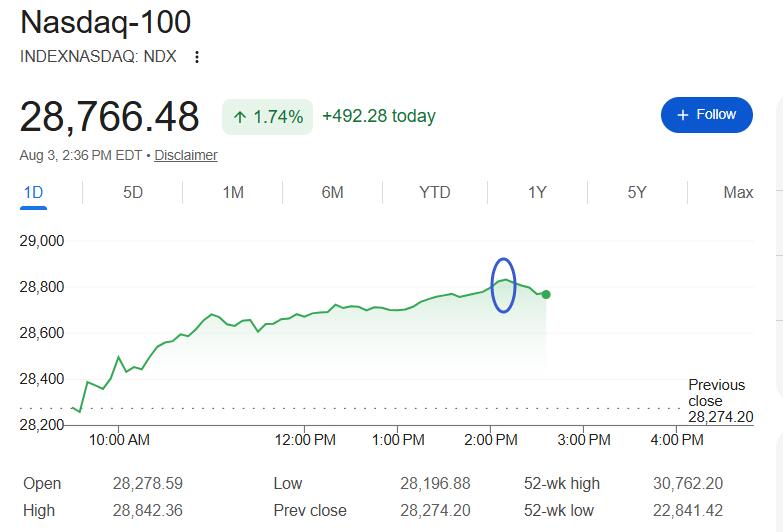
After Trump mentioned discussions about reopening the Strait of Hormuz on Tuesday, U.S. stock market gains widened further, with the Nasdaq 100 Index briefly rising more than 2% during intraday trading.
Less than 24 hours before Trump’s social media posts, he had publicly stated on the previous Sunday that the U.S. and Iran would begin negotiations on Monday, saying, 'After the Hormuz agreement comes the nuclear deal.' Earlier on Monday, Iran denied reports of ongoing talks with the U.S. According to China Central Television (CCTV), Iranian Foreign Ministry spokesperson Baghaei said on August 3 that there were no plans 'these days' to host or dispatch any delegations regarding renewed negotiations with the United States.
Also on Monday, Arab media outlet Al Mayadeen, citing an Iranian source, reported that the Iranian government had rejected the latest U.S. proposal regarding the Strait of Hormuz, insisting it would not fully reopen the strait until the war ended. The source also claimed the U.S. had already made concessions on closing the southern shipping lanes of the strait. This report has not yet been confirmed by the U.S. government or any independent channels.
According to U.S. broadcaster CBS, citing American officials, no new negotiations between the U.S. and Iran have been scheduled. The report added that talks between U.S. and Iranian negotiating teams, facilitated by intermediaries, are still ongoing.
Trump accused Iran of “begging” for talks while simultaneously claiming no discussions were taking place.
U.S. media noted that Trump, who had expressed considerable optimism about a diplomatic solution less than 24 hours earlier, had now reverted to a pessimistic outlook regarding the prospects of U.S.-Iran diplomacy.
On the evening of Sunday, August 2 (local time), Trump told reporters aboard Air Force One: “The Hormuz agreement will be reached, and then comes the nuclear deal.” He also stated at the time that the two sides would begin discussing nuclear issues on Monday afternoon.
According to CCTV, Iranian Foreign Ministry spokesperson Baghaei stated during his regular press briefing on August 3 that there were currently no talks between Iran and the United States, and that Iran’s current interlocutor was Oman, with discussions focused on the Strait of Hormuz. Baghaei further noted that, given the U.S.’s continued violations of the memorandum of understanding, the situation in the Strait of Hormuz would not undergo significant changes.
Subsequently, during early U.S. trading hours on August 3 (Eastern Time), Trump took to social media to sharply criticize the Iranian government, calling its leadership “incredibly duplicitous.”
Trump’s post stated that while Iran was calling for talks—‘some might even say begging’—negotiations had already begun and more meetings were scheduled soon; yet at the same time, Iran publicly, and even ‘proudly,’ claimed there were no discussions whatsoever, asserting it was only engaging with Oman.
Commentators noted this stands in sharp contrast to Trump’s conviction just one day earlier that diplomacy could achieve a breakthrough.
Regarding Iran’s statements about the Strait of Hormuz, Trump said Iran continues to repeat its claim about ‘exercising strong control over the Strait of Hormuz,’ but in reality, the strait is fully under the control of the U.S. Navy, effectively blockaded by the United States—or, as some have called it, the ‘American steel wall.’
Trump further warned:
“Nothing gets into Iran unless we allow it; nothing will be permitted through unless an agreement is reached—or unless Iran ‘completely surrenders.’”
However, even as he issued these tough warnings, Trump insisted, ‘Whether Iran wants to admit it or not, we have actually been discussing how to resolve the problem they’ve created over decades,’ implying that some form of communication between the two sides continues behind the scenes.
At the end of his post, Trump reiterated his long-standing position: ‘It’s actually very simple: Iran will never have nuclear weapons!’
Notably, although Trump clearly walked back his optimistic outlook on diplomatic prospects expressed just the previous day and intensified pressure on Iran, he did not deny that contacts exist. Instead, he maintained that the U.S. and Iran are, in fact, still discussing solutions—a stance that sharply contrasts with Iran’s firm assertion on the same day that ‘there are no talks whatsoever,’ highlighting the persistent divergence in how both sides characterize the current state of diplomatic engagement.
Trump urges oil companies: Lower gasoline prices now
Aside from Iran, Trump also posted a separate message on social media, directing criticism squarely at the U.S. oil industry.
Trump mentioned that Chevron Chairman and CEO Mike Wirth, in an interview with Fox Business host Maria Bartiromo that day, discussed the reasons behind the company's strong performance.
However, Trump argued that the one point Wirth conveniently omitted was that without the Trump administration’s 'genius, vision, strength, and stability,' the U.S. oil industry—and the entire nation—would be 'DEAD.'
Trump specifically cited the example that Chevron had previously been forced out of Venezuela but has now re-entered the country on a larger and stronger scale; he added that not only Chevron but other U.S. oil companies would also reap substantial profits as a result.
Trump then issued a direct public appeal to the entire oil industry:
“Bring down consumer (retail) gasoline prices—do it now!”
In recent months, Trump has repeatedly urged U.S. energy companies to increase supply and lower fuel prices, aiming to alleviate inflationary pressures and reinforce his political narrative of 'reducing the cost of living.'
Touting 'Best Poll Numbers Ever': Claims 'Denuclearization of Iran' and a 'Major Victory' in Venezuela
Another post Trump made on Monday returned to his familiar theme of political messaging.
Trump claimed that “real polls” show he currently enjoys his best-ever approval rating, attributing this to: the largest tax cuts in U.S. history; the strongest employment data ever recorded; the largest influx of foreign investment into the U.S. in global history; a “completely secure” border; a “huge victory” in Venezuela; the “denuclearization of Iran”; and America regaining global respect.
Trump again criticized mainstream media polls as “all fake” and called on voters to support the Republican Party.
Notably, Trump directly used the phrase 'denuclearization of Iran' in his post, but as of now, no formal nuclear agreement has been announced between the U.S. and Iran, and Iranian officials continue to deny that direct negotiations are underway.
The Strait of Hormuz remains a focal point of their strategic contestation.
Trump’s latest remarks once again underscore that the Strait of Hormuz remains at the heart of the current U.S.-Iranian standoff.
According to reports, Iran is currently consulting with Oman on a temporary shipping arrangement for the Strait of Hormuz, but emphasizes that such discussions do not imply a resumption of direct U.S.-Iran negotiations. Meanwhile, Trump insists that the two sides are, in fact, discussing solutions and claims that the U.S. Navy has full control over the Strait of Hormuz.
Although the two sides’ statements remain markedly contradictory, markets generally believe that as long as expectations persist regarding the resumption of navigation through the Strait of Hormuz and diplomatic engagement between the U.S. and Iran, concerns about further escalation in the Middle East will ease somewhat. However, given the ongoing mutual denials in their public statements, significant uncertainty remains regarding the prospects for future negotiations and shipping arrangements in the Strait of Hormuz.
Editor/Liam