
JPMorgan was the first to raise its forecast for U.S. long-term Treasury yields, lifting its year-end target for the 10-year yield to 4.85% and the 30-year yield to 5.40%, and recommending positioning for a steeper yield curve. Goldman Sachs, Morgan Stanley, Barclays, and JPMorgan share similar views. Bank of America stated that if the Federal Reserve fails to clearly articulate its inflation-fighting strategy, U.S. Treasuries could resume their downward trend; however, it recommends a flattening trade on the 2s10s spread, betting on a restoration of the Fed’s credibility. Scotiabank believes the market is underestimating the likelihood of a rate hike in October and simultaneously recommends going long the middle leg of a 2s5s10s butterfly trade.
JPMorgan raised its forecast for U.S. long-term Treasury yields, making it a central topic in this week’s Wall Street discussions on interest rate outlooks. Several major institutions have since released reports expressing views—marked by both divergence and consensus—on the Federal Reserve’s credibility, rising inflation risk premiums, and the trajectory of the yield curve.
Last week, the Federal Reserve decided to hold rates steady, and Chair沃什 subsequently delivered remarks that sparked widespread market skepticism about the Fed’s credibility in fighting inflation. In a report dated July 31, JPMorgan strategists including Jay Barry noted that the market reaction—characterized by falling short-end yields and rising long-end yields—"reflects concerns about the Federal Reserve’s credibility."
 JPMorgan economists subsequently moved forward their forecast for the Fed’s first rate hike from the second half of next year to December of this year.
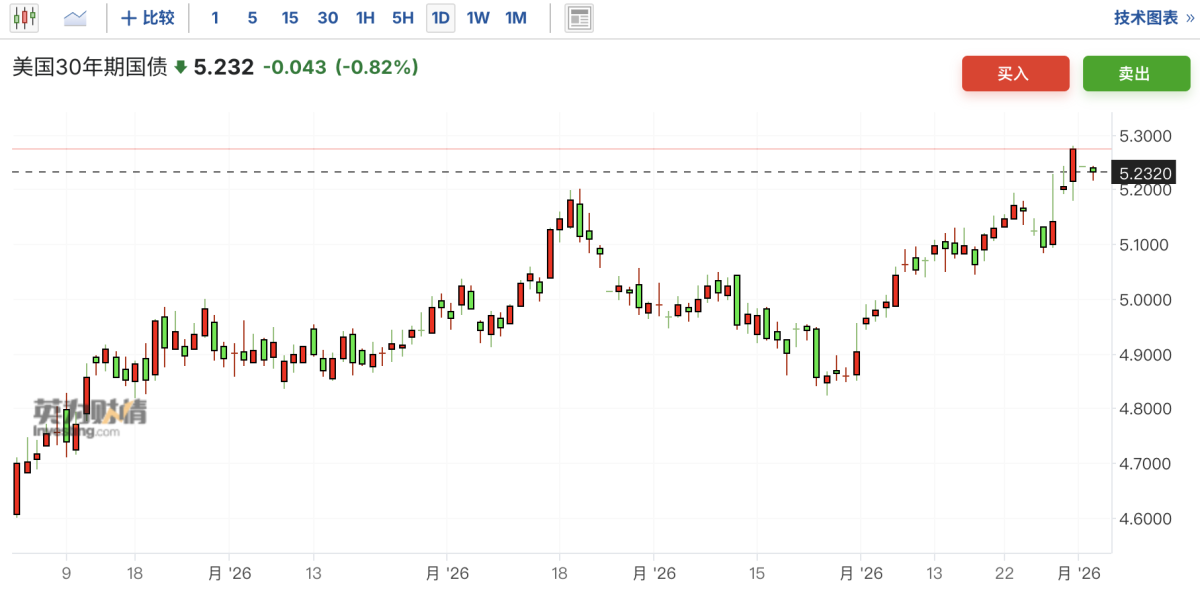
On Monday, the yield on the U.S. 10-year Treasury note fell by approximately 5 basis points to around 4.68%, pressured by a sharp decline in oil prices. However, this short-term fluctuation has not altered institutions’ overall view of upward pressure on long-end rates. Most institutions believe that elevated inflation expectations and an expanding term premium will continue to push long-term rates higher, and the trend toward further steepening of the yield curve is unlikely to reverse in the near term.
The 30-year yield briefly rose to 5.28% last Friday—the highest level since 2007—before easing slightly to around 5.22% on Monday.
JPMorgan: Raises Forecasts, Recommends Positioning for Curve Steepening
JPMorgan raised its year-end forecast for the 10-year U.S. Treasury yield from 4.70% to 4.85%, and its 30-year forecast from 5.20% to 5.40%. The report stated:
"These adjustments primarily stem from our renewed bullish stance on inflation breakeven rates and our expectation that the term premium may also rise."
Based on this assessment, JPMorgan recommends that investors position for a further widening of the spread between 2-year and 10-year yields to capture opportunities from continued yield curve steepening.
Barclays: Long-end rates still have room to rise; scope for further curve steepening remains
Barclays strategists, including Anshul Pradhan, similarly argued in a July 30 report that long-term rates still have room to rise, citing the following reasons:
Strong economic performance has pushed estimates of the neutral rate from some models into the 1.5%–2% range, and the scope for markets to price in a higher inflation risk premium could dampen investors’ positive reaction to the Federal Reserve’s reaffirmation of its commitment to price stability.
Barclays also noted that the current 2s30s curve remains significantly below its long-term average of 150 basis points, leaving room for further steepening.
The bank continues to recommend paying the 5-year forward 5-year rate and emphasized: "Unless Chair Waller commits to initiating a hiking cycle—which would starkly contradict his previous stance of providing no forward guidance—long-end yields will need to find their own direction amid an evolving economic outlook."
Goldman Sachs and Morgan Stanley: Tactical Steepener with Refined Hedging
Goldman Sachs strategists George Cole, William Marshall, and others stated in a July 31 report that they prefer expressing the view that the yield curve retains additional risk premium through cross-market trades, but remain cautious about the sustainability of a bear steepening trend. The report noted:
"We view broad-based bear steepening more as a tactical risk than a structural one; it is more prudent to hedge against rising yields by taking directional exposure in the middle part of the yield curve."
Morgan Stanley strategists Matthew Hornbach, Martin Tobias, and others, in a report published the same day, maintained their recommendation for a steepening trade in the U.S. Treasury 7s30s segment but advised hedging via a SFRU6 95.9375/95.875 put spread to cover risks around the next two employment reports and CPI releases, which could fuel expectations of a September rate hike.
The report warned that if the August CPI, released on September 11, comes in above expectations, "it could prompt markets to price in more than one 25-basis-point rate hike ahead of the September FOMC meeting."
Bank of America: Recommends a 2s10s flattening trade, betting on the Fed’s credibility restoration
Bank of America strategist Mark Cabana believes that if the Federal Reserve fails to better communicate to the market how it intends to achieve its 2% inflation target, the sell-off in U.S. Treasuries will resume.
He stated that the long-end bond selloff last Wednesday, which pushed yields to near 20-year highs, was a “textbook inflation credibility shock.” On that day, Fed Chair Waller failed during his press conference to explain to investors how the Fed would contain price increases.
“It’s great that you’re firmly committed to achieving 2% inflation, but unless you tell us how you plan to do it, we won’t believe you,” Cabana said in an interview. “And you can’t fool the bond market—it sees right through you.”
However, the bank has added a new recommendation to pay the January 2027 FOMC overnight index swap (OIS), in response to a Federal Reserve that "may wish to adopt a more hawkish stance on inflation," while continuing to recommend paying the 2-year rate and suggesting a flattening trade on the 2s10s yield curve spread.
Bank of America also noted that if long-end Treasury yields remain under pressure, the Fed could seek to restore inflation credibility in the future through speeches by senior officials or op-eds in the media.
Bank of Nova Scotia: Underestimating October Rate Hike Probability Presents Trading Opportunity
In a report dated July 31, Bank of Nova Scotia strategists Boris Sender and Rachel Zheng offered a contrarian view, arguing that markets currently underestimate the likelihood of the Federal Reserve taking rate action at the October FOMC meeting.
The bank recommends paying the October FOMC meeting while receiving the September and December meetings to capture this pricing discrepancy.
Additionally, Bank of Nova Scotia favors going long the middle leg of the 2s5s10s butterfly trade to benefit from multiple factors, including potentially weaker nonfarm payroll data, unchanged U.S. Treasury issuance guidance, and further policy signals from Fed officials.
Editor/Liam