
$Amazon (AMZN.US)$ The stock price rose another 4.6% on Monday, pushing its market capitalization above $3 trillion for the first time, making it the fifth company in history to reach this milestone—previously achieved only by $NVIDIA (NVDA.US)$ 、 $Alphabet-C (GOOG.US)$ 、 $Microsoft (MSFT.US)$ and $Apple (AAPL.US)$ to reach this milestone.
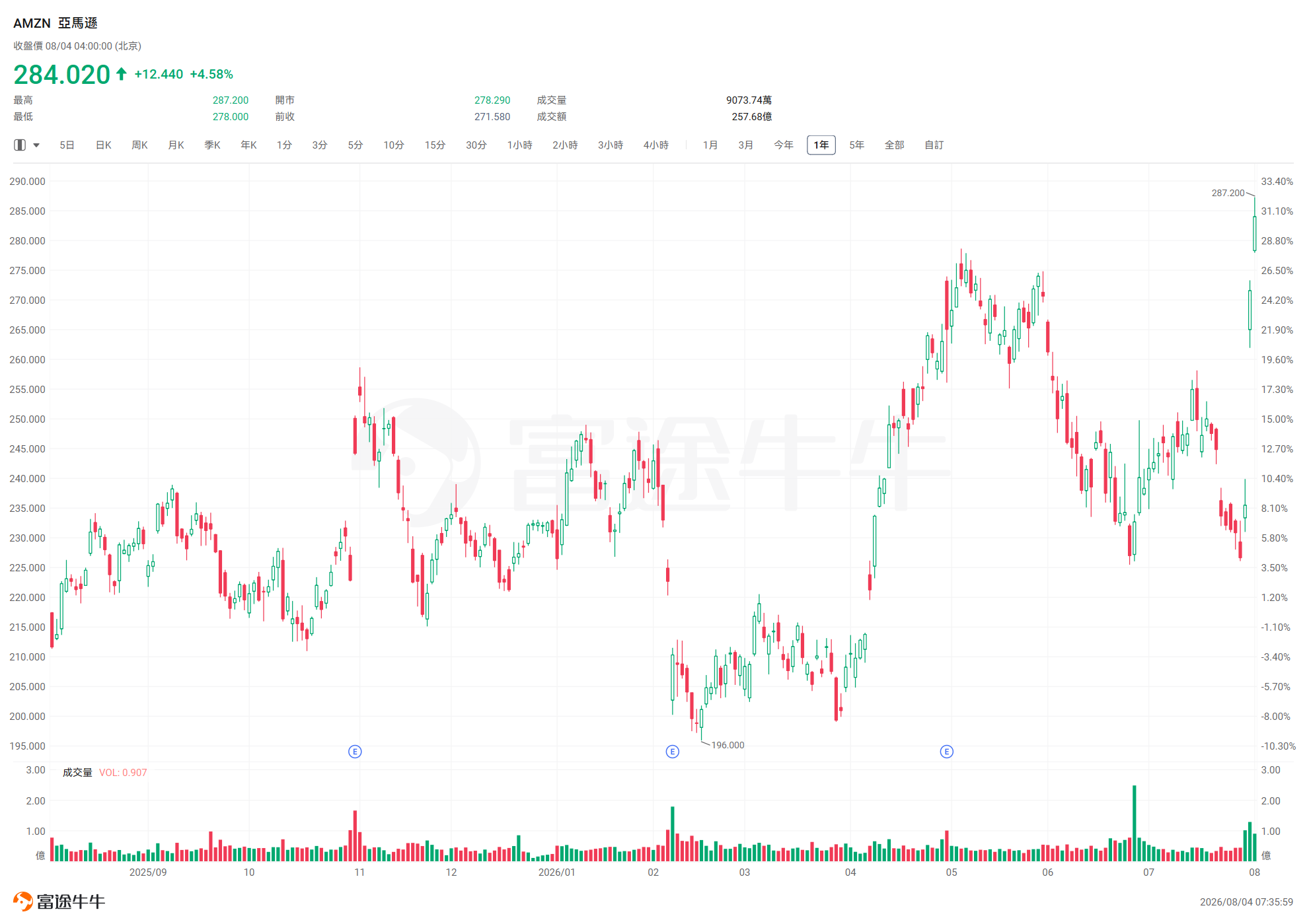
This rally extends the strong rebound following last week’s earnings release, as accelerating revenue growth from Amazon Web Services (AWS) reignited broad-based investor optimism.
On Friday, it surged more than 15% in a single day—the largest one-day gain in over 14 years—adding nearly $400 billion to its market capitalization. With further gains this week, Amazon has overtaken its peers to become the top performer year-to-date among the 'Magnificent Seven,' with a cumulative gain of approximately 23% this year, compared to an average increase of only about 2.1% for other major tech stocks.
 In an interview on Monday, Matt Garman, head of Amazon’s cloud business, stated: "We still see many companies using large-scale training clusters, but as these models become increasingly popular and powerful, more enterprises are integrating inference capabilities into their own workflows."
Garman did not disclose specific spending forecasts for next year but described the potential business opportunities in artificial intelligence as "enormously large in scale."
Amazon is forecasting demand for new data centers by entering into long-term contracts with customers. Garman stated, "As we continue to invest, we are also signing five-year commitment agreements with our customers. Right now, demand still significantly outstrips supply, and we are working hard to accelerate construction and investment to keep pace with customer needs."
AWS Accelerates Growth, Alleviating Market's Primary Concern
Over the past several months, Amazon’s stock has faced significant downward pressure. Investors have grown increasingly skeptical about whether the massive capital expenditures by large tech companies betting heavily on artificial intelligence will yield tangible returns. Since hitting a record high on May 6, Amazon’s share price declined steadily, falling nearly 18% cumulatively by the time it reached a recent low last month.
The release of its second-quarter earnings report dispelled this wave of pessimism. The results showed that AWS posted its fastest year-over-year revenue growth since 2021, directly addressing the market’s core concern over whether its cloud computing business could absorb the substantial AI-related investments. This development triggered a sharp rally in the stock, with the company’s single-day increase in market capitalization ranking among the largest in history.
Valuation Remains Attractive, with Analysts Recognizing Upside Potential
In terms of market capitalization trajectory, Amazon’s current expansion is far outpacing historical trends. The company first reached a $1 trillion valuation at the end of 2018 and took more than six years to surpass $2 trillion in June 2024.
However, the climb from $2 trillion to $3 trillion took just over two years, significantly accelerating the pace between milestones—a clear reflection of the powerful revaluation driven by the cloud computing and AI boom.
Despite the substantial rebound in its share price, Amazon’s current valuation remains relatively low by historical standards. Based on a forward 12-month price-to-earnings (P/E) ratio of approximately 25x, it is about 44% below its ten-year average. Although the valuation has recovered notably from the 17-year low reached in late March, it still remains well below its historical mean.
According to data compiled by Bloomberg, Wall Street analysts remain highly optimistic about Amazon’s outlook. Consensus price targets imply an additional upside of roughly 14% from current levels, indicating broad institutional confidence that the recent rally has not yet priced in excessive valuation.
Want to select stocks or get a stock diagnosis? Curious about the opportunities and risks in your portfolio? For all your investment questions,Just ask Futubull AI!

Edited by Joryn