
After the market close on Monday, Eastern Time, Snap Inc., the parent company of Snapchat, released its second-quarter 2026 earnings report, with both revenue and profit exceeding market expectations, and provided strong guidance for third-quarter performance.
Zhitong Finance APP learned that, after the U.S. markets closed on Monday, Eastern Time, Snap Inc $Snap Inc (SNAP.US)$ released its second-quarter 2026 earnings report, with both revenue and profit exceeding market expectations, and provided strong guidance for the third quarter. Boosted by this news, the company's share price surged more than 13% in after-hours trading, erasing concerns over its year-to-date decline of over 37%.

The earnings report showed that for the quarter ended June 30, Snap generated revenue of $1.6 billion, a significant 19% year-over-year increase, substantially exceeding the Wall Street consensus estimate of $1.54 billion. Advertising revenue, which constitutes the bulk of total revenue, rose 9% year-over-year to $1.28 billion. Revenue from the 'Other' segment, which includes the Snapchat+ subscription service, grew 85% year-over-year to $316 million in the second quarter.
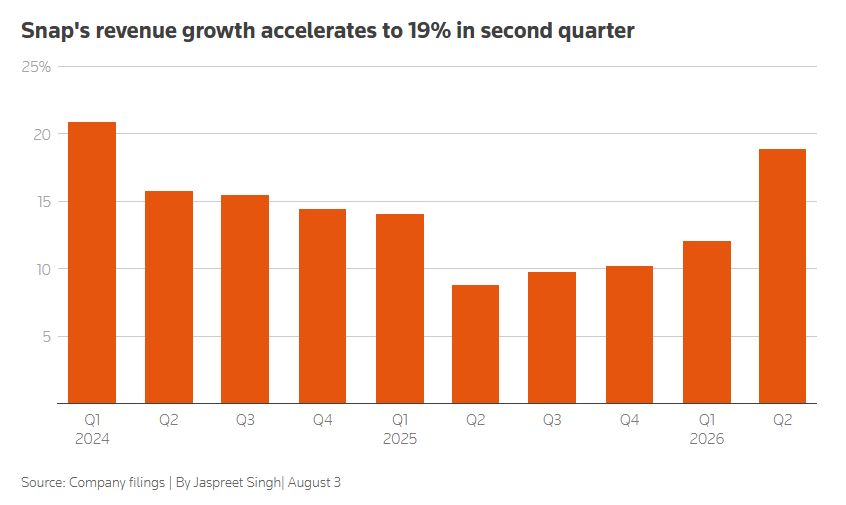
 The company’s net loss narrowed significantly from $262.6 million in the same period last year to $164 million. Adjusted profit reached $250 million, notably surpassing the market expectation of $192 million. Global average revenue per user (ARPU) rose to $3.25, also exceeding the expected $3.16.
World Cup and North American Key Clients Drive Advertising Recovery
Snap’s strong advertising performance this quarter was largely driven by marketing spending related to the FIFA World Cup and a marked improvement in ad spend momentum from major advertisers in North America.
In his letter to investors, CEO Evan Spiegel stated, “After several quarters of refining our advertising products and go-to-market strategies, we are seeing improved momentum among large North American advertisers and stronger international revenue growth.” He specifically noted that World Cup-related advertising spending contributed to the quarter’s results, while small and medium-sized business clients continued to show steady growth.
This statement stands in stark contrast to the previous quarter. When Snap released its earnings in May, it had warned that large North American advertisers remained a headwind and cited uncertainty in advertising due to conflicts in the Middle East. In this earnings report and shareholder letter, the company did not reiterate concerns about geopolitical tensions, instead emphasizing that its direct-response advertising offerings and AI-powered automated bidding, budget management, and audience targeting tools are continuously enhancing its appeal to advertisers.
Mixed User Growth, Regulatory Risks Loom Large
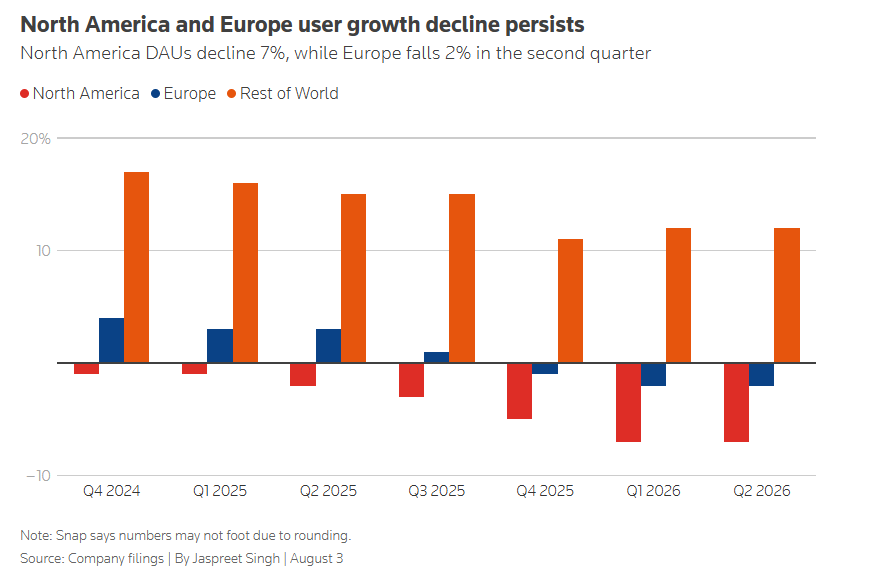
In terms of user metrics, Snap reported 493 million global daily active users (DAUs) this quarter, an approximately 5% year-over-year increase—consistent with the prior two quarters—and exceeding the market expectation of 488 million. However, user growth showed clear regional divergence: DAUs in its core North American market declined nearly 7% year-over-year to 92 million, and the European market also recorded a roughly 2% decrease.
Spiegel disclosed that U.S. user numbers increased sequentially, primarily driven by users aged 35 and above. He also noted that new features such as Spotlight short videos have helped boost user engagement. Previously, Snap experienced its first user decline in years at the end of 2025; now, having returned to growth in the first half of 2026, the platform demonstrates a degree of resilience.
However, Snap expressed deep concern about the increasingly challenging global regulatory and legal environment. Both Spiegel and Chief Financial Officer Doug Horowitz warned that this situation 'could have a material impact on the company’s business and financial performance.'
In December last year, Australia became the first country to impose a ban prohibiting users under the age of 16 from accessing a range of social media applications, including Snapchat. Last month, France became the first European Union member state to implement a similar restriction on social media use by minors. In the United States, Snap remains embroiled in multiple large-scale lawsuits alleging that it, along with other social media giants, deliberately designed addictive products that harmed minors. Although the company has already settled three closely watched cases this year, it still faces several trials scheduled for 2026.
Spiegel stated, 'We are closely monitoring the regulatory landscape, including requirements related to age verification, privacy, and online safety, all of which could affect the product experience or, over time, our user growth and engagement.'
Betting on AR Glasses to Forge the 'Next Computing Platform'
Amid the intense competition among tech giants pouring tens of billions of dollars into AI models and data centers, Snap has opted for a differentiated path. Spiegel has firmly staked the company’s long-term future on augmented reality (AR) glasses. In January of this year, Snap spun off this business into an independent subsidiary. In June, the company officially launched its first consumer-facing AR glasses, named 'Spectacles,' priced at $2,195, with a refundable $200 deposit, aiming for shipment within the year and a formal launch event scheduled for September 16 in Los Angeles.
In his letter to shareholders, Spiegel described Spectacles as 'our biggest long-term opportunity' and emphasized that they can be used without a Snapchat account, potentially enabling the company to reach entirely new user segments. During an earnings call with analysts, in response to concerns about Snap’s resource gap compared to giants like Meta (META.US), Spiegel pointed to Snapchat’s prior success in breaking through a crowded social media market, saying, 'The long-term opportunity to build the next computing platform is absolutely enormous... Our position as a pioneer is precisely what makes this opportunity unique.'
At the same time, he sought to alleviate investor concerns about excessive investment, noting that such devices would likely not achieve mass-market adoption until 'the end of this decade,' and pledged, 'We are managing this investment with significant discipline, currently focusing on customer experience, product quality, and ecosystem development.'
While pursuing its long-term vision, Snap has not relaxed its short-term profitability discipline. In April this year, the company announced a 16% workforce reduction aimed at improving cost efficiency and operational effectiveness. The newly appointed CFO, Horowitz, stated that the layoffs will generate annualized cost savings exceeding $500 million, 'which we expect to be more fully reflected in our financial results starting in the third quarter and beyond,' partly due to productivity gains enabled by AI tools.
Meanwhile, to support advertising revenue growth, Snap raised its full-year infrastructure spending guidance by $50 million, to a range of $1.65 billion to $1.7 billion, to accommodate additional investments in AI and machine learning.
Looking ahead to the current quarter, Snap provided a notably optimistic outlook: Third-quarter revenue is expected to range between $1.7 billion and $1.74 billion, with a midpoint above the analyst consensus of $1.7 billion; adjusted profit is projected to be between $300 million and $350 million, with a midpoint of $325 million slightly below the market expectation of $327 million.
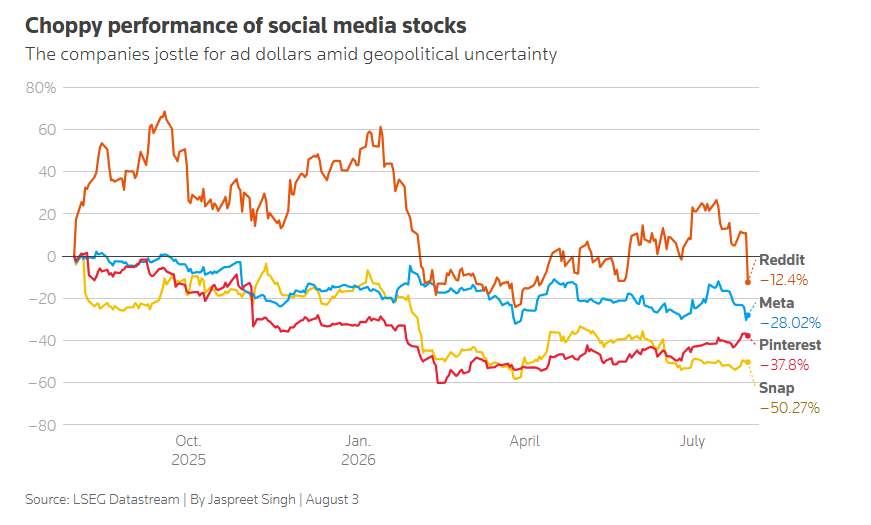
While Snap delivered an impressive earnings report, its sector peers faced a chilly reception from Wall Street last week. Reddit (RDDT.US), despite beating expectations on both revenue and profit, saw its share price drop after disclosing that traffic from search referrals has been 'volatile,' sparking market concerns over user growth. Meta’s stock also came under pressure as it issued a weaker-than-expected sales outlook and reported that its free cash flow was eroded by substantial AI-related expenditures.
Editor/rice