
The company's AI data center 'Power Engine' business has exploded—driven by surging demand for power management chips used in artificial intelligence data centers, its share price surged more than 7% at one point during U.S. after-hours trading.
Zhitong Finance APP learned that ON Semiconductor (ON.US), a semiconductor manufacturing behemoth serving the automotive and industrial sectors, reported stronger-than-expected financial results and forward guidance after U.S. market hours on Monday (early Tuesday Beijing time). The company’s Q3 revenue outlook exceeded the consensus estimate of Wall Street analysts, highlighting a surge in demand for its AI data center 'power engine' business—specifically, power management chips for artificial intelligence data centers—which drove its share price up more than 7% in after-hours trading. Amid the AI infrastructure boom, ON Semiconductor also delivered robust Q2 results ended July 3, with its Power Solutions Group (PSG), which encompasses automotive, industrial, and AI data center businesses, posting the strongest growth.
So far this year, ON Semiconductor’s share price has risen sharply, driven by unprecedented expectations of a strong recovery in demand for analog and data center power-chain-related chips amid the massive wave of AI data center construction. Although the stock has pulled back since July alongside global deleveraging in AI computing themes and unwinding of extremely crowded positions, it has still gained 50% since the beginning of 2026. By comparison, the chip giant’s shares fell 15% over the entirety of 2025.
 The chip demand frenzy triggered by AI is spilling over from core 'computing chips (GPUs/ASICs/HBM)' to the broader 'data center power and signal chain,' and the pace of this spillover is accelerating significantly—further validating the thesis that 'AI ultimately comes down to power,' which underpins the bullish trajectory of the data center power supply chain. The seemingly insatiable chip demand generated by AI training and inference is now successfully extending from AI and memory chips to analog and power semiconductors, strongly propelling leading analog chipmakers such as Texas Instruments, Infineon, and ON Semiconductor onto a robust recovery path. The market interprets these strong earnings as evidence that 'the analog chain is now capturing substantial benefits from the AI infrastructure supercycle.'
A $7 billion acquisition combined with surging AI data center demand ignites power chip sales, ushering ON Semiconductor into a new growth cycle
As ON Semiconductor announced strong financial results and forward guidance, it is also actively pursuing its largest acquisition to date—the all-stock deal announced in June to acquire Synaptics, an EDA and chip design software powerhouse under Synopsys, in a transaction valued at $7 billion—to fully capitalize on the rapidly growing demand in AI devices and robotics.
ON Semiconductor’s management projected Q3 revenue to be in the range of $1.65 billion to $1.75 billion. According to LSEG-compiled data, the midpoint of this guidance exceeds the Wall Street analyst consensus estimate of $1.67 billion.
ON Semiconductor CEO Hassane El-Khoury stated in the earnings release: 'Our AI data center-related business remains our fastest-growing segment. We now expect this segment’s revenue to at least double in 2026, reflecting the strength of our intelligent power portfolio and our customers’ expanding adoption of ON Semiconductor solutions across the entire power tree architecture.'
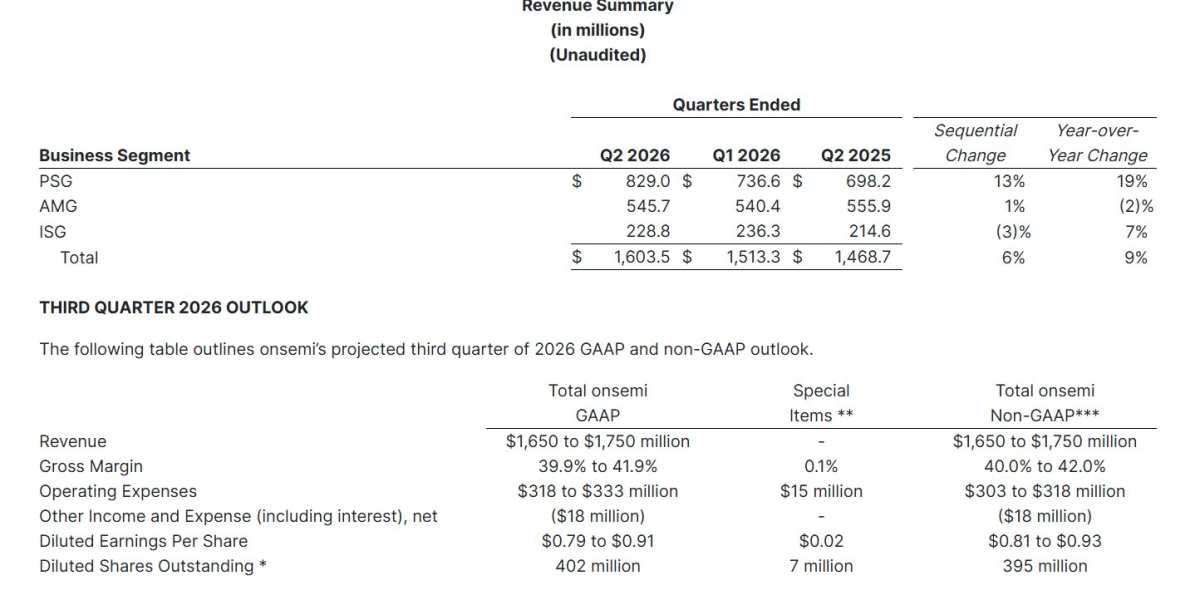
For the second quarter ended July 3, the company reported revenue of $1.6 billion, up 9.2% year-over-year, slightly exceeding the Wall Street consensus estimate of approximately $1.59 billion. Adjusted earnings per share came in at $0.74, an increase of about 40% year-over-year, surpassing the market expectation of $0.71.
The company’s management expects adjusted earnings per share for the third quarter to be in the range of $0.81 to $0.93, with a midpoint significantly above the Wall Street consensus estimate of approximately $0.83.
ON Semiconductor continues to advance its 'Fab Right' strategy to significantly reduce costs and substantially improve operational efficiency. In July, as part of this strategy, the company sold two fabrication facilities.
On other second-quarter performance metrics, ON Semiconductor’s GAAP gross margin improved from 37.6% to 38.4%, while its non-GAAP gross margin rose to 39.3%. GAAP operating margin increased from 13.2% to 16.1%, and non-GAAP operating margin rose from 17.3% to 20.8%. Net income attributable to shareholders grew from $170.3 million to $226.8 million, a substantial year-over-year increase of 33.2%. GAAP earnings per share (EPS) rose from $0.41 to $0.56, an increase of 36.6%.
As of July 3, the company reported operating cash flow of $459.7 million, up 149.4% year-over-year. Free cash flow surged dramatically from $106.1 million to $425.4 million—approximately four times the prior-year level—and free cash flow margin expanded from roughly 7% to 27%. The company repurchased $332 million worth of shares during the quarter. In other words, despite revenue growth of only about 9%, profits, cash flow, and shareholder returns expanded at multiples of that rate, demonstrating that ON Semiconductor’s Fab Right capacity optimization, cost discipline, and product portfolio upgrade are already generating tangible operating leverage.
Segment data further confirms that growth is clearly concentrating in data center power semiconductor business. Revenue from the Power Solutions Group (PSG) reached $829.0 million, up 18.7% year-over-year and 13% sequentially, increasing its share of total revenue from 47.5% a year ago to 51.7%, making it the source of more than half of the company’s revenue. Revenue from the Analog & Mixed-Signal Group (AMG) was approximately $545.7 million, down 1.8% year-over-year. Intelligent Sensing Group (ISG) revenue was $228.8 million, up 6.6% year-over-year.
ON Semiconductor’s total first-half revenue was $3.1168 billion, up 6.9% year-over-year. Adjusted EPS increased from $1.08 to $1.38, a 27.8% year-over-year rise, and free cash flow for the period was $642.6 million, up 14.6% year-over-year. Both the half-year and segment results indicate that ON Semiconductor has not yet experienced synchronized growth across all businesses; instead, PSG is leading the acceleration, driven by AI data centers, high-voltage power solutions, and certain automotive electrification demands, while AMG remains in a relatively modest recovery phase.
The 'chip demand frenzy' triggered by the AI infrastructure boom is spreading from AI chips and memory chips to analog and power semiconductors.
ON Semiconductor’s strong performance illustrates that demand for AI chips is systematically spilling over from GPUs, ASICs, and HBM themselves to power semiconductors, analog control, and signal-chain monitoring components. This is not merely analog chip companies opportunistically 'riding the AI hype,' but rather a physical necessity driven by the rising compute density.
ON Semiconductor has identified its AI data center business as its fastest-growing segment and expects related revenue to more than double by 2026. Texas Instruments reported approximately 90% year-over-year growth in its data center business in the first quarter of 2026, with continued growth in the second quarter led jointly by industrial, data center, and automotive segments. Infineon has joined NVIDIA’s MGX ecosystem, offering a complete solution—from high-voltage conversion to GPU core power delivery—centered around 800V DC power architecture, significantly boosting its first-half results. As a result, the beneficiaries of AI capital expenditure are expanding beyond a few advanced-node chips to include a large volume of lower-priced, long-lifecycle, reliability-certified foundational analog components in the data center power chain.
The fundamental driver behind the robust demand expansion in the analog/power IC and power semiconductor/discrete device sectors amid the unprecedented AI wave is that AI racks are evolving from traditional server power levels of tens of kilowatts to over 100 kilowatts—and even toward 600 kilowatts or 1 megawatt. Next-generation GPUs/TPUs/ASICs may each consume 2–4 kilowatts. Under conventional 48V/54V architectures, this would result in currents of several thousand amperes, causing sharp increases in copper losses, heat generation, and busbar volume—precisely why global AI data centers are actively transitioning to the ±400V or 800V DC architectures co-promoted by ON Semiconductor and NVIDIA.
Before electricity reaches the GPU, it must pass through AC/DC rectification, a power supply unit (PSU), a battery backup unit (BBU), high-voltage power distribution, an intermediate bus converter stepping down from 800V to 50V, and finally a multiphase voltage regulator module (VRM) that reduces voltage to below 1V required by the GPU core. Each stage requires silicon (Si), silicon carbide (SiC), or gallium nitride (GaN) power switches, gate drivers, digital controllers, power management ICs, and electronic fuses. ON Semiconductor, Texas Instruments, and Infineon supply precisely these 'watt-essential' components—thus, the higher the rack power and the more complex the conversion stages, the greater the semiconductor content per rack.
ON Semiconductor offers EliteSiC MOSFETs/JFETs, high- and low-voltage silicon MOSFETs, GaN devices, hot-swap intelligent fuses, multiphase controllers, power stages, and point-of-load (PoL) regulators along this 'grid-to-GPU' power tree. This means each AI rack not only requires more chips but also higher-value, higher-voltage, and higher-efficiency power devices. NVIDIA’s MGX platform serves as the strategic cornerstone of ON Semiconductor’s AI data center business. ON Semiconductor already supplies power FETs, multiphase power solutions, SiC JFETs, and GaN solutions to existing MGX systems and directly serves NVIDIA as well as PSU, BBU, and future 800V power distribution board suppliers within the MGX ecosystem. The standardized MGX server and rack design also enables a certified power component to be more readily adopted across multiple OEMs and ODMs.