
The U.S. and Japan jointly intervened in the foreign exchange market, with U.S. Treasury Secretary Bessent taking the rare step of buying yen by selling euros—rather than dollars—to forcefully lift the yen from its 40-year low. What drew even greater market attention was Bessent’s public pressure on the Federal Reserve to expand the FIMA repo facility’s capacity, a move former officials openly criticized as “highly unusual.” However, analysts warned that without a shift in the Bank of Japan’s policy stance, the intervention’s effects are unlikely to last, and the risk of unwinding over $1 trillion in carry trades remains unresolved.
The United States and Japan jointly intervened in the foreign exchange market, prompting a brief rebound in the yen, though market participants widely doubt its sustainability.
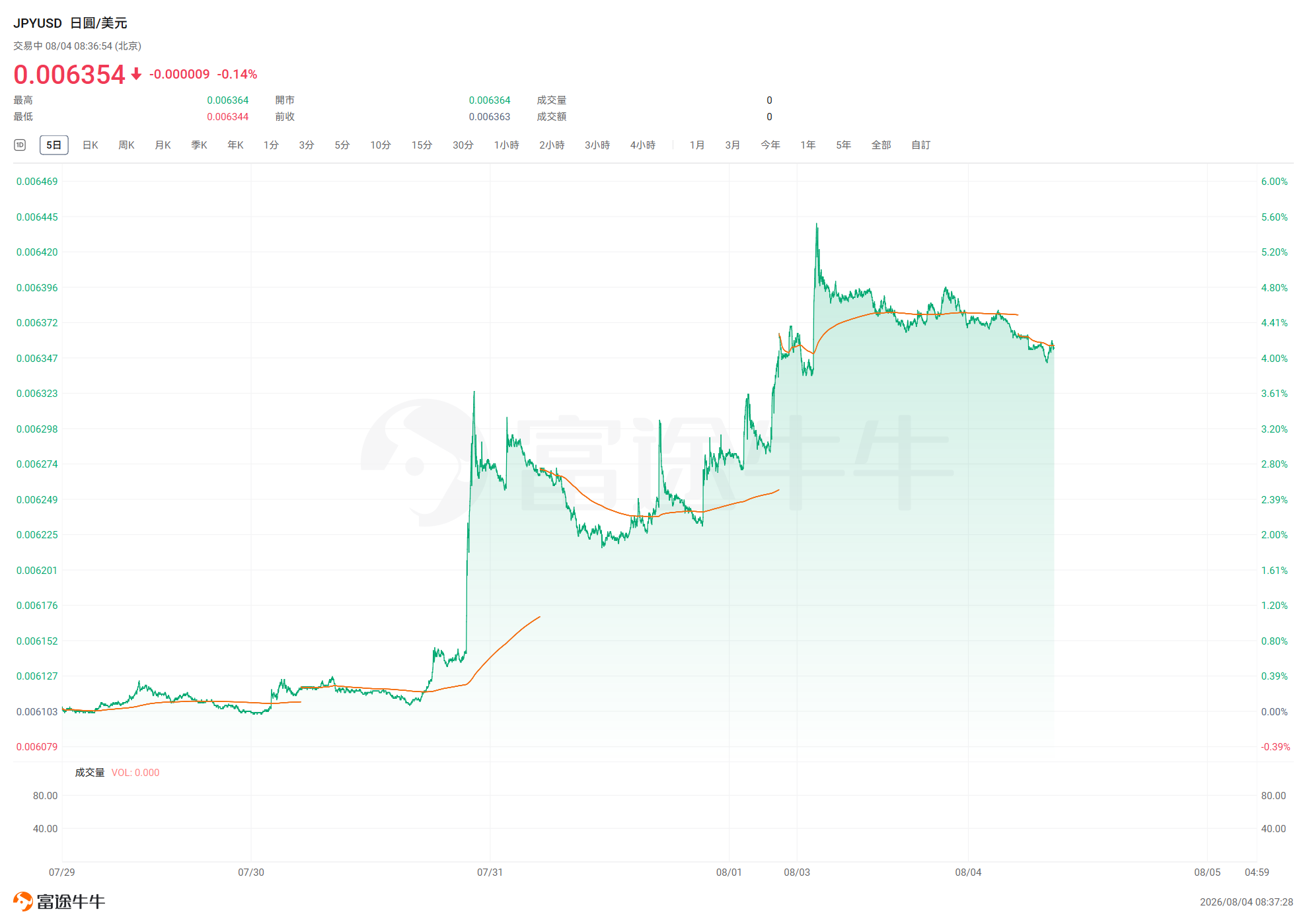
U.S. Treasury Secretary Bessent took the rare step last Friday of participating in coordinated intervention by selling euros to buy yen, pulling the yen back from a 40-year low. Simultaneously, Bessent publicly urged the Federal Reserve to expand access to the seldom-used Foreign and International Monetary Authorities (FIMA) Repo Facility, enabling Japan to secure U.S. dollars for future interventions without having to sell U.S. Treasuries.
 Japanese Finance Minister Saeko Katakura promptly confirmed that Japan would utilize this Federal Reserve facility to fund subsequent interventions.
However, analysts warned that without a substantive shift in the Bank of Japan’s monetary policy, the impact of this intervention is unlikely to last. More concerning for markets is the risk that a persistently strengthening yen could trigger the unwinding of over $1 trillion in carry trades, delivering a shock to global risk assets.
Intervention Details: Selling Euros, Avoiding Direct Dollar Sales
According to The Wall Street Journal, the U.S. Treasury’s method of intervention last Friday was notably unconventional—supporting the yen by selling euros and buying yen rather than directly selling dollars, thereby sidestepping the political sensitivity associated with deliberately weakening the dollar.
This intervention lifted the yen from near 164—the weakest level since 1986 and a 40-year low—to around 157 by Monday afternoon. On Monday, Finance Minister Saeko Katakura stated that Japan “would not hesitate” to intervene again in coordination with the United States.
In a social media post, Bessent stated that the coordinated foreign exchange action was aimed at addressing "disorderly movements in the yen" and characterized the U.S.-Japan alliance as an embodiment of the principle that "economic security is national security."
Bessent’s Public Pressure on the Fed Draws Unusual Attention
Another notable aspect of this intervention was Bessent’s public call for the Federal Reserve to expand the capacity of the Foreign and International Monetary Authorities (FIMA) Repo Facility.
The FIMA facility allows foreign governments to borrow U.S. dollars from the Federal Reserve using their holdings of U.S. Treasuries as collateral, without having to sell those securities directly in the open market, thereby avoiding upward pressure on Treasury yields. The facility was established during the pandemic in 2020 and made permanent in July 2021, with a current daily limit of $60 billion per counterparty.
In his post, Bessent stated that he would 'encourage expanding the capacity of this facility in the coming months.'
Several Fed watchers noted that it is highly unusual for the Treasury Secretary to publicly comment on a specific Federal Reserve tool. Mark Sobel, a former senior Treasury official, said: 'This is extremely unusual. During my tenure, the Treasury Secretary always avoided public commentary on matters involving the Fed’s monetary operations. Even when necessary, such matters were addressed privately with the Fed Chair, not through public statements.'
Tobin Marcus of Wolfe Research also remarked: 'I can’t recall another instance where the Treasury Department publicly called on the Fed to adjust one of its facilities in this manner, rather than coordinating behind the scenes.'
Notably, any adjustment to the FIMA facility’s capacity must be approved by the Federal Reserve’s Foreign Currency Subcommittee, which operates under the Federal Open Market Committee (FOMC), and any proposed changes must be communicated to the full FOMC. Bessent’s public statement comes amid ongoing White House pressure on the Fed to cut interest rates, further intensifying concerns about the Fed’s independence.
Short-term Treasuries: The primary instrument in past interventions
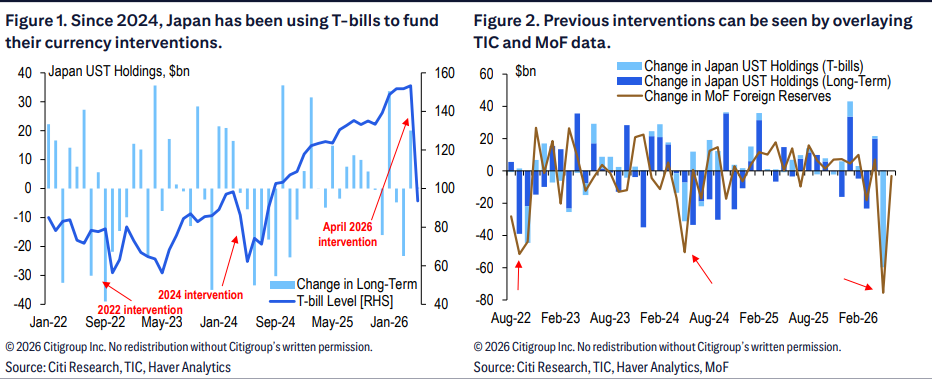
According to Citi research, which examined historical patterns linking Japanese foreign exchange interventions to shifts in U.S. Treasury holdings, since 2024 the Ministry of Finance (MoF) has systematically used short-term Treasury bills (T-bills), rather than long-term bonds, as the main funding source for interventions.
Based on Citi’s estimates using monthly Treasury International Capital (TIC) data, Japan held approximately $56 billion in short-term Treasuries during the 2022 intervention round, at which time the MoF raised funds by selling or allowing around $75 billion of long-term coupon-bearing bonds to mature. Since then, Japan has steadily rebuilt its short-term Treasury holdings. By the time of the 2024 intervention, its short-term Treasury position had risen significantly, prompting the MoF to sell roughly $40 billion in T-bills; holdings declined to approximately $60 billion by the end of the intervention.
The April 2026 intervention followed the same pattern. By then, Japan’s short-term Treasury holdings had been rebuilt to around $150 billion, and the MoF sold approximately $60 billion to support the yen. As of the latest TIC data through the end of May this year, Japan’s short-term Treasury holdings stood at about $90 billion. Citi estimates that the intervention around July 30—amounting to roughly $53 billion—was most likely executed primarily through sales of short-term Treasuries.
Limitations of the FIMA Facility: Its cap aligns closely with Japan’s typical single-day intervention scale
According to Bloomberg, Evercore ISI strategists Marco Casiraghi and Gang Lyu noted that the FIMA facility has a clear limitation—the $60 billion daily cap per counterparty is only slightly above the estimated scale of Japan’s single-day intervention last Thursday.
This means that if Japan needs to conduct large-scale, sustained interventions, the facility’s practicality would be significantly diminished. Evercore ISI warned in a client report: "We believe placing emphasis on a capped Federal Reserve repo facility could backfire—if markets realize that large-scale intervention requires selling U.S. Treasuries, it may instead test the resolve of both the U.S. and Japan to defend the yen."
In practice, the facility remains largely idle under normal conditions. According to the latest Federal Reserve data, as of the week ending July 29, average balances stood at just about $6 million; the last time it saw meaningful usage was in early February this year, with $3 billion drawn.
Moreover, the facility carries relatively high funding costs—an interest rate of 3.75%, with seven-day funding priced at the one-week overnight index swap (OIS) rate plus 25 basis points. Evercore ISI strategists pointed out that the Fed intentionally set the rate above private repo market funding costs, signaling that the facility is intended for short-term liquidity support during periods of market stress, not as a regular funding source for sustained foreign exchange intervention.
Effectiveness of Intervention in Question: Monetary Policy Holds the Key
Analysts widely agree that without a fundamental shift in the Bank of Japan’s monetary policy, the effects of intervention are unlikely to be sustainable.
Nabil Milali, portfolio manager at Edmond de Rothschild, stated: "Unless the Bank of Japan tightens monetary policy, the yen cannot sustain its gains."
Currently, the short-term interest rate differential between the U.S. and Japan stands at approximately 2.5 percentage points, and markets broadly expect the Federal Reserve to hike rates further at its September meeting, continuing to drive investor flows toward higher-yielding currencies.
Robin Brooks, senior fellow at the Brookings Institution, noted an inherent contradiction within the Bank of Japan’s policy framework: "On one hand, the BOJ continues to purchase roughly ¥2.5 trillion (about $16 billion) in Japanese government bonds each month, suppressing long-term yields; on the other, the Ministry of Finance intervenes in the currency market to strengthen the yen—these two actions are fundamentally at odds."
Goldman Sachs analysts believe that more durable support for the yen could come from domestic Japanese investors repatriating overseas assets, which would constitute "the most powerful long-term policy lever for influencing the exchange rate."
Risk of Carry Trade Reversal: Over $1 Trillion in Exposure Remains Unresolved
This intervention has raised market concerns about a large-scale unwinding of global carry trades.
For years, Japan’s ultra-low interest rates and a weak yen have fueled massive carry trades—in which investors borrow low-yielding yen to invest in higher-return assets such as U.S. tech stocks and Mexican pesos. HSBC estimates the total scale of such carry trades exceeds $1 trillion.
Milali warned, 'For decades, the simplest carry trade has been borrowing yen at zero interest rates and investing in any high-yield asset. Clearly, many investors are still betting on this trade continuing. A reversal in Japanese rates and the yen would pose significant risk for these investors.'
The unexpected sharp appreciation of the yen in 2024 triggered global market turmoil, forcing investors to unwind carry positions, sell assets, and buy back yen. Although markets have reacted relatively calmly to recent yen strength—with the Dow Jones Industrial Average rising 1.3% to a record high of 53,178.41 points on Monday, the S&P 500 gaining 1.5%, and the Nasdaq Composite climbing 2.1%—analysts caution that if the yen strengthens significantly further, the systemic risk of widespread carry trade unwinds cannot be ignored.
Want to select stocks or get a stock diagnosis? Curious about the opportunities and risks in your portfolio? For all your investment questions,Just ask Futubull AI!

Edited by Joryn