
① Amazon rose 4.58%, reaching a new all-time high after 61 trading days, with its market capitalization surpassing $3 trillion; ② CEO Andy Jassy stated that the company is “less than three years” away from breaking even on investments in servers and networking equipment; ③ Recently, AWS CEO Matt Garman publicly expressed support for open-weight models on social media.
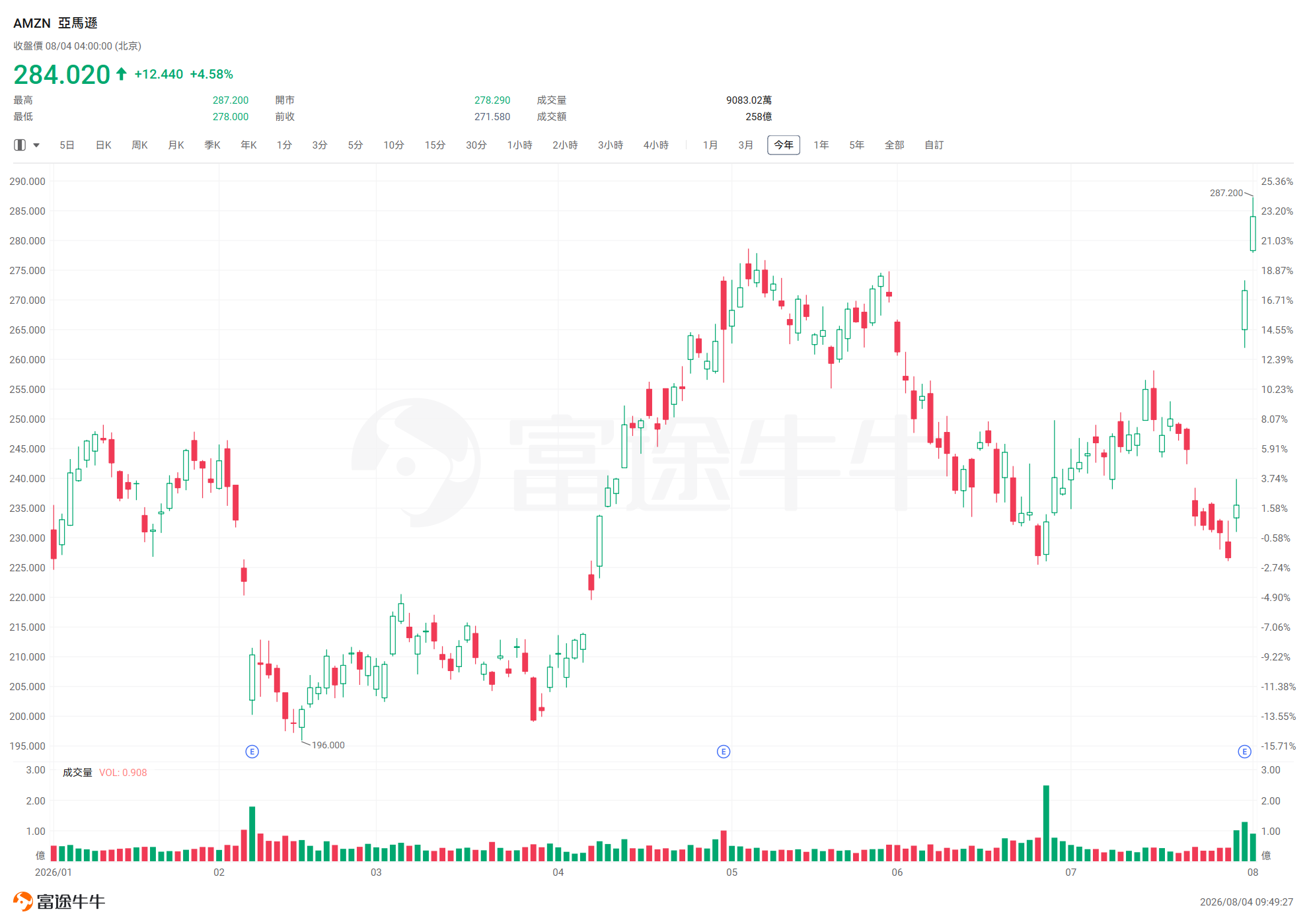
According to The Science and Technology Innovation Board Daily on August 4, U.S. cloud providers saw significant gains in after-hours trading on August 3 (U.S. Eastern Time). $Amazon (AMZN.US)$ rose 4.58%, reaching a new all-time high after 61 trading days, with its total market capitalization surpassing USD 3 trillion. $Alphabet-C (GOOG.US)$ 、 $Microsoft (MSFT.US)$ gained more than 4%, $Meta Platforms (META.US)$ rose more than 6%, $Oracle (ORCL.US)$ while posted an even stronger single-day gain of over 9%.
Behind this wave of stock price gains lies broad validation of AI monetization capabilities among major cloud providers.
 Earlier, Amazon reported its second-quarter earnings: AWS cloud revenue reached $42.23 billion, surpassing analysts’ expectations of $40.57 billion, marking the highest revenue growth rate in 18 quarters. Concurrently, the company raised its full-year 2026 capital expenditure guidance and expressed an optimistic outlook on the long-term potential for AI-related revenues to reach the trillions.
Regarding the critical question of return on investment (ROI) for AI spending, Amazon CEO Andy Jassy stated that the company is “less than three years” away from reaching the breakeven point on investments in servers and networking infrastructure, indicating that a virtuous cycle of AI investment returns has already begun to take shape.
Microsoft’s latest earnings report showed that Azure cloud revenue grew 43% year-over-year, exceeding analysts’ forecast of 39.98%. By the end of the quarter, its cloud business had $678 billion in remaining performance obligations, up from $627 billion in the prior quarter. Meanwhile, rival Google Cloud reported an 82% surge in cloud service revenue, also significantly surpassing market expectations.
Huafu Securities assessed that, based on Q2 results from the four major North American cloud providers, the industry remains in a phase of intensive investment, with market focus rapidly shifting toward when ROI from AI computing investments will materialize. Huachuang Securities noted that while CSPs’ capital expenditure trend has not reversed, greater attention should now be placed on inference costs and cash flow conversion.
The industry has entered the ROIC validation phase.
One clear trend is that the AI sector has moved beyond pure capital expenditure expansion and entered a phase of validating ROIC (Return on Incremental Capital).
Recently, Amazon raised its full-year capital expenditure forecast to $220 billion. During the investor call, Andy Jassy stated that even at this investment scale, “computing capacity supply in 2026 will still fall short of fully meeting customer demand. We anticipate a similar supply gap in 2027. In fact, customer commitments for 2028 computing capacity are already remarkably substantial.”
It added, 'We have long believed that Amazon Web Services could become a business generating tens of billions of dollars in revenue, and now we believe it will at least double—and quite possibly, in due course, become a $1 trillion annual revenue business, delivering highly attractive free cash flow and returns on invested capital.'
This logic has also gained recognition on Wall Street.
Morgan Stanley’s latest analysis shows that return on invested capital (ROIC) from generative AI investments in the AI inference era could reach 25% to 50%, significantly exceeding market expectations and addressing concerns about whether massive AI-related capital expenditures can generate returns. The report argues that as inference demand surges, large-scale players such as Amazon, Google, Microsoft, and Meta will continue to benefit.
Over the past three trading days, Amazon’s stock has risen more than 25%. Wall Street analysts remain highly optimistic about Amazon’s outlook, with consensus price targets implying approximately 14% further upside from current levels, indicating broad institutional belief that the recent rally has not yet priced in excessive valuation.
CITIC Securities noted that the capital expenditure narrative has already reversed: the market is no longer willing to pay for tech giants’ 'long-term strategies' but is instead closely scrutinizing actual returns, demanding tangible improvements in cloud revenue, order intake, and other metrics. Accelerating cloud revenue growth at Microsoft and AWS is seen as a validated signal of delivery.
Open-source models are unlocking new revenue potential.
Behind the market’s capital flows into cloud providers, the narrative around open-weight models is quietly gaining traction, potentially offering a new source of revenue support.
Recently, Amazon AWS CEO Matt Garman publicly expressed support for open-weight models on social media and signed the Open Weight Manifesto.
‘For many years, Amazon has consistently offered customers a diverse range of AI model choices,’ he stated. ‘No single model defines leadership in AI. Customers need both the most capable frontier models and open-weight models they can fine-tune, optimize, and deploy according to their specific workloads.’
To date, Amazon Bedrock already offers large language models from China, including DeepSeek, Qwen, MiniMax, Moonshot AI, and Z.AI.
Regarding the impact of the leapfrogging advancement of open-source models, institutions noted that in July this year, three domestically developed open-source large AI models—Kimi K3, DeepSeek V4, and Qwen3.8-Max-Preview—reshaped the global AI landscape with their high cost-performance advantage, driving high-quality foundational models from being merely 'usable' to increasingly 'easy-to-use,' thereby accelerating enterprise-level AI deployment and commercialization.
Furthermore, Guojin Securities opined that as enterprise AI deployments scale up, cloud providers will not only handle model training and inference compute demands but will also increasingly cover enterprise data integration, model customization, dedicated deployment, database management, security, and ongoing operations and maintenance. Meanwhile, AI demand is gradually shifting from infrastructure toward platform services, enterprise software, and recurring revenue models, a trend further validated by the accelerating revenue growth of the three major global cloud vendors, signaling the emergence of a closed-loop AI commercialization model.
Zheshang Securities added that the investment narrative in the AI market has shifted from 'buying grand stories' to 'buying proof of delivery.' As cost-reduction trends suppress demand for premium offerings, enterprises are turning to lower-cost models, compressing the pricing premium of cutting-edge, high-end models. Under the open-source model paradigm, model developers lacking sufficient compute resources will rely on cloud vendors for 'distribution plus deployment,' which is expected to simultaneously enhance both their revenue quality and profit margins.
Want to select stocks or get a stock diagnosis? Curious about the opportunities and risks in your portfolio? For all your investment questions,Just ask Futubull AI!

Edited by Joryn