During the earnings call, Palantir's management sharply criticized the current 'compute-token' billing model used by large AI labs as a 'parasitic model,' arguing that it not only forces enterprises to pay for ineffective outputs but also compels them to disclose core proprietary information. By championing its 'sovereign AI' architecture—which ensures enterprises retain full control—Palantir has declared the end of AI's 'benchmarking era' and is accelerating the conversion of computing power into tangible economic value. The company expects to sustain an exceptionally high growth rate over the next 18 months.
Fueled by the astonishing 149% growth rate of its U.S. commercial business and a precise strategic bet on 'sovereign AI,' Palantir delivered a record-breaking performance for the second quarter of 2026 and launched a sharp critique against the current large-model industry's 'cash-burning game' during its earnings call.
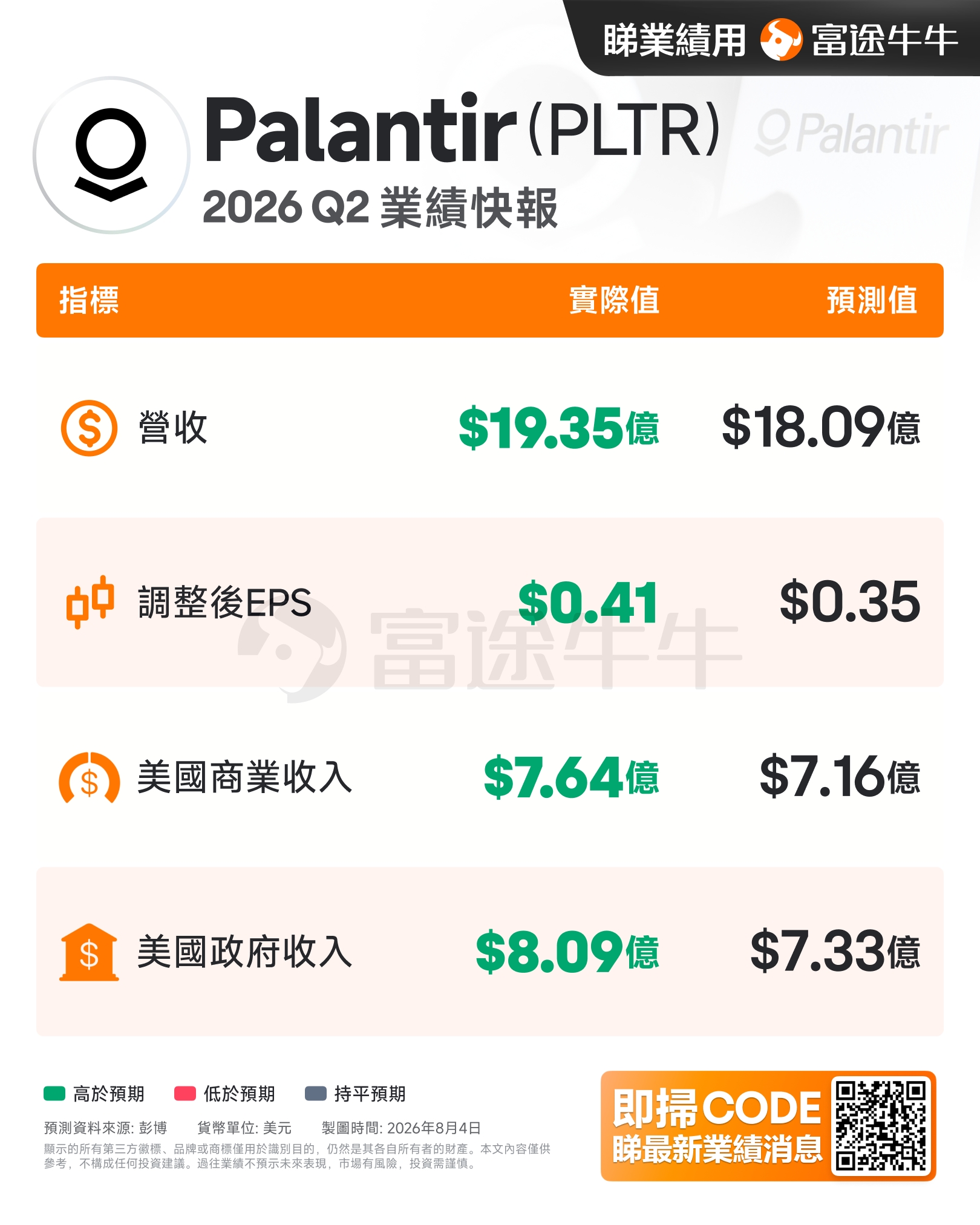
After U.S. market hours on August 3 local time, Palantir Technologies reported second-quarter results, with adjusted earnings per share of $0.41, exceeding the market expectation of $0.35; revenue surged 93% year-over-year to $1.94 billion, significantly surpassing the expected $1.8 billion.
 During the earnings call, Chief Financial Officer David Glazer announced an upward revision of the company’s full-year 2026 revenue guidance midpoint to $8.154 billion—approximately 11 percentage points higher than last quarter’s guidance—marking the largest annual guidance increase in the company’s history.
Palantir’s U.S. business accounted for over 81% of total revenue this quarter, serving as the primary engine behind the stellar performance. Chief Revenue Officer Ryan Taylor described this outcome on the call as “unprecedented, yet entirely expected.”
Ryan Taylor stated:
I have never seen such determination and urgency from customers in deepening their collaboration with Palantir.
The company declared that the era of 'enterprise AI sovereignty' has officially arrived. The core rationale behind Palantir’s strong quarterly performance lies in its flagship concept of 'enterprise AI sovereignty'—enabling enterprises to retain control over their own data, model weights, and business logic, rather than relying on large, cutting-edge model providers.
Ryan Taylor characterized the current market landscape as follows:
Companies not using Palantir are continuously burning cash on outputs that deliver no real value, while simultaneously handing over their most critical business secrets to model providers—who then use them as training data for future models.
The U.S. market emerges as the strongest growth engine, with U.S. government business continuing to expand.
The core growth narrative this quarter continues to center on the U.S. market.
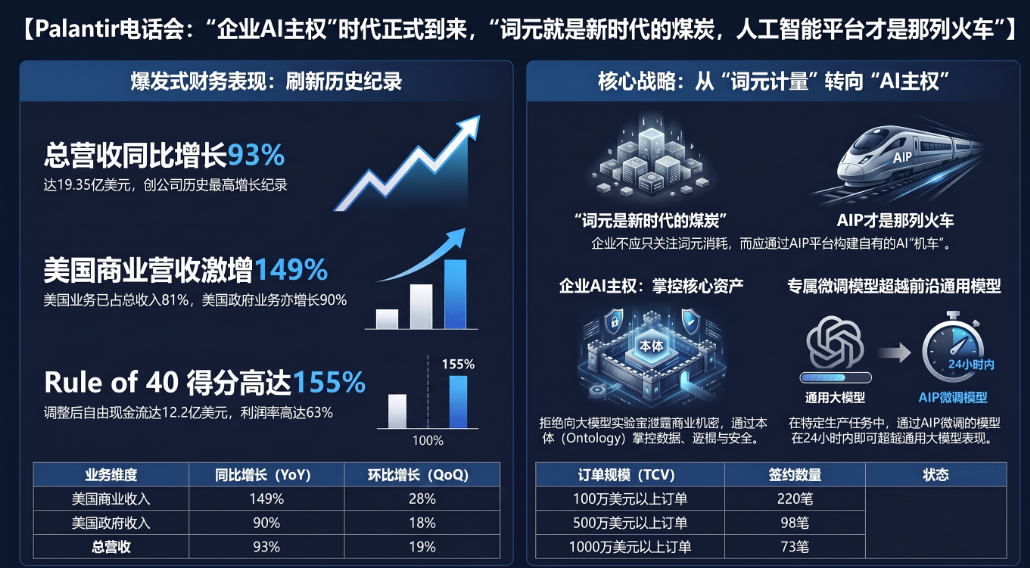
Financial metrics show that U.S. operations now account for more than 81% of Palantir’s total revenue, with a year-over-year increase of 115% in the second quarter. Notably, U.S. commercial revenue—the segment attracting the most market attention—accelerated further, growing 149% year-over-year and 28% quarter-over-quarter to reach $764 million.
U.S. government business generated $809 million in revenue this quarter, a 90% year-over-year increase, which the company described as an “extraordinary source of strength.”
Shyam Sankar disclosed that Maven, Palantir’s AI-enabled combat operations platform, has completed its first Program of Record deployment for a government customer. The program selected Maven as its operating platform, leveraging its open data standards, Ontology, and developer toolchain as foundational capabilities.
To date, the Maven platform hosts over 25,000 developers, including active-duty military personnel, civilian employees, contractors, and enterprise users.
Notably, Shyam Sankar pointed out that Palantir’s U.S. Department of Defense–related revenue over the past 12 months remains below 25 basis points of the Pentagon’s total budget, underscoring significant potential for future growth.
International government revenue rose 42% year-over-year to $181 million this quarter, while international commercial revenue increased 26% year-over-year to $182 million—both significantly lagging the growth pace observed in the U.S. market.
Condemning the 'parasitic model' of large AI models, enterprises are paying for worthless 'garbage'
In response to the ongoing frenzy surrounding large AI models, Palantir’s management directly addressed key industry pain points during the earnings call, highlighting the challenges many companies currently face in applying AI effectively.
During the call, Palantir Chief Revenue Officer Ryan Taylor sharply stated:
Our second-quarter performance was unprecedented, yet entirely expected, as the dramatic shift in the large language model market we have long warned about has now arrived. Companies not using Palantir are watching helplessly as their token-meter spins endlessly, yielding nothing but worthless 'slop.'
Taylor emphasized that the current token-based billing model 'might work for labs, but it doesn’t work for anyone else.'
He stated that this not only drains corporate budgets, but worse still:
Companies are paying to give away their most critical secrets—the very foundation of their competitive advantage. As those secrets become training data for all future models, this will ultimately lead to the commoditization of their own businesses.
Palantir CEO Alex Karp also criticized Silicon Valley’s traditional software business model, stating that the company rejects a parasitic approach that 'tricks customers into paying us, makes them dependent on us, and delivers no real value.'
Karp warned companies that relying solely on external frontier large models carries extremely high risks:
People are paying for the 'self-gratification' tokens provide, but the real cost is allowing others to migrate your intellectual property, know-how, and expertise into their models—enabling them to build a competing business that doesn’t need your company or your employees... Unprotected interaction with frontier models is extremely dangerous.
AI Sovereignty and the Era of 'Self-Benchmarking': Turning Compute Power into Real Alpha
Having abandoned the pursuit of large models for their own sake, Palantir offers 'Sovereign AI' as the solution—granting enterprises full ownership over the operational definitions of their data, logic, actions, and security.
Chief Technology Officer Shyam Sankar summarized the current AI landscape with a vivid analogy:
Tokens are the coal of the new era, and artificial intelligence platforms (AIPs) are the locomotives. Now our clients can build their own engines.
He pointed out that the market generates far more 'intelligence' than is actually converted into tangible 'value,' and even more powerful models cannot solve this problem.
Sankar announced that the era of the large model industry blindly chasing general-purpose benchmark tests is over:
‘The age of benchmaxing is over. Now begins the new era of benchmaking.’
He revealed that in testing, Palantir found that even standard open-source models—without fine-tuning—could outperform state-of-the-art, massive models when run within Palantir’s AIP architecture for specific tasks.
Sankar said:
Customer-specific benchmarks are not just scorecards—they are mountains to be climbed, defining what 'better' means in alignment with your business strategy.
Regarding future growth potential, CEO Karp expressed extreme confidence. He presented the market with an aggressive forecast:
“I am driving the company to grow over the next 18 months at a rate equal to or exceeding the growth we achieved in the U.S. commercial segment this quarter (which was 149%)... This is a very high bar, but we can achieve it because we are fully aligned with real enterprise needs. For the first time, people truly believe in us.”
Full Transcript of Palantir’s Q2 Earnings Call (AI-Assisted Translation):
Host: Good afternoon.
Ana Soro, Finance Team:
I am Ana Soro from Palantir’s finance team, and welcome to our second quarter 2026 earnings conference call. During this call, we will discuss the results disclosed in the press release issued after market close today and available on our Investor Relations website.
During this call, we will make certain statements regarding our business that may constitute forward-looking statements under applicable securities laws. These include projections for our third quarter and fiscal year 2026 results, management’s expectations regarding our future financial and operational performance, and other statements concerning our plans, prospects, and expectations. These statements are not guarantees or promises and are subject to various risks and uncertainties that could cause actual results to differ materially. Information regarding these risks is included in the earnings press release issued after market close today and in the filings we have submitted to the U.S. Securities and Exchange Commission (SEC). Except as required by law, we undertake no obligation to update any forward-looking statements.
In addition, during today’s call, we will reference certain adjusted financial measures. These non-GAAP financial measures are intended to supplement, not replace or be viewed in isolation from, GAAP financial measures. Further information about these non-GAAP measures, including a reconciliation of each non-GAAP measure to the most directly comparable GAAP measure, is included in the press release and investor presentation materials issued today. The press release, investor presentation, and other earnings-related materials are available on our Investor Relations website at investors.palantir.com.
During today’s call, when discussing our business, we will reference various growth rates, which, unless otherwise stated, refer to year-over-year growth rates.
Joining us on today’s call are Chief Executive Officer Alex Karp, Chief Technology Officer Shyam Sankar, Chief Financial Officer Dave Glazer, and Chief Revenue Officer and General Counsel Ryan Taylor.
I will now turn the call over to Ryan to begin the discussion.
Ryan Taylor, Chief Revenue Officer and General Counsel:
Our second-quarter results set a new record—but this outcome is not surprising. The structural shift in the large language model (LLM) market that we have been warning about for years has now arrived.
This quarter, we achieved a record-breaking year-over-year revenue growth of 93%. The standout driver of this performance remains our U.S. business, which now accounts for over 81% of total revenue, growing 115% year-over-year and 23% quarter-over-quarter. Within this segment, U.S. commercial revenue accelerated to 149% year-over-year and 28% quarter-over-quarter growth, while U.S. government revenue delivered an impressive 90% year-over-year and 18% quarter-over-quarter increase.
Concurrent with this revenue growth, our 'Rule of 40' score reached 155%, and we generated $1.22 billion in adjusted free cash flow. During the quarter, we closed 220 contracts valued at $1 million or more, including 98 contracts worth $5 million or more and 73 contracts exceeding $10 million—each setting new historical highs.
These results clearly demonstrate the profound value we unlock together with clients bold enough to cross the chasm. In contrast, enterprises that have yet to adopt Palantir are watching token meters spin endlessly, only to receive low-quality, valueless outputs. While this token consumption pattern may benefit large language model labs, it offers no meaningful return for others—it erodes enterprise budgets without delivering outcomes sufficient to justify the investment.
Worse still, as they spend, enterprises are surrendering their most critical secrets—the very foundation of their competitive advantage—thereby commoditizing their own businesses, as these secrets become embedded in the training data underlying all future models.
On the other side of the chasm, what enterprises truly need is AI sovereignty—the complete control over their data definitions, business logic, operational workflows, and security frameworks. An organization’s data constitutes its core asset, and its intrinsic value resides precisely therein. We work in deep alignment with our clients to build a technology stack that continuously amplifies their 'alpha' value. This close integration unites our clients’ ambitions with our own mission.
As Kirkland & Ellis emphasized: 'Through our partnership with Palantir, we have built a new operating model for legal services, enabling the centralized capture and compounding of our most senior lawyers’ expertise. Tasks that previously required days of analysis, discussion, and drafting by attorneys can now be completed in minutes. None of this would have been possible without the Ontology. We do not view this as a vendor relationship or a one-off project; rather, it represents a revolutionary transformation in how we work.'
This is precisely the mission we are advancing alongside clients across industries, and the contracts we are signing serve as compelling evidence of the profound shift currently underway in the AI market.
In U.S. commercial business, we closed $2.1 billion in Total Contract Value (TCV), based on dollar-weighted duration, representing 271% year-over-year growth. A multinational technology company began collaborating with us last Q4 through one of its operating subsidiaries; after fully validating the platform’s value, it expanded the engagement across its entire portfolio and converted it into a nearly $370 million, three-year contract last quarter.
Clients are demonstrating boldness and resolve in deepening their partnerships with Palantir. A global asset management firm initiated collaboration in Q1 and converted it last quarter into a $35 million, three-year TCV contract spanning four business lines: asset management, process automation, and investment lifecycle intelligence. A global software and services company, following its participation in the Agent Camp in May, signed an initial $15 million, five-month contract. A leading nonprofit health system completed its pilot at the end of 2025 and converted it last quarter into a $370 million TCV, three-year strategic partnership.
Our U.S. government business continues to be a significant source of strength, with robust momentum across both defense and civil sectors. We remain deeply proud to serve the U.S. government and are committed to equipping the nation with the most advanced, battle-tested AI capabilities. For Palantir, this is our mission.
Our clients are choosing to partner with us more deeply than ever before, driven by an unprecedented sense of urgency and conviction—to replace dependency with AI sovereignty and continuously compound their own 'alpha' value, placing it forever out of reach of competitors and potential adversaries.
I will now turn the floor over to Shyam.
Shyam Sankar, Chief Technology Officer and Executive Vice President:
Thank you, Ryan. Ryan just spoke about the exciting customer momentum behind sovereign AI. I’d like to delve deeper into our foundational product investments that position us to seize this historic opportunity.
AIP’s success lies in its status as the most capable and human-centric operating environment for enterprise AI. It integrates hybrid human-machine AI teams into heterogeneous, interdependent workflows and converts tokens into tangible economic value for customers in complex, high-stakes environments—faster than any alternative.
What makes this possible is a sophisticated, layered technical architecture: data integration and transformation, ontology and action layer, security and audit, workflow engine, agent SDK, agent orchestration with telemetry and observability, evaluation frameworks and customer-specific benchmarks, AIP Evolve, and our latest investments in post-training—including supervised fine-tuning and reinforcement learning.
Each layer is built upon our core foundational primitives and seamlessly interoperates with the others. This infrastructure captures rich operational telemetry, fueling a compounding feedback loop—an automated model factory operating within the customer’s security perimeter, continuously accumulating intelligence in the model weights they control—
Ryan Taylor, Chief Revenue Officer and Chief Legal Officer:
—accumulating intelligence in the model weights they control. Last quarter, I said, 'Tokens are the new coal, and AIP is the railroad.' Now, our customers can build their own locomotives. AIP is where you build, deploy, and continuously compound the strength of your sovereign AI.
We are entering an exciting new era—not one of 'bench maxing,' but of 'bench making.' The assumption that frontier models are inherently the highest-performing simply does not hold up in practice.
Within just 24 hours of integrating Nemotron Ultra into our tech stack, we identified five production tasks on which the standard Nemotron Ultra model—without any post-training—outperformed state-of-the-art models. This strongly suggests that a handful of general-purpose benchmarks can be deliberately optimized or even 'gamed.'
"Benchmark supremacy" is over. The new era belongs to "custom-built benchmarks"—customer-specific benchmarks are not merely report cards; they are mountains to climb. They represent a value-driven compass that guides your entire operational workflow and post-training pipeline, defining what "better" means based on your own business and strategic priorities, and aligning all efforts toward continuous optimization against that standard. Because this benchmark is yours, the trade-offs are yours to make. AIP provides you with a control plane to flexibly balance cost, performance, and latency—and to continuously decide, workflow by workflow, where to run your weights and where to use theirs.
In this way, you establish a compounding cycle of continuous improvement, steadily embedding your 'alpha' value into the model weights under your control. AIP was built precisely for this purpose.
We continue to witness our products repeatedly outperforming competitors in head-to-head contests. While competitors focus on boosting productivity, we concentrate on converting tokens into real economic value for our customers. The reality is that the intelligence generated by the market far exceeds the portion actually converted into value—and more powerful models alone cannot solve this problem. The bottleneck lies in the deployment velocity of AIP.
Recently, a major Silicon Valley technology company organized a 'bake-off': on one side was a leading AI lab and its deployment team; on the other were AIP and our Forward-Deployed Engineers (FDEs). Remember: only Palantir has true FDEs—other companies merely have 'enhanced' sales engineers. The lab selected a ticket automation problem but failed to deliver any meaningful results. In contrast, we built an agent swarm for each of the customer’s end users, proactively recommending marketing strategies, packaging options, and pricing adjustments to boost revenue and resource utilization. This effort ultimately translated into a $10 million annual contract value (ACV). The lab was shown the door. Same customer, same timeframe, identical models—the sole differentiator was AIP and Palantir’s unique FDE methodology, which proved decisive.
This quarter, our U.S. government business delivered exceptional performance—not only evidenced by 90% year-over-year revenue growth, but more importantly by tangible mission impact. Maven continues to support joint warfighting forces everywhere, from factory floors to forward trenches. Last quarter, the Maven platform welcomed its first formal government procurement program: an active government program selected Maven as its operational platform, leveraging our open data standards, Ontology, developer tools, interoperability capabilities, security mechanisms, and other foundational platform primitives to deliver seamless experiences and capabilities to the Department of Defense’s designated command-and-control platforms at unprecedented speed.
Maven also continues to gain recognition as the joint force’s preferred development and build platform, now hosting over 25,000 builders. Active-duty personnel, civilians, contractors, and enterprises are developing agents and applications on the platform at wartime speed. Despite this rapid growth, our Department of Defense revenue over the past 12 months remains below 25 basis points of the Pentagon’s total budget.
Finally, last week we hosted the inaugural 'American Builders Summit' in Washington, D.C., to honor participants who boldly joined the American Tech Fellowship (ATF), enabling them to share firsthand stories of how AI is creating jobs and prosperity and to showcase their builds to the world.
We created ATF because the most transformative AI applications we’ve seen often come from individuals without traditional tech backgrounds—they’re right there on the front lines and factory floors. Today, ATF has graduated over 1,000 fellows.
One of the speakers—Jonah—joined a submarine parts manufacturer called Tabbit thirteen years ago, starting directly on the factory floor. He is a proud blue-collar worker who still earns his living with a wrench. Yet it was he who developed an AI application that reduced production scheduling cycles from 30–40 days to less than one day. This achievement could not have been realized by AI alone—it required the fusion of AI with American workers: their hard-won industry expertise forged through success and failure on the production line, and the deep insights only they possess. Models are commodities—but American workers are not.
I will now turn the floor over to Dave, who will walk you through the financial results in detail.
David Glazer, Chief Financial Officer and Treasurer:
Thank you, Shyam. We delivered an exceptional second quarter—achieving a record 93% year-over-year revenue growth and a record $1.22 billion in adjusted free cash flow, representing a 63% margin and 115% year-over-year growth. We surpassed the $1 billion mark across three key metrics: GAAP net income, adjusted free cash flow, and adjusted operating income.
U.S. revenue grew 115% year-over-year and 23% quarter-over-quarter in the second quarter. Within this, U.S. commercial revenue accelerated to 149% year-over-year and 28% quarter-over-quarter growth, while U.S. government revenue increased 90% year-over-year and 18% quarter-over-quarter.
We secured $2.132 billion in U.S. commercial total contract value (TCV) orders, up 153% year-over-year and 81% quarter-over-quarter, nearly $800 million above our previous record for U.S. commercial orders in a single quarter. We are witnessing robust enterprise demand for sovereign AI—more and more enterprises recognize that only by owning their AI sovereignty can they fully control their own 'alpha' value.
Driven by the continued strength of our U.S. business and accelerating demand for sovereign AI capabilities, we are raising our full-year U.S. commercial revenue guidance to over $3.424 billion, representing at least 134% growth. We are also increasing the midpoint of our full-year 2026 revenue guidance to $8.154 billion, reflecting 82% year-over-year growth—an 11-percentage-point increase from last quarter’s guidance and the largest upward revision to annual revenue guidance in our history.
On a global basis: Second-quarter revenue reached $1.935 billion, up 93% year-over-year and 19% quarter-over-quarter. U.S. revenue totaled $1.573 billion, growing 115% year-over-year and 23% quarter-over-quarter. Revenue from top-tier customers continued to expand—with the trailing 12-month revenue from our top 20 customers growing 67% year-over-year to $124 million per customer.
Commercial segment: Second-quarter commercial revenue reached $945 million, up 110% year-over-year and 22% quarter-over-quarter. Commercial TCV orders for the quarter totaled $2.337 billion, up 118% year-over-year. Our AI platform continues to dominate the U.S. market as the only true solution for operationalizing large language models (LLMs), particularly as an increasing number of customers require full ownership over their data, business logic, operational workflows, and security frameworks. U.S. commercial revenue in the second quarter grew 149% year-over-year and 28% quarter-over-quarter to $764 million. U.S. commercial TCV orders hit a record high of $2.132 billion, up 153% year-over-year. Over the past 12 months, we have secured $5.964 billion in U.S. commercial TCV orders, a 117% increase compared to the prior 12-month period—highlighting the accelerating market demand for AI that delivers tangible operational value.
Large deal TCV within U.S. commercial grew 124% year-over-year and 27% quarter-over-quarter. The number of U.S. commercial customers increased to 653, up 35% year-over-year and 6% quarter-over-quarter. International commercial revenue in the second quarter was $182 million, up 26% year-over-year and 2% quarter-over-quarter. Strategic commercial contract revenue was approximately $400,000, representing 0.02% of total revenue; we expect revenue from these contracts to remain below $500,000 in each of the remaining quarters of this year.
Government segment: Second-quarter government revenue totaled $990 million, up 79% year-over-year and 15% quarter-over-quarter. U.S. government revenue reached $809 million, growing 90% year-over-year and 18% quarter-over-quarter, driven by ongoing execution of existing programs and new contract awards, reflecting sustained market demand for our AI platform in the government sector. International government revenue in the second quarter was $181 million, up 42% year-over-year and 5% quarter-over-quarter.
Total Contract Value (TCV) orders for the quarter reached $3.4 billion, an increase of 49% year-over-year; on a dollar-weighted duration basis, TCV orders grew by 129%. Net Dollar Retention (NDR) was 157%, up 700 basis points from the prior quarter.
As of the end of Q2, Total Remaining Deal Value stood at $13.1 billion, up 83% year-over-year and 11% quarter-over-quarter; Remaining Performance Obligations (RPO) amounted to $4.9 billion, up 103% year-over-year and 10% quarter-over-quarter. It should be noted that RPO is primarily composed of our commercial business, as it excludes contracts with initial terms shorter than 12 months and contractual obligations that arise only upon the triggering of 'convenience termination' clauses—both of which are common in our government contracts.
Margins and expenses: Adjusted gross margin (excluding stock-based compensation expenses) was 86%, reflecting higher costs associated with providing cloud-hosted services to a government customer. While this resulted in higher cost of revenue in Q2, we believe it will accelerate time-to-value for customers, enhance overall efficiency, improve cost predictability for clients, and support the expansion of their future workflows.
Adjusted operating income (excluding stock-based compensation expenses and related employer payroll taxes) was $1.194 billion, representing an adjusted operating margin of 62%. Adjusted expenses for Q2 were $741 million, up 14% quarter-over-quarter and 37% year-over-year, primarily driven by continued investment in our AI platform and recruitment of technical talent. Consistent with prior years, we expect expenses in Q3 to increase significantly due to seasonal hiring patterns and additional product and marketing initiatives. We remain committed to investing in top-tier technical talent and R&D in our product pipeline and sovereign AI capabilities, with the goal of achieving sustained GAAP profitability.
GAAP operating income for Q2 was $912 million, representing a 47% margin. GAAP net income for Q2 was $1.062 billion, representing a 55% margin. Stock-based compensation expenses for Q2 were $265 million, and employer payroll taxes related to equity awards were $17 million. GAAP earnings per share (EPS) for Q2 were $0.41, and adjusted EPS were also $0.41. During the quarter, unrealized gains on our SpaceX equity holdings contributed positively by $0.03 to GAAP EPS and $0.02 to adjusted EPS.
Additionally, the sum of our revenue growth rate and adjusted operating margin accelerated to 155% this quarter, improving our 'Rule of 40' score by 10 percentage points—the twelfth consecutive quarter of improvement in this metric.
Cash flow: Cash generated from operating activities in Q2 was $1.216 billion, and adjusted free cash flow was $1.220 billion, representing a 63% margin. At quarter-end, cash, cash equivalents, and short-term U.S. Treasury securities totaled $9.1 billion.
Outlook: For Q3 2026, we expect revenue in the range of $2.160 billion to $2.164 billion and adjusted operating income between $1.292 billion and $1.296 billion. For full-year 2026, we are raising our revenue guidance to $8.150 billion–$8.158 billion; increasing our U.S. commercial revenue guidance to over $3.424 billion, implying growth of at least 134%; raising our adjusted operating income guidance to $4.889 billion–$4.897 billion; and increasing our adjusted free cash flow guidance to $4.5 billion–$4.7 billion. We continue to expect GAAP operating profit and net income in each quarter of the year.
I will now turn the call over to Alex for a few closing remarks, after which Ana will moderate the Q&A session.
Alexander Karp, Co-Founder, Chief Executive Officer, and Director:
Clearly, these results are deeply inspiring to us and carry profound implications for our clients and the entire Western world.
Reflecting on the overall 93% growth, nearly 150% growth in U.S. commercial business, and 115% growth across the U.S. as a whole—these figures are staggering. They represent a substantial leap forward even from our already exceptional prior performance, and they are now occurring at a considerable scale.
The true origin of all this traces back to the very beginning—when we fully committed ourselves to the U.S. government, our most critical partner, and built products capable of delivering real value. To achieve this, we had to confront the world as it truly was. At that time, there were no ready-made software solutions or usable AI; we had to rely on natural language processing (NLP) technology. We were compelled to develop the 'Forward-Deployed Engineer' (FDE) model to extend our technical capabilities and deliver tangible value.
It was during that period that the initial concept of Ontology emerged. Shyam, Aki, and other colleagues once strapped BlackBerry phones to their heads to run code in highly sensitive environments. What became deeply embedded in the company during those years was a set of beliefs: certain values, principles, and structures matter more than merely extracting value from customers.
We rejected the prevailing Silicon Valley playbook for building software companies—one centered on creating customer lock-in and dependency through various means without genuinely delivering value, essentially operating as a parasitic model. It was precisely through our outright rejection of this approach that we achieved genuine, full alignment with our partners.
Over the years, to uphold this philosophy, we have successively built PG, Foundry, Gaia, Maven, Ontology, and AIP. Today, we are extending the AIP technology stack into the domain of sovereign AI—which requires us to orchestrate and fine-tune models to provide our partners with a fully autonomous and controllable sovereign technology stack.
What is the philosophical significance behind this? What we offer is a gift pointing toward the future we aspire to build together. What does that future look like? Under the Privacy Guard (PG) framework, we enjoy greater rights; under the sovereign AI framework, we are more secure—and this may well be the most critical element yet, as everything else is ultimately a downstream outcome of GDP growth and economic health.
Consider what it would mean if we positioned the United States as the only democracy that truly achieves economic growth, sustained productivity gains, and a genuine return of manufacturing to its shores. That vision is certainly not one where you accept a future in which you have no job while your adversaries win everything—a future where a small clique believes they are entitled to control the nation’s entire productive capacity simply because they eat vegetarian food and claim not to support the military, while everyone else is left to bear the costs of this revolution. And how exactly have we borne these costs?
At the enterprise level, people willingly pay for token consumption—and such consumption carries real costs. You are spending money to allow them to migrate your intellectual property, proprietary expertise, and accumulated knowledge into their models, thereby constructing a competitive system that no longer needs your business or your talent. Why do they do this? It stems from what they perceive as a morally justified logic—they believe they are superior and thus entitled to 'colonize' your enterprise, and that you deserve to be colonized.
Palantir’s approach is fundamentally different: we have established a deep partnership with NVIDIA and are continuously expanding the application layer. As Shyam mentioned, we have already entered—and will further penetrate—the market for model fine-tuning in classified environments. Consequently, models fine-tuned internally within enterprises using the NVIDIA technology stack now outperform frontier models. You retain the weights, you retain the 'alpha,' you retain everything.
Every enterprise in this country will either proactively examine how to achieve this, seek a viable path forward, or at the very least actively avoid the perilous option of interacting with cutting-edge models without safeguards. Such unprotected interaction is extremely dangerous—a lesson that should have been clear since high school, and one you are now experiencing firsthand within your own organizations. In this revolution, Palantir stands at the forefront, leading the transformation.
I am fully committed to driving the company to sustain growth over the next 18 months at a rate no lower than that of our current U.S. commercial business—an exceptionally challenging goal, yet achievable because we are tightly aligned with what is genuinely right, truly beneficial, and demonstrably effective within enterprises. And this time, people finally believe us. If you remain skeptical, consider our 149% growth in U.S. commercial business, a 'Rule of 40' score of 155%, overall growth of 93%, 90% growth in U.S. government business, and a free cash flow margin of 62% to 63%.
In the past, people questioned whether we could ever become profitable. Thus, this is one of the most exhilarating moments in Palantir’s history—and one of the most exciting times to engage with Palantir’s mission. To all those still on the sidelines: it’s time to step down from the stands. This sovereignty revolution will profoundly affect everyone—your stance within it will determine not only your livelihood and that of the people you care about, but also whether the United States and the Western world can prevail in this competition.
We cannot revert to that narrow philosophical model—where a small group of individuals, whose mindset differs drastically from most of us, captures all the nation’s commercial gains and value while shifting all the risk onto the rest of us. That is precisely what this revolution is about, and it serves as an immensely powerful motivator for every one of us at Palantir. Thank you.
Q&A Session
Moderator: Thank you, Alex. The first question comes from Dan at Yorkville Ives. Dan, please turn on your camera, and the system will prompt you to unmute.
Please hold briefly while we wait.
Ana Soro, Finance Team: Let’s return to Dan’s question. The next question is from Mariana at Bank of America. Mariana, please turn on your camera, and the system will prompt you to unmute.
Mariana Perez Mora, Analyst: Great, thank you. Could you share—based on your conversations with clients at the Sovereignty Bootcamp—any insights that exceeded your expectations? I mean, the executive attendance was clearly impressive; could you elaborate on that, Alex?
Alexander Karp, Co-Founder, Chief Executive Officer, and Director:
Certainly. First, for those unfamiliar with the context, let me provide some background—we held a Sovereignty Bootcamp following the outbreak of this revolution. Here’s the context: two years ago, we spent four or five months preparing AIPCon under Sasha’s coordination. Initially, this bootcamp was conceived more like 'inviting a few old friends over for a casual dinner,' but it was soon met with overwhelming demand—not only from those we invited but also from those we didn’t, spanning all levels of enterprise leadership.
In corporate practice, the involvement of operational staff is critical—and this group of attendees exemplifies that: it includes both CEOs and heads of operations.
This event featured extensive educational content, on which Shyam placed significant emphasis. Attendees generally understood that they need a way to control their own 'alpha' value; they broadly recognized that unrestrained token consumption would ultimately erode their interests; and they were acutely aware that such token usage was causing them to cede their data, prompts, operational methodologies, and domain expertise to third parties.
What they truly need, however, is education on 'how to respond'—how to address this issue either with our help (ideally) or without us. How should contracts be structured? How can open-weight models be used? How about closed-source models? What role does Ontology play in this context? Is Ontology truly the protective layer they believe it to be? Can it generate value in the way they expect? What would this look like within their own business environments? How do they integrate with the computational tech stack? It is precisely this large-scale demand for education that constitutes a strong market signal—and we are delivering exactly that education to our clients and to the broader market.
Notably, attendees came from diverse industries and backgrounds—their composition, types of needs, and even the presence of new faces with whom we have not yet partnered were all impressive.
By the way, this is also why Net Dollar Retention (NDR) has been so outstanding. People often write analyses focusing solely on customer adoption rates, but the exceptional strength of this NDR figure stems partly from another factor: it is poised to rise further and become even more impressive. Some of our earlier partners—who previously had limited engagement—attended this time. They said, 'Alright, we now understand why we need you, not just Foundry.' They are migrating toward our entire tech stack—clients who previously used only Foundry now want Ontology and aspire to become part of a sovereign AI tech stack.
One final point worth noting—you asked about external dynamics, but the same holds true internally: hiring, retention, and enthusiasm within Palantir. I am genuinely energized, and I believe everyone here feels the same. Even the legal team is excited—an occurrence unheard of in quite some time—and they’re now fully engaged, like rock stars. This makes everything even more compelling.
This is how things are unfolding, and I believe this is only the beginning. From an internal perspective, what we’re considering is the total addressable market for participants who aim both to create and retain value. That market has expanded significantly beyond the niche segment we originally focused on—it now encompasses a substantial portion of U.S. GDP. This is precisely why we need partners.
Behind the scenes, we are actively seeking partners—and they must be technically exceptional. 'Partnership' does not mean 'subordination.' We don’t need to agree on every issue or align on every client matter, and there can even be occasional competition between us. We’ve already seen this model work in the defense technology sector—Shyam also discussed our approach to partnerships in defense tech: partnership doesn’t imply complete alignment; sometimes we compete, but it means we’re moving in the same direction, enabling us to scale effectively.
This partnership model will become a critical component of the company’s path forward. This is precisely why I am committed not only to driving strong growth by year-end but also to sustaining that momentum into next year—which, in turn, compels us to find scalable approaches to meet the immense market demand.
Ana Soro, Finance Team: Thank you, Alex. Our next question comes from Mariana at Bank of America. Mariana, please turn on your camera, and the system will prompt you to unmute.
Mariana Perez Mora, Analyst: Good afternoon, everyone.
Alexander Karp: Hello.
Mariana Perez Mora, Analyst:
This is a follow-up to Dan’s question. At the dawn of the AI revolution, the business community clearly understood that data—particularly proprietary data—and how models were trained would be critical determinants of success. Yet, three years later, companies are only now beginning to grasp just how vital it is to own their own data and the insights derived from it.
What exactly happened during this period? In your view, why did Palantir adopt such a fundamentally different approach to AI from the outset, while the broader enterprise software industry failed to recognize this at the time? And today, these figures clearly demonstrate that Palantir is a winner in the AI space—why wasn’t this evident earlier to other software application companies?
Unidentified Speaker:
This issue can be broken down into two dimensions: effectiveness and scalability—or more precisely, how to achieve large-scale deployment.
In the zero-to-one phase, focusing on the application layer is crucial—that is, how to translate this emerging technology into tangible economic value. Over time, as stakeholders experience this economic value firsthand, they begin to realize that some entities initially viewed as partners are actually building competitive offerings.
I believe this realization takes time to permeate—wait a moment; perhaps this isn’t quite what I originally thought. I know this capability holds significant value when placed in the right hands and on the right platform, but I must also retain control over model weights—because the 'alpha' being generated isn’t just the raw internal data stored within an enterprise. It also includes metadata, inference trails, system 'emissions,' and usage logs, over which I currently lack effective governance mechanisms. Now I understand that these elements may be even more valuable than the internal data itself.
And this very realization is precisely the sobering message the market has been sending over the past one or two quarters.
Shyam Sankar, Chief Technology Officer and Executive Vice President:
Your question also implies another follow-up: why are we able to make the right judgment?
I believe the answer lies in the fact that we have truly achieved complete alignment of interests with our partners. Sometimes, we make decisions that are not in our immediate economic interest—for example, we continue to support numerous institutions in Europe despite their lackluster growth performance. I am referring to certain discreet agencies that would face rampant terrorist threats—and see the consequences of migration crises intensify tenfold—without our products. Continuing these partnerships is no longer economically advantageous for us, yet we persist because we are genuine believers.
Moreover, since its inception, Palantir has placed great emphasis on 'artistic insight'—meaning that some matters cannot be modeled purely through science; one must possess an aesthetic and artistic sensibility toward them. We have placed many significant bets. Everyone seated at this table, along with hundreds of our colleagues at Palantir, shares this artistic insight. We have always defined ourselves as a community of artists and believers. People often assume this simply means we are difficult to work with—and yes, that is also true. But more importantly, we cherish insights that arrive far ahead of others’ and translate those insights into core business value for the company.
This is extremely difficult for conventional enterprises. There’s an inside joke at Palantir: if we could charge royalties from everyone copying us, we’d easily exceed next year’s performance targets. Ordinary companies—not meant as criticism—typically operate based on proven business playbooks, whereas we operate in a world without a fixed script. The core of that playbook from five to ten years ago was building parasitic software and monetizing it—a strategy that no longer works today. While there are countless variations of this model, its essence constitutes our most fundamental competitive advantage.
We are a community of believers and artists, passionately driven to create value. If you had asked me the same question ten years ago, I might not have foreseen how critical this would become.
Fortunately, we live under a capitalist system—though some wish to abolish it, until that day arrives, you must look at results. And our results are the strongest proof.
There is one additional aspect that is especially distinctive for us: we are outsiders. Being an outsider means you must deliver truly exceptional outcomes. At Palantir, we know we must produce the best possible results because no one chooses our products due to our polished presentation or because we take them out for dinner—they wouldn’t even invite us for a steak.
This outsider status caused us tremendous difficulties during our first 18 years, but it will confer significant advantages over the next 18. Interestingly, others do not enjoy the feeling of being outsiders, and I am currently wrestling internally with our newfound popularity.
Ana Soro, Finance Team: Thank you. Our next question comes from Gil at D.A. Davidson. Gil, please turn on your camera, and the system will prompt you to unmute.
Unidentified Participant:
Thank you, Ana. Regarding the topic of sovereignty, you’ve consistently emphasized how dangerous it is to hand over the 'keys' to a lab, as they might choose to compete with you. But beyond that, isn’t there another layer of risk—if you select a particular lab and purchase their orchestration systems, consulting services, and tooling frameworks from them, you become dependent on their model? If that model ceases to be optimal or gets discontinued, you—as the customer—are left vulnerable, and mission-critical systems could face failure.
Unidentified Participant (continued):
This isn’t a hypothetical scenario—it’s already happened several times this year, where a cutting-edge model was taken down either by the government or by the company itself. If you partner with Palantir, I assume that when such an event occurs, you can tell your client: ‘This model is no longer available, but I can switch you to another one.’
Alexander Karp, Co-Founder, Chief Executive Officer, and Director:
Let me start with a few brief remarks, and then I’ll ask Ryan and Shyam to add their perspectives. We’re already implementing this approach at the U.S. government level—we have a product that allows us to switch underlying models at any time.
Ultimately, if you’re locked into a single product, the provider can raise prices or degrade quality at will—this is the very essence of monopolistic capitalism, and precisely why players seek to create lock-in: once you’re locked in, they can hike prices and cut corners. We firmly oppose this approach because we stand with American workers, the American public, America’s great institutions, and our Western allies.
Business leaders who operate large enterprises are extremely savvy—they understand these risks well and deeply resent designs that blatantly make them feel deceived or even mocked. There is, frankly, considerable frustration in the market. To be candid, a significant portion of my time is spent explaining to people that some of the actors involved aren’t quite as bad as they’re portrayed. However, the business logic embedded in this design—‘Heads I win, tails I still win’—is something American business leaders strongly reject. Moreover, many contractual mechanisms reflect this stance.
Ryan Taylor, Chief Revenue Officer and Chief Legal Officer:
Yes, exactly. Our core mission is to convert tokens into real-world value. The example Shyam gave reflects a common scenario in our conversations with clients. This is precisely why they seek to expand their collaboration with us and reposition themselves within their industries—they don’t want to be locked into a single model. Instead, they want the flexibility to deploy the most suitable model for each specific use case. Our contract structures and service models are specifically designed to support and continuously amplify the 'alpha' value our clients generate within their organizations.
Shyam Sankar, Chief Technology Officer and Executive Vice President:
I mentioned this earlier, but I’d like to elaborate further— for a long time, the industry has been dominated by a handful of benchmarks. Model companies optimize specifically for these benchmarks, then release models touting exceptional performance. Yet these benchmarks have almost no relevance to your actual business.
So, how do you build a benchmark that genuinely reflects your business reality, your strategic objectives, and the directions in which you aim to continuously improve—and then use that benchmark to evaluate which model is truly the best fit? Even setting aside all other arguments about sovereignty, this logic alone naturally leads you to ask: How do I scale this mountain? How do I feed what my company genuinely excels at back into the model weights that I can actually control? And this very question presupposes openness and sovereignty.
Moreover, once you embark on this path, your mindset shifts from ‘waiting until a model gets deprecated before switching’ to proactively using automated mechanisms to continuously assess: when the next checkpoint arrives and affordable new models become available, which one best meets my needs?
The example I cited truly struck me—the moment we integrated Nemotron into our stack, with absolutely no post-training, the standard Nemotron Ultra outperformed cutting-edge models on certain tasks within just 24 hours. If you only look at industry-reported metrics, you’d say: that’s simply impossible—the gap between them is substantial. But of course, this discrepancy arises because those benchmarks themselves are biased—not wrong per se, but fundamentally misaligned with the dimensions that matter for the real-world tasks our customers face.
Therefore, reframing the problem on an empirical basis, I believe, serves as a key accelerator for transforming tokens into tangible economic value.
Ana Soro, Finance Team:
Thank you, Alex. As always, we have many individual investors participating in our earnings call today. Before we conclude, do you have any final remarks for them?
Alexander Karp, Co-Founder, Chief Executive Officer, and Director:
Your support has been essential to how far we’ve come—and it will be equally indispensable as we move forward toward becoming a company of far greater scale than today. This is one of the most exciting moments to be part of Palantir’s mission. We will drive profound transformation across both the commercial and government sectors—not only in the United States, but also among our allied nations. Our sovereign AI framework, serving as our core organizing principle, welcomes everyone who aspires to a better present and future. We sincerely invite each of you to participate in this endeavor in any way you can. Thank you.
Ana Soro, Finance Team: Thank you all. The Q&A session for today's conference call has now concluded.
Editor/rice