
On Thursday, the largest IPO in U.S. stock market history faced its first lock-up expiration, with approximately $116 billion worth of insider-held shares becoming eligible for sale—a record-breaking amount for the U.S. market. Concerns that early shareholders may cash in their gains have triggered fresh selling pressure, sending SpaceX’s share price down nearly 40% from its peak. However, if actual sell-offs fall short of expectations, the substantial short interest could spark a short squeeze and rally, making this lock-up expiration a pivotal moment in the battle between bulls and bears.
The first lock-up expiration following the largest IPO in history is about to take effect, and U.S. equity markets are holding their breath.
Approximately 911.5 million shares $SpaceX (SPCX.US)$ Insider-held shares will be released from lock-up restrictions on Thursday, August 6, with a market value of approximately USD 116 billion—an unprecedented scale in the history of U.S. equities.
 This timing comes just two days after SpaceX released its first-ever quarterly earnings. Concerns over potential selling pressure have already been priced into the stock: since its closing peak on June 16, SpaceX’s share price has declined by approximately 40%, erasing more than USD 425 billion in market value.
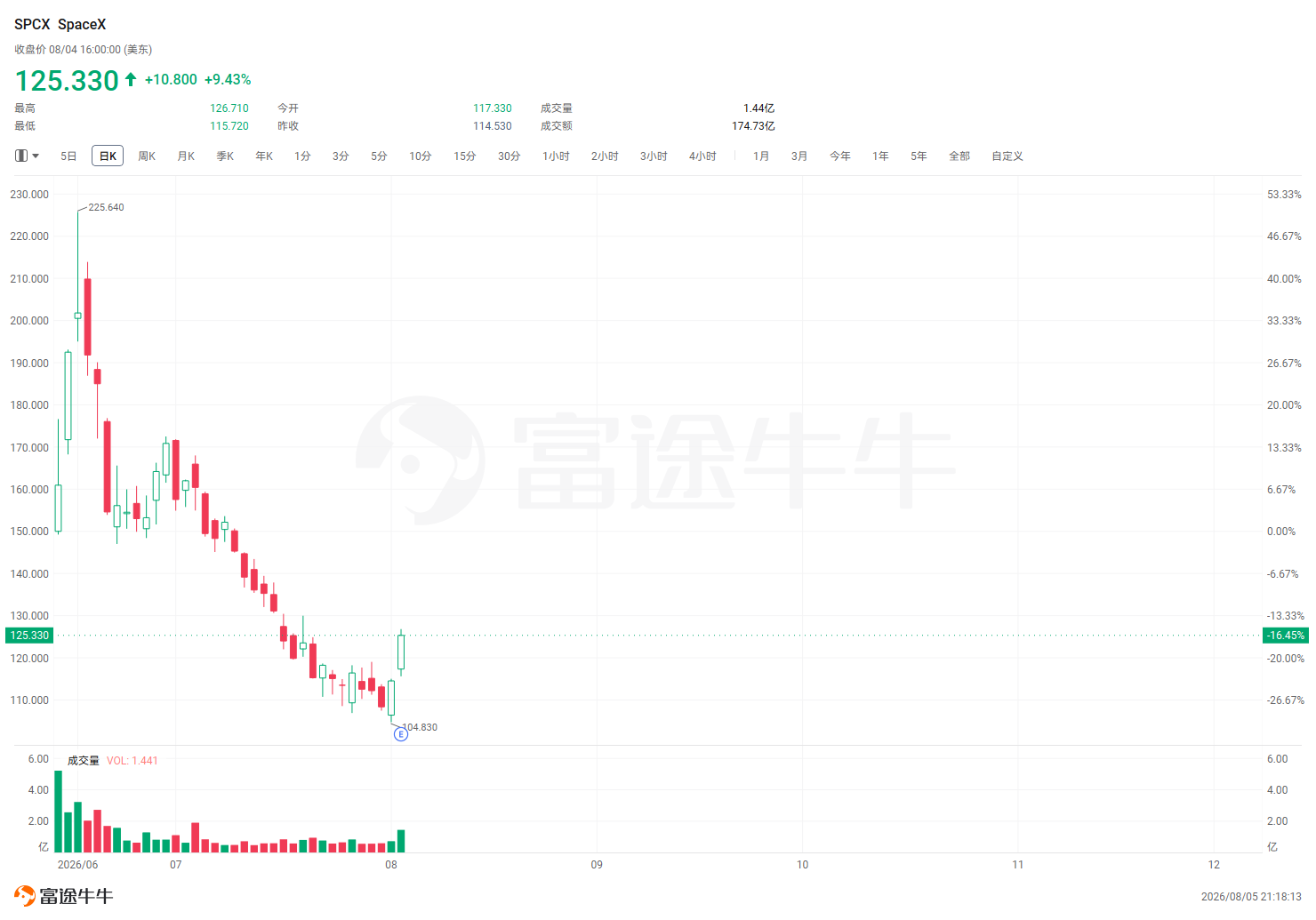
Mounting pressure from the upcoming lock-up expiration, combined with valuation disputes, has triggered a significant influx of short sellers.
According to S3 Partners, roughly 30% of the currently tradable shares are already sold short, generating paper profits of approximately USD 7 billion for short sellers—the dollar value of these short positions even exceeds that of Tesla’s short interest. Moreover, the phased structure of the lock-up expiration means Thursday is not the endpoint: by early December this year, SpaceX’s total freely tradable shares will surge from the current level of approximately 639 million to 5.33 billion, an increase of more than sevenfold.
The scale of this lock-up expiration is unprecedented, abruptly reshaping the supply dynamics.
At its IPO, SpaceX featured an unusually small public float—approximately 639 million publicly traded shares represented only a tiny fraction of the company’s total outstanding equity. Investors were effectively bidding for a very limited slice of the company, and this scarcity significantly underpinned its early valuation.
The 911.5 million shares unlocking on Thursday represent roughly 140% of the original public float. Combined, the potential pool of tradable shares would rise to approximately 1.55 billion. It should be noted that these shares already exist; the lock-up expiration does not dilute existing shareholders but rather grants employees and early investors their first opportunity for liquidity after years of holding.
The central market question is not whether all 900 million shares will be sold immediately, but rather who holds these shares and why they might choose to sell now. For many SpaceX employees, company stock has long formed a substantial component of their compensation, and for some, it may constitute the bulk of their net worth—making modest sales a rational diversification strategy. Venture capital funds, meanwhile, are constrained by their own fund lifecycles; even if they remain optimistic about SpaceX’s long-term prospects, they may opt to distribute proceeds or shares to limited partners at this IPO milestone.
Early investors have accumulated substantial paper gains, providing ample incentive to exit.
Although the stock price has recently experienced a sharp correction, early shareholders still hold substantial unrealized gains relative to their entry cost, which is the fundamental reason behind market concerns about selling pressure.
SpaceX was valued at approximately $400 billion in a private fundraising round one year ago. Earlier this year, SpaceX completed its acquisition of xAI. According to Bloomberg, that transaction assigned SpaceX an overall valuation as high as $1 trillion, with xAI valued at $250 billion—an outcome that delivered paper gains of several times their initial investments for many investors.
Even at Tuesday’s intraday price range of approximately $114 to $115, the level remains significantly above the cost basis of most early private investors, meaning that selling at current prices would still be profitable for them. The staged lock-up expiration schedule provides these investors with the flexibility to selectively realize gains at different price points over the coming months.
Short sellers have entered aggressively, but short squeeze risk also exists.
Expectations of share unlockings have become the core rationale behind short sellers’ bearish bets.
According to S3 Partners, as of July 29, approximately 219.3 million shares of SpaceX were sold short, representing about 34% of the float, with a dollar value of roughly $24.6 billion—exceeding Tesla’s short interest in dollar terms during the same period. Notably, short positions stood at only around 40 million shares as of June 23; they have surged more than fivefold in just over a month, reflecting how rapidly and comprehensively the market has priced in unlock-related risks.
However, this dynamic is not unidirectional. Short sellers ultimately need to buy back shares to cover their positions. If insiders sell fewer shares than expected on Thursday and institutional buying emerges concurrently, the large short interest could instead fuel a rebound in the stock price, triggering a short squeeze.
Over the past 12 trading days, SpaceX’s stock price has declined on 10 of them. Contributing factors include not only unlock expectations but also the aborted Starship rocket launch due to engine failure and broader rotation pressure as capital exits artificial intelligence–related stocks.
Thursday is just the beginning.
Rather than adopting the standard 180-day uniform lock-up expiration typical after an IPO, SpaceX has implemented a staggered, phased release mechanism designed to minimize disruption to market supply-demand dynamics while gradually expanding the float.
After August 6, an additional conditional trigger mechanism remains in place: if SpaceX’s share price reaches $175.50 on at least five of the ten trading days preceding the earnings announcement, up to an additional 455.8 million shares will become eligible for immediate trading following the release. Based on Monday’s closing price of $119.85, clearing this threshold would require a gain of over 46% from current levels—a hurdle widely viewed by the market as challenging.
Elon Musk holds approximately 7.8 billion shares, representing about 60% of total outstanding shares. His stake is subject to a lock-up period extending beyond one year after the company’s listing—i.e., at least until mid-2027—and thus will not contribute to near-term selling pressure from share unlocks.
Two key signals warrant close monitoring
Analysts note that investors should not assess the impact of the lock-up expiration based solely on Thursday’s single-day performance, but instead focus on two core indicators.
The first is trading volume. If abnormally high volume—significantly exceeding typical daily levels—emerges on Thursday and in the subsequent days, it suggests the market is absorbing genuine supply pressure rather than reacting emotionally to headlines about the unlock. Insider selling disclosures filed afterward will provide further details on who is selling, though they will not cover all employees and early shareholders.
The second is the IPO offer price of $135. While this price carries no special significance for fundamental valuation, it serves as a well-known reference point shared by both public investors and insiders. If the share price consistently recovers and stabilizes above $135 following the unlock, it indicates that market demand is effectively absorbing the expanded float. Conversely, if the price lingers persistently below the IPO price, it provides stronger incentive for early shareholders—whose cost basis is significantly lower—to sell.
SpaceX’s pronounced volatility has already spilled over into the broader new-issue market. According to Bloomberg data, the weighted average return of companies newly listed this year has fallen to -4.4%. Even excluding SpaceX and SK Hynix, the aggregate return for this year’s IPOs stands at just 5.3%, significantly underperforming the S&P 500’s 9.4% gain over the same period. Striking the right balance between enabling liquidity and stabilizing the share price will be the central challenge facing SpaceX and its underwriting syndicate in the months ahead.
Editor/lambor