
① Goldman Sachs estimates that Japan may have spent up to USD 85 billion over two days at the end of July to intervene in the yen, marking the largest such intervention since 2011, though the exchange rate response was limited; ② The United States participated for the first time by selling euros and buying yen, aiming to stabilize the yen while minimizing the impact on the U.S. dollar and Treasury markets; ③ Goldman Sachs believes the yen's weakness is primarily driven by interest rate differentials and capital outflows, and a single foreign exchange intervention is unlikely to alter the underlying long-term fundamentals.
Caixin News, August 5 (Editor: Xia Junxiong) — Japan and the United States recently conducted a rare coordinated intervention in the foreign exchange market to curb the rapid depreciation of the yen. In a report published on August 4, Goldman Sachs estimated that Japanese authorities may have purchased up to USD 85 billion worth of yen within just two days—July 30 and 31—marking the largest two-day foreign exchange intervention since the Fukushima nuclear disaster in 2011.

The United States not only provided policy support this time but also adopted the unusual operational approach of selling euros and buying yen, aiming to strengthen the yen while reducing the impact on the U.S. dollar and U.S. Treasury markets.
 However, Goldman Sachs noted that despite the large scale and high degree of coordination of this intervention, the yen’s appreciation response remained relatively muted. This suggests that the yen’s prior weakness largely reflected macroeconomic fundamentals, including interest rate differentials, economic outlook, and cross-border capital flows. Unless there are material shifts in the global growth environment, Japan’s monetary policy, or domestic capital allocation, interventions can at best provide the yen with a 'significant but temporary' reprieve.
Japan deployed up to USD 85 billion over two days
Based on indirect data such as the Bank of Japan’s liquidity forecasts and interbank market trading volumes, Goldman Sachs estimates that Japanese authorities likely spent JPY 7–8 trillion to buy yen on July 30 alone, setting a new record for single-day yen-buying intervention by Japan.
On July 31, Japan may have intervened again with JPY 4.5–5.5 trillion. The combined two-day intervention could have reached as much as USD 85 billion, exceeding the JPY 11.7 trillion (approximately USD 74 billion) deployed over one week between late April and early May this year.
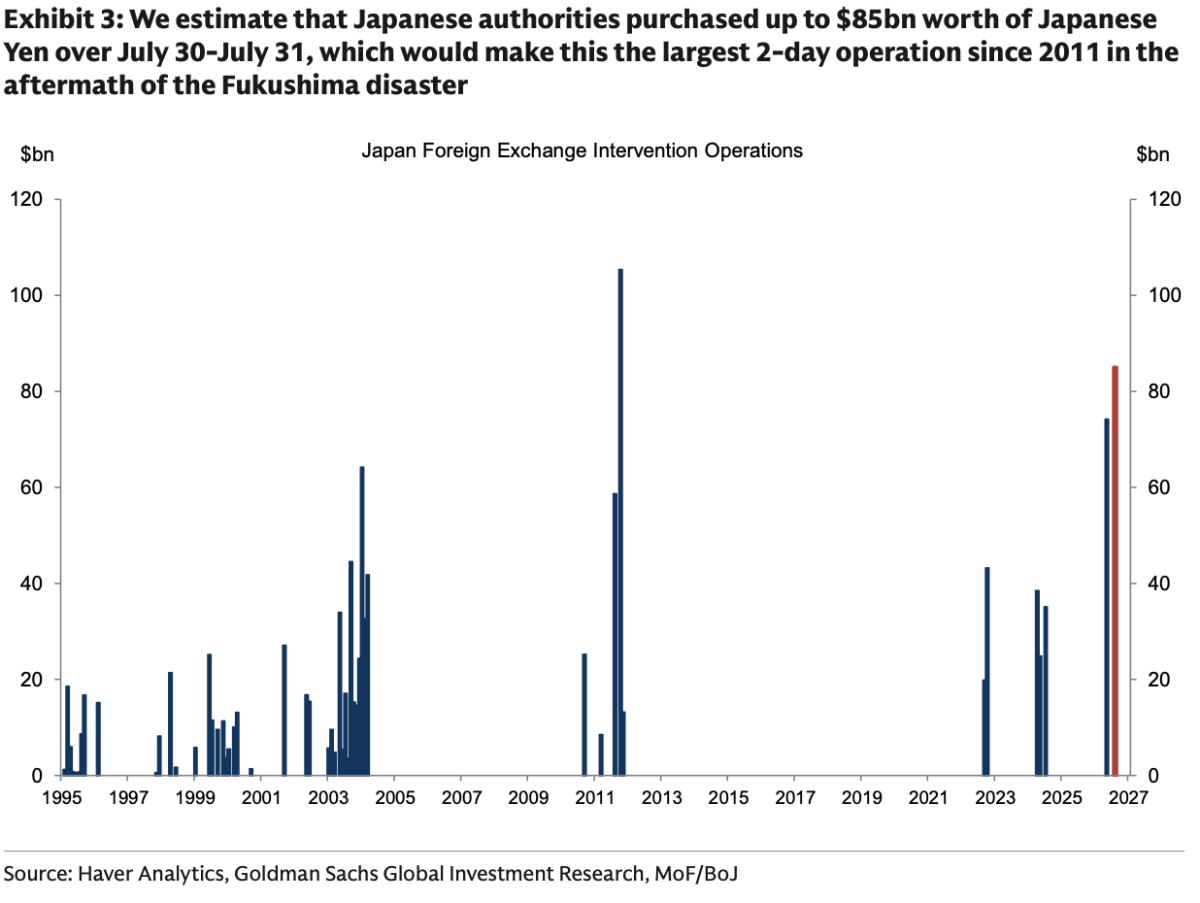
(Chart: Scale of Japan’s historical foreign exchange interventions)
On August 3, foreign exchange market trading volumes rose again, consistent with Japanese officials’ statements that intervention efforts were ongoing.
By comparison, the actual amount of funds committed by the United States was likely very small. Historically, U.S. foreign exchange interventions typically range from USD 1–2 billion per instance, meaning the primary role of the U.S. in this round was not to provide substantial funding but rather to send a policy signal through its participation.
Official figures still await release by Japan's Ministry of Finance. Japan discloses the total amount of intervention for a given month after settlement of that month’s transactions, while more detailed daily data are typically published more than a month after the end of each quarter. Goldman Sachs expects that daily data for the intervention conducted at the end of July could be released in early November.
The yen’s response remains limited.
Despite the unprecedented scale of U.S.-Japan intervention, such extensive policy efforts have yet to produce a commensurate appreciation in the yen.
Goldman Sachs believes this indicates that yen depreciation is not solely driven by speculative trading or market disorder, but rather by deeper fundamental forces. Among the most important factors is the persistent interest rate differential between Japan and major overseas economies.
Foreign exchange intervention can temporarily reduce market incentives to short the yen and mitigate excessive exchange rate reactions to economic data and policy announcements, but it cannot directly eliminate interest rate differentials. The report notes that while intervention enhances the Bank of Japan’s policy flexibility, it does not imply that the central bank will significantly accelerate its pace of rate hikes.
Goldman Sachs economists still consider it unlikely that the Bank of Japan will substantially increase the pace of rate hikes. Although faster tightening could help alleviate downward pressure on the yen, interest rate hikes are a broad-based policy tool affecting economic growth, government borrowing costs, and the Japanese government bond market, rather than a precise instrument targeted specifically at the exchange rate.
Moreover, recent foreign exchange interventions, fiscal measures, and arrangements related to the Government Pension Investment Fund and individual savings accounts do not signal that Japanese policymakers are preparing to fundamentally overhaul their current policy mix.
Capital outflows are a key driver of the yen’s prolonged weakness.
Goldman Sachs believes that, compared with simply raising interest rates, encouraging the repatriation of Japanese capital from abroad could be a more direct and powerful approach to providing long-term support for the yen.
Japan holds an enormous stock of international assets, a key distinction between Japan and countries typically associated with currency crises. Over the past decade, Japanese investors have consistently increased their allocations to foreign equities, bonds, and other assets. This capital outflow largely explains why the yen has remained persistently below fair-value levels suggested by certain valuation models.
If Japan can reverse this trend and steer domestic investors to reduce overseas allocations and redirect capital back to domestic markets, it would generate sustained yen buying pressure—potentially far more effective than a one-off foreign exchange intervention.
However, this approach also carries costs. Japanese investors have historically earned higher returns through overseas assets; if policy measures forcibly drive capital repatriation, they could reduce returns for pension funds, insurance companies, and household investors.
Thus, the Japanese government faces a core dilemma: it seeks to stabilize the yen without significantly accelerating interest rate hikes or sacrificing the returns generated by overseas investments. Under these circumstances, foreign exchange intervention becomes a relatively low-cost option in terms of both political and economic impact in the short term.
The United States unusually sold euros, aiming to stabilize both the yen and the dollar simultaneously.
In this coordinated intervention, the United States did not simply replicate Japan’s action of selling dollars to buy yen, but instead opted to sell euros and buy yen—conducting transactions in the euro-yen market.
According to Goldman Sachs, this may be the first instance of a country implementing an official foreign exchange intervention that does not involve its own currency at all. While there have been past cases where Japan and Europe intervened simultaneously in the dollar-yen and euro-yen markets, no country had previously deliberately used a third-party currency to neutralize the impact on its own currency.
This move carries dual implications.
First, market participants typically anticipate Japanese intervention in the dollar-yen market in advance. By shifting to the euro-yen market, the United States can disrupt speculators’ expectations and trigger broader unwinding of yen short positions.
Second, Japan’s sale of dollars could weaken the dollar against other currencies, while the U.S. sale of euros can offset some of that downward pressure on the dollar. In other words, the United States aims to maximize the impact on the yen while minimizing the adverse effect on the dollar.
However, the relative movements between the euro-yen and dollar-yen exchange rates suggest that the actual scale of U.S. transactions may have been limited, with the primary objective being to signal to the market that the United States and Japan share a degree of policy consensus on stabilizing the yen.
The absence of direct involvement by European authorities has also weakened the signaling effect of this intervention. Markets may therefore question whether Europe endorses the U.S. use of euros for intervention and whether it would be willing to join similar coordinated actions in the future.
What the United States is truly concerned about may be the U.S. Treasury market.
Goldman Sachs offers a cautious assessment of the U.S. Treasury’s motivation for participating. The report suggests that the U.S. action does not necessarily indicate a clear stance on the yen’s valuation, nor does it imply that the United States will push Japan toward more aggressive monetary policy adjustments.
A more plausible explanation is that the United States hopes to prevent Japan from significantly selling U.S. Treasuries to raise intervention funds—which could disrupt the U.S. Treasury market—through low-cost cooperation.
Japan’s recent intervention funds have primarily come from cash holdings and short-term U.S. Treasuries. Data from the U.S. Treasury’s International Capital (TIC) system show that during months when Japan conducted interventions, its holdings of short-term U.S. Treasuries typically declined noticeably, with the reduction roughly matching the scale of intervention.
Japan may first draw on its dollar deposits and subsequently replenish cash by selling short-term U.S. Treasuries or allowing them to mature without reinvestment. If no further intervention occurs afterward, its holdings of short-term U.S. Treasuries usually partially rebound the following month.
Historical data show that during Japan’s September 2022 intervention, the reduction in holdings was concentrated in long-term U.S. Treasuries, exerting a relatively pronounced impact on U.S. interest rate swap spreads. Subsequent rounds of intervention relied more heavily on cash and short-term securities, gradually diminishing the impact on the U.S. Treasury market.
Japan still has approximately USD 195 billion in short-term intervention capacity.
Although deploying up to USD 85 billion over two days is substantial, Japan does not face an imminent risk of depleting its foreign exchange reserves in the near term.
Japan holds approximately USD 980 billion to USD 1 trillion in dollar-denominated foreign exchange reserves, of which roughly USD 230 billion consists of cash and short-term securities. As of the end of June 2026, Japan’s Ministry of Finance held approximately USD 160 billion in deposits and USD 930 billion in securities assets.
Goldman Sachs assumes that approximately 90% of Japan’s foreign exchange reserves are denominated in U.S. dollars, and about 30.5% of its securities have maturities of less than one year, equivalent to roughly USD 255 billion. If cash and short-term securities can be utilized up to 70%, Japan originally had around USD 280 billion in readily deployable funds.
After deducting the USD 85 billion potentially deployed between July 30 and 31, Japan theoretically still retains approximately USD 195 billion in intervention capacity before it would need to more visibly sell longer-term securities.
The FIMA facility serves more as a deterrent than as a primary source of funding.
The United States has also encouraged Japan to use the Federal Reserve’s Foreign and International Monetary Authorities (FIMA) repo facility.
Through this facility, Japan can pledge its holdings of U.S. Treasury securities to the Federal Reserve in exchange for immediate U.S. dollar liquidity. In theory, if the Federal Reserve were to expand Japan’s access limit, Japan’s readily available dollar liquidity could increase from approximately USD 200 billion to nearly its entire USD 1 trillion reserve, though a certain safety buffer would still need to be maintained.
The FIMA facility was established in 2020 and currently has a per-user cap of USD 60 billion. Its only significant prior usage occurred in 2023, when the Swiss National Bank tapped the facility to secure dollar liquidity during UBS Group’s emergency acquisition of Credit Suisse.
Goldman Sachs views the FIMA facility as more of a signaling and deterrent tool for Japan rather than a core financing mechanism. On one hand, Japan already holds substantial short-term U.S. dollar securities; on the other, if intervention persists, Japan’s demand for dollars would not be temporary, and funds borrowed via repos would still need to be repaid upon maturity.
However, expanding the FIMA limit could signal to speculators that Japan possesses greater potential intervention capacity and alleviate market concerns about Japan’s concentrated selling of long-dated U.S. Treasuries. Goldman Sachs expects Japan may use the facility symbolically but will not rely on it as a dominant operational tool.
U.S. intervention capacity is not as limited as markets might assume.
While the U.S. Treasury and the Federal Reserve hold relatively small direct positions in Japanese yen and euro-denominated assets, their usable resources would significantly increase if Special Drawing Rights (SDRs) and other reserve assets are included.
More importantly, U.S. foreign exchange interventions have historically been relatively small in scale and have relied more heavily on policy signaling. Given that typical U.S. interventions usually amount to only USD 1–2 billion per operation, existing reserves do not pose a significant constraint.
If the Federal Reserve agrees to conduct unsterilized interventions, the theoretical funding constraint would be further reduced. Since the Fed can create U.S. dollars, the scale of interventions aimed at weakening the domestic currency primarily depends on whether policymakers are willing to accept asset losses and whether they are concerned that such interventions might send conflicting signals relative to monetary policy.
In principle, foreign exchange operations by the Federal Reserve require approval from the Federal Open Market Committee (FOMC). However, under conditions of severe market volatility and time constraints, authorization may be delegated to the FOMC’s Subcommittee on Foreign Exchange. If the cumulative intervention amount since the last FOMC meeting does not exceed USD 5 billion, or if there is insufficient time to consult the full committee, the authority may even be delegated to the Chair of the FOMC.
Historically, the U.S. Treasury’s Exchange Stabilization Fund and the Federal Reserve’s System Open Market Account have typically shared the costs of such interventions. During the 2011 G7-coordinated intervention, both the Federal Reserve and the U.S. Treasury contributed USD 500 million each.
IMF rules are unlikely to impose meaningful constraints on Japan.
According to the International Monetary Fund’s (IMF) technical criteria for freely floating exchange rates, a country should not intervene more than three times within a six-month period, and each intervention episode should last no longer than three business days.
However, Goldman Sachs believes this classification will not constitute a practical obstacle to Japan’s continued intervention. Officials at Japan’s Ministry of Finance have also downplayed the significance of this framework, stating that IMF rules will not limit their intervention activities.
More controversially, the IMF generally requires that interventions be used to address 'market disorder.' Goldman Sachs argues, however, that the current weakness of the yen remains consistent with macroeconomic fundamentals.
This once again underscores that the current intervention is primarily aimed at managing exchange rate volatility, rather than addressing the underlying causes of the yen’s long-term depreciation.
Editor/Deng