Jensen Huang described the funding as third-party capital, noting that financial institutions will conduct independent due diligence, and emphasized that AI demand is genuinely real. He stated that NVIDIA’s 'AI factory' holds long-term economic value and supports a broad ecosystem. NVIDIA has already partnered with six financial institutions—including Apollo, Blackrock, and Blackstone—to establish an independent financing platform. Nouriel Roubini, nicknamed 'Dr. Doom,' drew a parallel to the 2008 financial crisis, commenting, 'The next time these individuals sit together to explain AI financing, it might very well be at a congressional hearing in 2031...'
NVIDIA CEO Jensen Huang personally stepped in to defend the company’s plan—jointly launched with six major financial institutions—to mobilize over $500 billion in third-party capital for AI infrastructure financing. He explicitly stated that NVIDIA’s AI factory computing power is becoming an investable asset class, driven by real-world commercial demand, and that independent institutional investors will conduct due diligence on each project separately, emphasizing that this is certainly not the so-called 'circular financing' criticized by external observers.
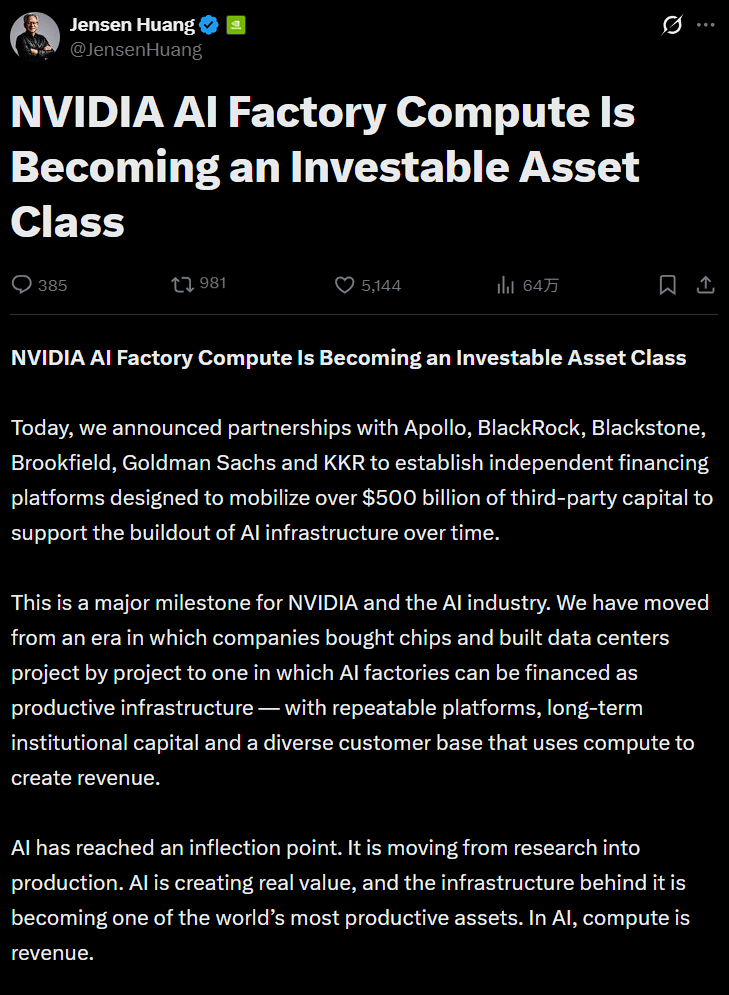
On August 10, Huang announced on social media platform X that NVIDIA has partnered with Apollo, BlackRock, Blackstone, Brookfield, Goldman Sachs, and KKR to establish an independent financing platform aimed at mobilizing over $500 billion in third-party capital over time to support AI infrastructure development. He stressed that the $500 billion represents the total amount of third-party capital the platform is designed to mobilize, 'neither NVIDIA’s revenue nor a commitment from a single fund or to a single customer.'
 Following the announcement, NVIDIA’s share price fell as much as 3.2%. The five-year credit default swap (CDS) spread, which measures the company’s credit risk, rose to 77.215 basis points on Monday—the largest single-day increase in two weeks—up approximately 5.3 basis points from the previous trading day. Analysts suggest this reflects growing market concern over NVIDIA’s potential credit risk under this massive financing model.
According to the Financial Times, citing informed sources, NVIDIA is seeking to form a consortium with Wall Street giants including Apollo, Blackstone, BlackRock’s Global Infrastructure Partners (GIP), Brookfield, Goldman Sachs, and KKR to raise up to $500 billion for AI infrastructure projects, earmarked for AI chip procurement, power generation, and data center construction.
After the report emerged, Jim Chanos, known as 'Dr. Doom,' posted a satirical comment comparing NVIDIA’s joint financing initiative with Blackstone and other financial titans to the financial engineering practices that preceded the 2008 crisis, implying that if the AI bubble bursts, the involved parties could face congressional scrutiny similar to that endured by Wall Street executives during the financial crisis.
AI Factories: From 'Buying Chips' to 'Financiable Infrastructure'
In his post, Huang systematically articulated the asset rationale behind NVIDIA’s AI factories, seeking to redefine the market’s conceptual framework for this business model.
He noted that the AI industry has moved beyond the era of 'companies purchasing chips project-by-project and building their own data centers' into a new phase where 'AI factories can be financed as productive infrastructure'—characterized by replicable platforms, long-term institutional capital backing, and a diversified client base generating revenue through computing power utilization.
Huang emphasized that NVIDIA’s computing power is not merely about chips but constitutes a complete AI factory platform encompassing accelerated computing, networking, system software, AI frameworks, and a global developer ecosystem.
He pointed out that a single NVIDIA AI factory can simultaneously serve multiple clients and diverse workloads, offering flexibility and substitutability; if one client’s needs change, the factory can be redeployed for another client, cloud service provider, or operator. 'This broad ecosystem provides NVIDIA’s computing power with a deep pool of potential users, helping to safeguard residual value.'
In the article, Jensen Huang characterized the aforementioned collaboration as 'the beginning of an open capital market for AI infrastructure.' He noted that these financial institutions are globally leading infrastructure investors with deep expertise in underwriting long-term productive assets, and that both parties will jointly create a replicable financing platform to support the construction of factories required by the AI ecosystem.
CUDA software continues to appreciate in value; the A100 remains commercially active six years after launch.
Jensen Huang emphasized the long-term economic value of NVIDIA's computing assets, substantiating his point with specific data.
He stated that continuous enhancements to CUDA software improve the performance, efficiency, and total cost of ownership of installed infrastructure, enabling AI factories to generate more intelligence at lower cost throughout their lifecycle, thereby extending their economic useful life.
Using the A100 as an example, Jensen Huang noted that NVIDIA launched the Ampere architecture-based A100 in 2020, and six years later, the product remains actively used in commercial applications for AI training, fine-tuning, inference, and high-performance computing. Customers continue to sign multi-year capacity contracts, and 'the A100’s economic lifespan is extending toward ten years.'
Regarding GPU leasing pricing, Jensen Huang cited market data indicating that the one-year lease price for the H100 rose from approximately $1.70 per GPU-hour in October 2025 to about $2.35 in March 2026. The median on-demand cross-provider price increased from around $2.00 in October 2025 to $2.70 in June 2026. Premiums for the Blackwell series are even more pronounced, with B200 cloud pricing ranging from approximately $5.30 to $7.05 per GPU-hour.
He argued that this data confirms the enduring economic value of NVIDIA's computing power.
Directly addressing concerns about 'circular financing'
In response to market concerns regarding 'circular financing'—the issue receiving the most attention—Jensen Huang included a dedicated Q&A section in his article to address it.
He explained that the financing structure was specifically designed to alleviate this concern. Demand originates from cutting-edge AI labs, AI-native startups, enterprise clients, cloud service providers, and nations building AI services—'the demand is real.' Each capital provider will independently conduct due diligence on every project, evaluating factors such as client creditworthiness, demand conditions, utilization rates, cash flows, and residual value. 'NVIDIA provides the platform; investors make independent financing decisions.'
Regarding NVIDIA’s own risk exposure, Jensen Huang disclosed that in certain cases, NVIDIA may provide residual value support of up to 25% for a single project, subject to 'prudent, case-by-case evaluation.' He emphasized that this percentage is 'significantly lower than other compute financing arrangements' and constitutes residual value support designed to complement—not replace—independent due diligence.
In closing his post, Huang placed AI factory construction within a broader historical context. He stated that every industrial revolution has been built upon infrastructure—electricity, transportation, communications, and computing—and that each wave of infrastructure development has relied on external financing. 'AI factories are the infrastructure of the intelligence era.'
He summarized AI’s business logic as a virtuous cycle: enterprises use AI to write software, discover drugs, design products, serve customers, automate operations, and build new services; more computing power yields better AI, better AI drives greater usage, greater usage generates more revenue, and more revenue fuels further investment in computing capacity.
"This is the virtuous cycle of the AI industrial revolution."
Huang stated that through this collaboration, NVIDIA and leading global financial institutions will jointly provide infrastructure financing for this industrial revolution, making AI factories more accessible to businesses, industries, and nations.
This collaboration is not NVIDIA’s first deep involvement in financing the AI supply chain. Previous reports indicated that NVIDIA was negotiating to provide up to $25 billion in financing guarantees for OpenAI and discussing a $350 billion financing arrangement for OpenAI’s chip procurement program. Last month, NVIDIA also announced an expansion of its partnership with South Korea’s SK Group, with the combined scale of their business exceeding $500 billion. These moves signal that NVIDIA is gradually transitioning from a chip supplier to the central mobilizer of capital within the AI infrastructure ecosystem.
"Dr. Doom" draws a parallel to 2008: Will the next congressional hearing be soon?
At the very moment Huang posted his message, James Chanos—a prominent Wall Street bear famously known as "Dr. Doom"—published a pointed comment on social media:
"The next time these individuals sit together to explain AI financing, it might well be at a congressional hearing in 2031..."
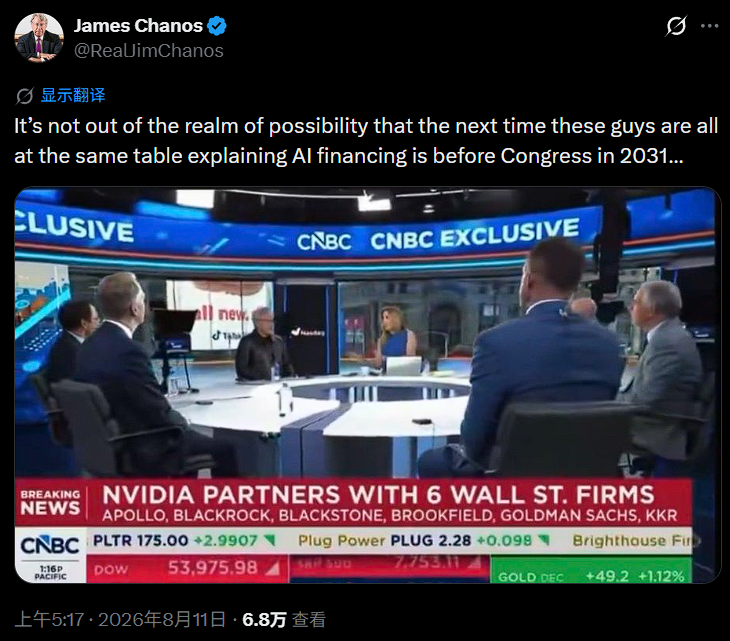
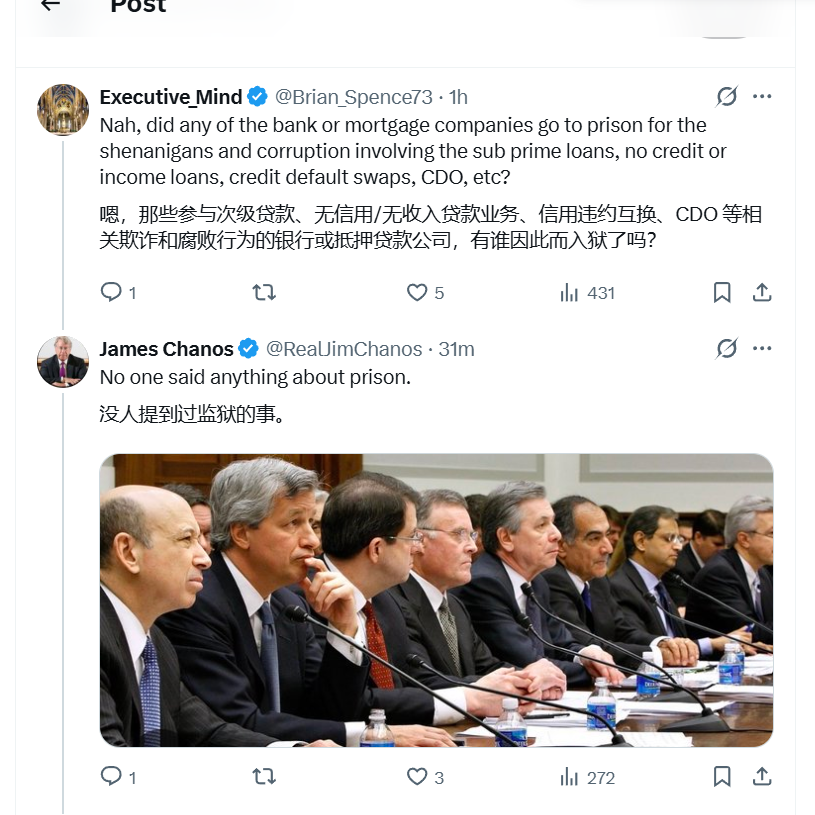
Chanos’s implication pointed to the 2008 financial crisis—when executives from major Wall Street financial institutions were compelled to appear before congressional hearings due to systemic risks triggered by subprime mortgages, credit default swaps, and complex financial instruments such as CDOs. He drew a parallel between NVIDIA’s current joint financing arrangement with Apollo, Blackrock, Blackstone, Brookfield, Goldman Sachs, and KKR and the financial engineering practices of that era, suggesting that if the AI infrastructure investment bubble bursts several years from now, Jensen Huang could find himself summoned to testify before Congress alongside those financial executives.
Notably, when someone asked in the comments beneath his post whether the parties involved might face criminal liability, Chanos explicitly stated: "Nobody said anyone’s going to jail."
Editor/lambor