
The yen weakened slightly against the U.S. dollar, approaching a key level that could fuel market speculation about renewed intervention by Japanese authorities to support the currency.
Zhitong Finance APP learned that the Japanese yen continued to weaken slightly in Tuesday's foreign exchange trading, approaching a critical level on the USD/JPY upside (indicating yen depreciation), which could reignite market speculation about renewed intervention by Japan’s Ministry of Finance to support the yen. Despite coordinated intervention by the U.S. and Japanese governments, the yen has once again neared 160 against the dollar—the core reason being that while foreign exchange intervention can alter short-term capital flows, it cannot change the fragile fiscal outlook, the yield differential, or the monetary policy reaction function that fundamentally determine the currency’s equilibrium level.
On Tuesday, with Tokyo markets closed for a public holiday, market volatility remained subdued, but foreign exchange traders were preparing for the yen’s depreciation path toward 160 per U.S. dollar—a key level that previously halted further yen weakness. During London trading hours, the yen slipped 0.1% to 159.39 per dollar.
 On Monday, the yen fell 1%—its worst single-day performance since mid-February—as the U.S. dollar strengthened against most G10 currencies. The yen has now retraced nearly half of its gains since July 31, when Japan and the United States conducted their first jointly coordinated intervention since 1998 to strongly support the yen.
Masayuki Nakajima, Senior Strategist at Mizuho Bank, wrote in a report: “If the USD/JPY exchange rate clearly breaks through the psychologically significant 160 threshold, concerns about intervention could intensify further.”
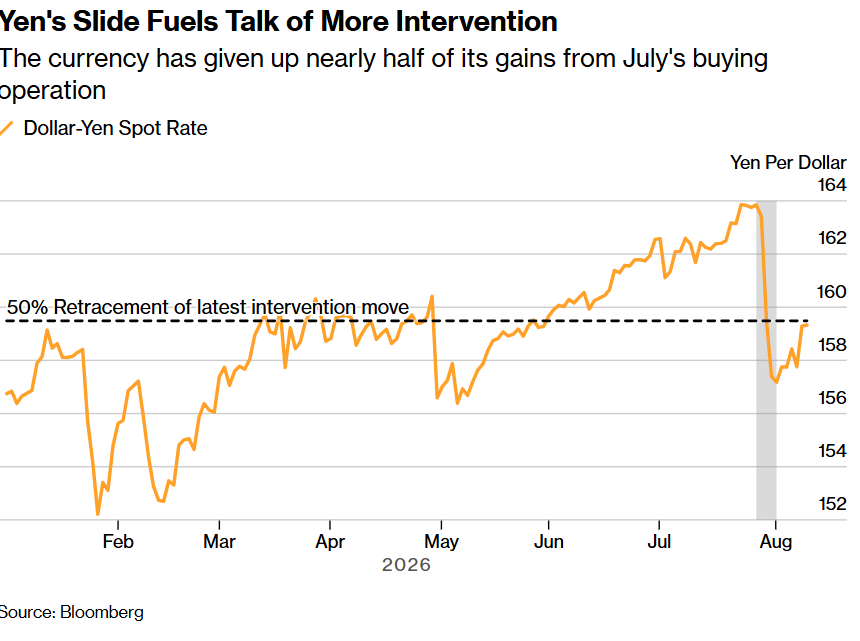
As illustrated in the chart above, the yen’s decline has reignited market discussions about further government intervention—the yen has already given back nearly half of the gains achieved from the U.S.-Japan joint intervention on July 31, which involved buying yen.
The U.S. government’s pledge, led by Treasury Secretary Bessent, to support the yen “at all costs” effectively masks its very limited intervention capacity.
The joint intervention helped the yen rebound from an extreme low of around 164 per dollar in late July—near a four-decade trough—and briefly pushed it up to 155 per dollar earlier this month.
Analyses by financial institutions based on Bank of Japan accounts suggest that relevant authorities, coordinated by the U.S. Treasury, likely deployed approximately $34 billion in foreign exchange market intervention on July 31 to support the yen. On the preceding day, Japanese authorities, acting under U.S. coordination, may have committed $53 billion; if officially confirmed, this would likely become the largest single-day foreign exchange intervention ever recorded in human history.
However, as market participants refocus attention on fundamental drivers, the yen has gradually weakened again. Even though officials in Tokyo and Washington have warned they stand ready to take joint action again if necessary, the substantial interest rate differential between the U.S. and Japan, concerns over Japan’s fiscal and monetary policy outlook, and geopolitical uncertainties continue to weigh on the yen.
For the Japanese government, the challenge is even more complex: it faces not merely a monetary policy dilemma, but a 'interest rates–fiscal policy–exchange rate' trilemma, creating a reflexive dynamic where more frequent interventions heighten the importance of policy credibility. Japan needs to raise interest rates to genuinely narrow the U.S.–Japan yield gap, but higher rates would increase financing costs for its extremely high government debt and push up term premiums on Japanese government bonds. If the government consequently remains cautious about rapid tightening by the Bank of Japan, markets will question how high it is truly willing to raise policy rates.
Moreover, if Japan continues to rely on its foreign exchange reserves to buy yen persistently, it could trigger a reallocation of global bond assets and generate spillover effects on already stressed U.S. long-end yields—an important backdrop behind the rare U.S. participation in this coordinated intervention.
Nearly $100 billion in interventions failed to prevent the yen from breaching 160! The true 'engine' driving yen short positions is not speculation, but the interest rate differential between the U.S. and Japan.
Around July 31, the U.S. and Japan conducted a rare joint intervention to buy yen, temporarily pushing USD/JPY down from approximately 163.99 to around 155.20. However, by August 11, the pair had rebounded above 159, retracing about half of that gain. The core issue lies in the fact that at its July meeting, the Bank of Japan maintained its policy rate at 1.0% by an 8-to-1 vote, with only Takahide Higuchi advocating an immediate hike to 1.25%. In contrast, U.S. monetary policy rates and yields on U.S. Treasury securities with maturities of 10 years or more remain significantly higher, sustaining the yield advantage of dollar-denominated assets and underpinning the economic rationale for yen carry trades.
Bank of Japan Governor Kazuo Ueda’s hawkish signal suggesting a possible acceleration in rate hikes has indeed led markets to view a September rate hike as increasingly plausible. However, anticipated rate hikes do not equate to an actual narrowing of interest rate differentials. As long as Japan’s real interest rates rise more slowly than consistently expected by financial market participants, the fundamental yield structure supporting yen shorts will not disappear.
The recent U.S. nonfarm payroll miss has effectively demonstrated that what truly enables sustained yen appreciation is not 'how much yen governments buy,' but whether the U.S.-Japan interest rate differential undergoes persistent compression. After U.S. nonfarm payrolls unexpectedly declined by 23,000 in July—far below the market expectation of an 80,000 increase—U.S. short-end yields plunged sharply, and USD/JPY dropped by 1.1% intraday to 156.68. This represented a textbook repricing based on fundamentals: markets revised down expectations for Fed tightening → U.S. yields fell → the dollar’s yield advantage narrowed → the yen strengthened. However, subsequent geopolitical risks in the Middle East drove oil prices sharply higher, reigniting U.S. inflation concerns and pushing U.S. Treasury yields back up, quickly restoring the dollar’s yield support and sending the yen back toward 160.
U.S.-Japan joint intervention appears more aimed at raising the cost of shorting, compressing leverage, and creating 'two-way risk' during episodes of disorderly one-sided exchange rate moves, rather than permanently altering the equilibrium level of USD/JPY. Consequently, although short positions have contracted significantly following the joint intervention, they could easily rebuild if the Bank of Japan fails to further tighten monetary policy in line with market expectations for real interest rates.
Editor/Deng