“Compute power as collateral: Six Wall Street titans join forces with a $500 billion financing commitment—America used this playbook to revitalize railroads, aviation, real estate, and power infrastructure.”
The move on August 10 could be NVIDIA’s boldest strategic play since CUDA.”
$NVIDIA (NVDA.US)$NVIDIA is partnering with Wall Street to transform AI chips into a new class of securitizable assets, aiming to open financing channels for small and medium-sized AI enterprises unable to afford high-priced GPUs.
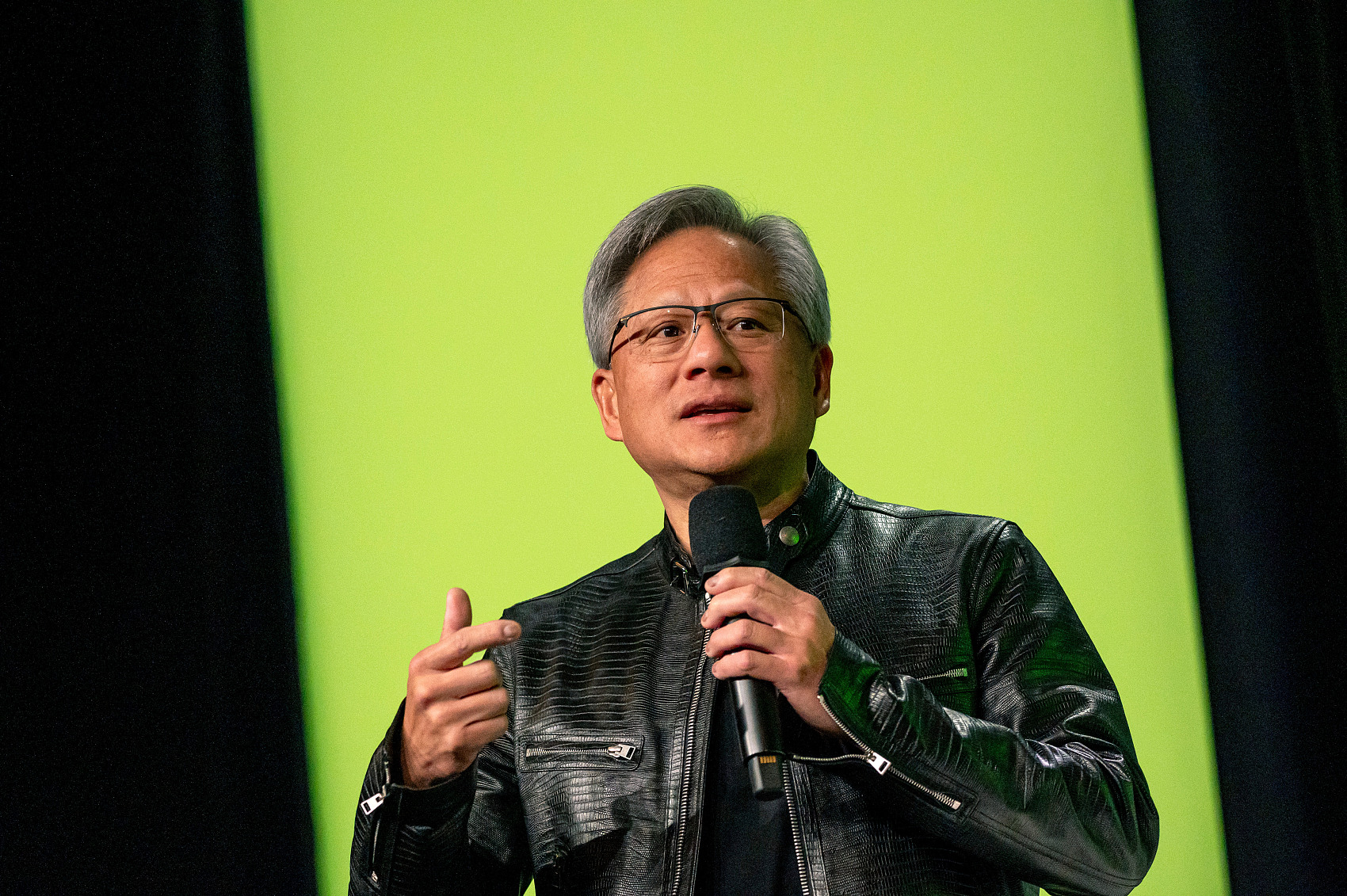
 According to The Wall Street Journal on Tuesday, NVIDIA CEO Jensen Huang announced this week a strategic partnership with Apollo Global Management, BlackRock, Blackstone, Brookfield Asset Management, Goldman Sachs, and KKR, targeting the creation of a chip-financing ecosystem with a potential scale of up to $500 billion.
This framework will use NVIDIA’s AI hardware as underlying collateral to issue public and private debt instruments to institutional investors such as pension funds, insurance companies, and sovereign wealth funds. Proceeds will be channeled into dedicated platforms to finance or lease AI chips for AI enterprises. To date, no actual fundraising has been completed under this collaborative framework. This initiative unfolds against a market backdrop of surging demand for AI compute capacity coupled with rising financing costs, pushing smaller AI firms further to the margins of the bond market as they are crowded out by the abundant debt issuance from highly rated tech giants.
BlackRock CEO Larry Fink likened the current moment in AI compute financing to the emergence of mortgage-backed securities markets in the 1970s. From railroad bonds to MBS, each U.S. infrastructure boom has leveraged securitization to mobilize capital—this time, it’s GPUs.
“Compute power as collateral: Six Wall Street titans join forces with a $500 billion financing commitment—America used this playbook to revitalize railroads, aviation, real estate, and power infrastructure. The move on August 10 could be NVIDIA’s boldest strategic play since CUDA,” said Byrne Hobart, an independent analyst covering technology and finance in his newsletter.
Critics, however, warn that using rapidly obsolescing chips as collateral carries inherent risks of accelerated depreciation, and NVIDIA’s partial credit support arrangements have fueled persistent concerns about potential 'circular financing.'
Financing constraints are driving financial innovation
$NVIDIA (NVDA.US)$The core dilemma lies in the fact that its most valuable customer segment—numerous small and medium-sized AI labs, cloud computing firms, and enterprise users—often lacks the capital to directly purchase expensive chips, a challenge further exacerbated by today’s high-interest-rate environment.
According to Bank of America Global Research, AI-related bonds issued by major technology companies, data center projects, and chip financing vehicles totaled $344 billion as of early August this year, an increase of over $200 billion compared to the full-year total for 2025. However, this surge in supply has largely come from investment-grade-rated tech giants such as Meta, Alphabet, and Amazon, making it increasingly difficult for borrowers with weaker credit profiles to secure footing in the bond market.
This month, AI cloud provider CoreWeave completed a $2.6 billion loan financing at a yield exceeding 9%, or 550 basis points above the benchmark rate—125 basis points higher than underwriters’ initial pricing expectations. Last month, Galaxy Digital issued $3.5 billion in high-yield (junk) bonds to finance the construction of a data center in Texas leased to CoreWeave, with investors demanding a yield close to 10%. These cases clearly illustrate the funding pressures currently faced by lower-quality AI borrowers.
Chip Securitization: The Logic Behind a New Asset Class
The core mechanism of this collaboration involves securitizing AI chip assets through a special purpose vehicle (SPV). Specifically, investors purchase debt issued by the SPV, which uses the proceeds to acquire NVIDIA hardware and then leases the equipment to end clients. These clients pay rent to the SPV, which in turn uses the cash flows to service principal and interest payments to investors.
Participants characterize this structure as a new asset class akin to aircraft, credit card, or mortgage-backed securitizations. The underlying logic is that NVIDIA AI chips are in short supply; if one client defaults, another will quickly step in, thereby providing debt investors with relatively stable cash flow protection. For debt investors who are bullish on the AI sector overall but wish to avoid exposure to any single borrower’s credit risk, such instruments hold certain appeal.
Jensen Huang stated on X,$NVIDIA (NVDA.US)$In certain projects, a “residual value support mechanism” may be employed, under which NVIDIA would backstop up to 25% of project costs using its own balance sheet. This arrangement means that if an end user defaults and the underlying asset value falls below a predetermined threshold, NVIDIA would absorb the resulting loss shortfall. For reference, competitor Broadcom provided similar support in a $35 billion chip leasing facility arranged in June by Apollo, Blackstone, and a group of banks for Anthropic, with disclosed maximum exposure reaching as high as $29 billion.
Collateral Quality and Revolving Financing Controversies
Two primary concerns surround this new financing framework.
First is the stability of chip‑related collateral values. Jack Ablin, founding partner of Cresset, a family office with $260 billion in assets under management, stated: "This…"$NVIDIA (NVDA.US)$Of course, it’s a positive development—its customers need access to capital. However, if you’re a debt investor using computing power as collateral, historically, the shelf life of such assets has been as short as that of lettuce.” Jensen Huang countered by noting that NVIDIA’s customers are still using previous-generation chips, demonstrating that the hardware retains value long after its initial release. Executives involved in the arrangement also emphasized in television interviews that NVIDIA chips are in extremely short supply, making them high-quality collateral distinct from conventional computer processors that rapidly depreciate.
The second concern is the risk of circular financing. NVIDIA has previously faced criticism for investing in companies purchasing its chips or using its own balance sheet to guarantee their financing. In a report published Tuesday, Morgan Stanley analyst Joseph Moore wrote that introducing third-party capital and credit decisions ‘should theoretically alleviate concerns about circular financing... but could also polarize the debate further.’
Michael Burry, an investor known for shorting mortgage-backed securities and recently betting against AI stocks like NVIDIA, stated plainly on Substack: ‘Credit structuring is a natural component of the financial system. But what’s truly concerning is when unnatural credit is structured during the late stages of a bull market purely to sustain momentum.’
Whether this financing structure can truly be implemented ultimately depends on the willingness of debt investors to accept it. To date, no actual fundraising has been completed under the aforementioned collaborative framework, and the specific terms will largely be determined by market demand.
Underwriters must address core questions such as: How will the cash flows of the underlying assets evolve if AI infrastructure development slows, or if projects are delayed or canceled? If NVIDIA’s technological breakthroughs cause older chips to lose value more rapidly, is the collateral’s cushion sufficient? The answers to these questions will determine how much real capital flow this ‘financing pipeline’—linking AI computing power to global capital markets—can actually deliver.
Editor/melody