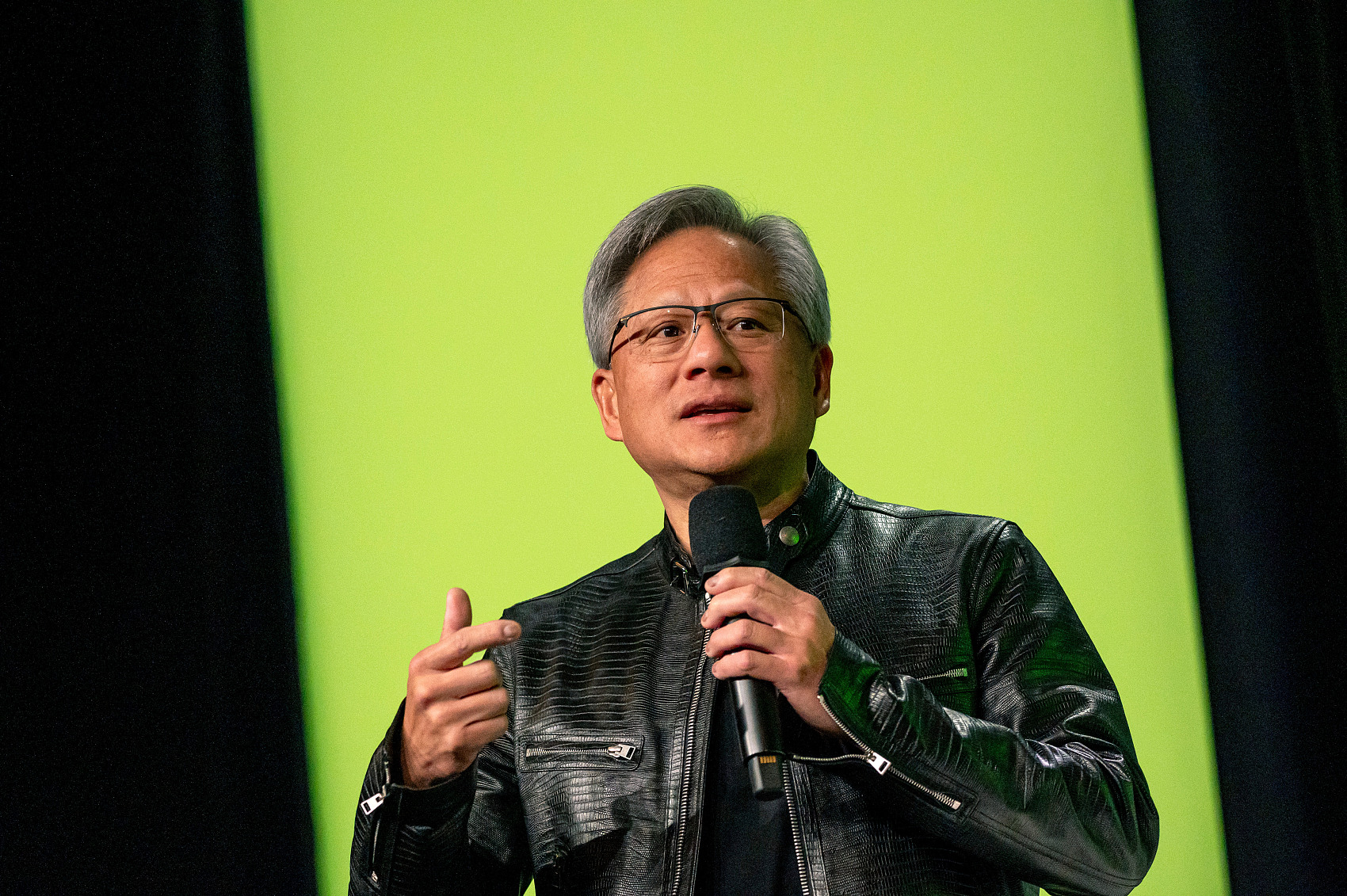
This bold wager involves securitizing receivables from AI chip leases to create a new class of financial assets. The core logic is that chip demand, driven by the AI boom, will keep chip prices elevated for an extended period. Jensen Huang cites the A100 chip’s better-than-expected value retention as evidence and offers a 25% residual value guarantee. The fundamental risk lies in whether this model can break the iron law of rapid depreciation for tech products, given the fast pace of chip technology iterations and uncertain demand.
$NVIDIA (NVDA.US)$ It is joining forces with Wall Street to bet on a disruptive proposition: Can AI chips break the financial iron law of rapid depreciation for technology products?
NVIDIA announced this week that it is partnering with Wall Street giants—including Apollo, Blackstone, Global Infrastructure Partners (GIP) under BlackRock, Brookfield, Goldman Sachs, and KKR—to raise up to $500 billion for AI infrastructure projects through a consortium. The funds will be used for AI chip procurement, power generation, and data center construction, with these financial giants providing semiconductor leasing financing to technology companies.
 On August 13, according to the Financial Times, financial executives involved in the deal revealed that the core logic of this plan is that chip demand driven by the AI boom will keep chip prices at high levels for a longer period, far exceeding the expectations of most analysts previously. NVIDIA CEO Jensen Huang stated that this transaction will create a new asset class with chips as the underlying assets, opening the door to the private capital industry, which stands at $22 trillion in scale.
However, this grand vision faces fundamental risks: whether financial institutions can accurately assess the durability of demand and long-term value of NVIDIA chips remains uncertain. Unlike leasing cars or commercial aircraft, chip technology iterates rapidly and demand fluctuates sharply, leading to high uncertainty regarding their long-term value. This $500 billion gamble is essentially a historic bet on whether the demand for AI computing power can sustain itself and whether chips can become reliable financial assets.
Deal Structure: Private Capital Enters the Market, NVIDIA Shifts Off-Balance-Sheet Pressure
The core architecture of this transaction involves securitizing chip leasing receivables and selling them to debt buyers such as insurance companies.
According to the Financial Times, private capital firms such as Apollo, KKR, and Brookfield plan to bundle GPU leasing contracts into securities, leveraging large-scale funds from the insurance asset pools they manage. Some institutions are considering establishing special purpose financing vehicles and, referencing the Collateralized Loan Obligation (CLO) structure commonly used in private equity acquisitions, tranching chip assets to cater to investors with different risk appetites.
"You can finance GPUs by tiering them according to different risk levels, similar to CLOs," said an executive involved in the transaction. However, others expressed reservations, noting that "the financing approach will vary across institutions."
For NVIDIA, this arrangement also holds significant financial implications. Bank of America analyst Vivek Arya pointed out this week that the involvement of Wall Street financial institutions means NVIDIA can gradually exit the "vendor financing" model—where NVIDIA previously provided guarantees directly to customers to assist them in raising capital in the capital markets.
"The burden is borne by the consortium rather than NVIDIA's balance sheet," Arya stated, which is a clear positive for NVIDIA.
Core Controversy: Can Chips Defy the Iron Law of Technological Depreciation?
The greatest uncertainty surrounding this transaction lies in whether the long-term value of chip assets is sufficient to support financialization.
Traditional financial logic has always been cautious toward technology assets. Currently, for debt supported by chip leasing, most lenders require full repayment within three to five years, operating on the assumption that the underlying assets will approach zero value thereafter. Unlike leased cars or commercial aircraft, which have mature secondary markets in the event of customer default, chips have almost no reliable buyers once they become technologically obsolete.
Ben Bajarin, a technology analyst at Silicon Valley-based Creative Strategies, bluntly highlighted the risks:
"The entire scheme presupposes continuous investment. There is a risk of overbuilding, demand may slow down, and models may improve, reducing the need for such extensive computing power."
Furthermore, chip buyers or lessees must simultaneously build data centers, meaning that expected revenue streams will significantly lag behind expenditure plans, further exacerbating cash flow pressures.
NVIDIA's Rebuttal: Older Chips Continue to Create Value
In response to skepticism, Jensen Huang backed his logic with actual data.
An article by Wallstreetcn stated that Jensen Huang posted on the social platform X this Monday, noting that leasing prices for NVIDIA's recent chips have risen, and even its A100 chips, launched six years ago, remain in use, exceeding their initial expected lifespan. He has previously emphasized multiple times that even older H100 chips retain value far beyond market expectations due to the explosive growth in computing power demand.
NVIDIA's strategy goes further. The company actively extends the lifespan of its chips by continuously updating its software platform, CUDA. The CUDA platform is central to NVIDIA's dominance in AI processing, enabling customers to use GPUs originally designed for graphics to accelerate AI applications.
Bajarin believes that robust demand for chips across all categories is expected to support NVIDIA’s solutions in the medium term, while long-term success will depend on the company’s ability to continuously reduce the total cost of ownership of its products.
Regarding risk-sharing mechanisms, NVIDIA has also made substantial commitments: it guarantees that chips will retain at least 25% of their residual value during the lease term, with the chip giant—valued at $5.3 trillion—absorbing initial losses.
According to the Financial Times, an executive involved in the $500 billion transaction stated, "GPUs have intrinsic value. NVIDIA has a ten-year track record for GPU leasing unit prices," characterizing NVIDIA’s guarantee as "first-loss protection" in future financing, meaning the company will absorb early value losses that exceed expectations.
Despite lingering risks, enthusiasm on Wall Street has already been ignited.
Jon Gray of Blackstone and Larry Fink of BlackRock have both publicly stated that their institutions intend to deploy capital to capitalize on the massive demand for newly built data centers, which will be used to train and operate the latest AI models.
The report noted that another executive collaborating with NVIDIA predicted that GPU leasing would drive pricing standardization and create economies of scale for AI companies. He stated that as "people gradually figure out the ropes," investors in the public debt market will eventually enter this space, enhancing the liquidity and tradability of this asset class.
Analysts believe the key to this process lies in whether the market can reach a consensus on the long-term value of chips. If NVIDIA’s 25% residual value guarantee withstands market scrutiny, the securitization of chip leases could become another mainstream asset category spawned by the AI investment wave, following debt for data center infrastructure. However, if AI demand cools and the growth rate of computing power demand slows, this $500 billion gamble led by Jensen Huang will face a severe stress test.
Editor/lambor