
Record-breaking joint foreign exchange intervention by Japan and the United States failed to reverse the yen's weakness. Instead, it provided carry traders with an opportunity to rebuild short yen positions at higher levels. In the face of wide interest rate differentials, any effort to support the yen may simply serve as a new entry point for short sellers.
The joint intervention by Japan and the United States in late July, totaling approximately $87 billion, yielded only a brief rebound in the exchange rate. According to market observers such as JPMorgan Private Bank and State Street Bank & Trust, hedge funds had halved their short yen positions by August 4. However, some investors have begun to return to yen-funded carry trades, causing the yen to give back half of its post-intervention gains and approach the 160 level.
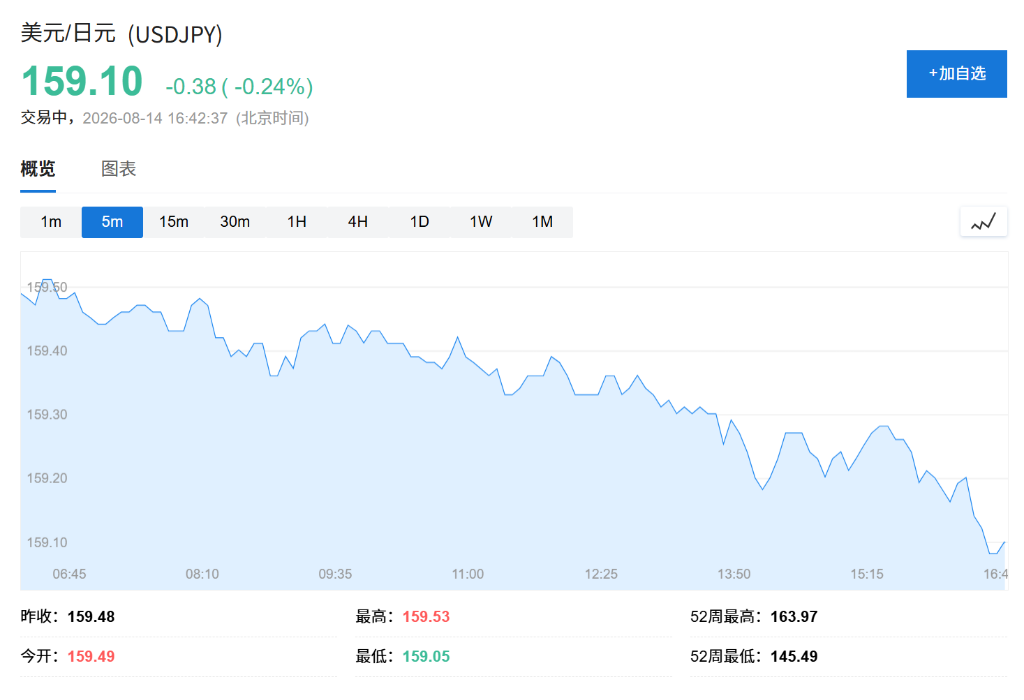
In response to the yen's renewed weakness, the Sanae Takaichi government supports a rate hike by the Bank of Japan (BOJ) in September or October. Overnight index swaps indicate that traders have priced in a 25-basis-point rate hike by the BOJ before October. Nevertheless, Japan's policy rate of 1% remains lower than that of most developed economies, leaving the interest rate differential unchanged and the appeal of carry trades undiminished.
 Details of the intervention scale further underscore its limitations: approximately $53 billion on July 30 (which would be the largest single-day intervention on record if confirmed) and about $34 billion on July 31. Carry trade funds showed the greatest interest in the Australian dollar, followed by the euro, U.S. dollar, Canadian dollar, and British pound, which together constitute the primary counterparties in yen-funded carry trades.
Intervention becomes a short-selling opportunity for carry traders
Ashwin Binwani, founder of Alpha Binwani Capital, bought into the USD/JPY pair around 157, betting on yen weakness; the exchange rate has since risen to 159.27. "Intervention provides an excellent opportunity to sell the yen at higher levels," said Binwani. "We are not deterred by authorities' actions; the returns from carry trades are too attractive to miss."
After hedge funds halved their short yen positions by August 4, some capital has begun to flow back. Damien Loh, Chief Investment Officer at Ericsenz Capital, also re-entered long USD/JPY positions near 157 following the previous round of intervention. In addition to positive carry, this position hedges other short USD exposures in the portfolio. However, the act of investors rebuilding short positions itself increases the likelihood of further intervention by authorities.
Government backs autumn rate hike, but interest rate differential remains unchanged
Reports indicate that the Sanae Takaichi government supports a near-term rate hike by the Bank of Japan, with the next move potentially occurring in September or October. Overnight index swaps show that traders have priced in a 25-basis-point rate hike by the BOJ before October, but this is insufficient to significantly narrow the interest rate differential with the United States.
Japan's policy rate of 1% is lower than that of most developed economies, and fiscal concerns are exerting additional pressure on the yen. In the bond market, the yield on 10-year Japanese Government Bonds (JGBs) has risen to 2.883%, reaching a new high since 1996, while the 40-year yield has climbed to 4.055%. The term spread between 10-year and 2-year JGBs has widened to 1.4 percentage points. George Efstathopoulos, Portfolio Manager at Fidelity International, stated:
As long as the Bank of Japan remains behind the curve, yen-funded carry trades will continue to thrive.
The Australian dollar and the euro have emerged as primary counterparts, raising alarms in the forward market.
Bart Wakabayashi, manager of State Street Bank & Trust’s Tokyo branch, stated that the bank’s proprietary data shows real money accounts are maintaining carry trade positions by selling the yen against a basket of G10 currencies, with the strongest interest in the Australian dollar, followed by the euro, the U.S. dollar, the Canadian dollar, and the British pound. During the joint intervention in late July, the U.S. Treasury coordinated sales of the euro and purchases of the yen.
The rise in one-year yen forwards is triggering caution in Tokyo, a trend typically associated with direct U.S. dollar buying, as traders reload carry trade positions amid the post-intervention rebound. This year, returns from shorting the yen against the Colombian peso, Turkish lira, and Norwegian krone have all exceeded 10%. Yuxuan Tang, Head of Asia Rates and FX Strategy at JPMorgan Private Bank, noted, “Unless there is a significant decline in the U.S. dollar and U.S. Treasury yields, carry traders may push USD/JPY to retest the 162 level.” She added that the market also recognizes that repeated interventions are becoming increasingly costly for Japan.
U.S. Treasury Secretary Bessent reiterated support for stabilizing the yen, warning that yen weakness could trigger broader depreciation across Asia, and stating that Washington would support Japan “at all costs.”
The Bank of Japan’s monetary policy meetings in September or October, along with whether authorities will intervene in the market again, will be critical junctures determining the trajectory of carry trades and the yen’s exchange rate.
Editor/Deng