1. As a massive volume of shares is set to become tradable, SpaceX's shareholder list has finally been unveiled; 2. Over 1,500 investors have disclosed their holdings, yet just 23 institutions account for more than 80% of the total disclosed shares. Nearly 1,340 investors hold fewer than 100,000 shares each, and their combined holdings represent less than 1% of the total reported shares.
As a massive volume of shares is set to become tradable, $SpaceX (SPCX.US)$ the shareholder list has finally been unveiled, with the stock closing up 4.45% on Monday.
Reports indicate that over 1,500 investors have disclosed their holdings, but only 23 institutions account for more than 80% of the total disclosed shares. These 23 institutions, each holding 10 million shares or more, collectively represent 83% of the disclosed shares.
 The concentration at the other end of the equity spectrum is even more striking: nearly 1,340 investors hold fewer than 100,000 shares each, and their combined holdings amount to less than 1% of the total reported shares.
Since its listing on June 12, these disclosures have provided the first comprehensive view of SpaceX's equity structure. Large investment management firms are required to report their U.S. equity holdings quarterly, and the latest disclosure list features several well-known institutions with substantial positions.
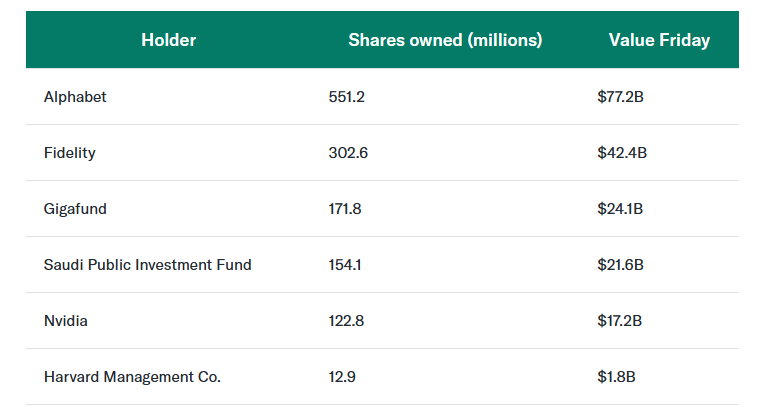
Alphabet, Google's parent company, leads with a holding of over 551 million shares, while Fidelity Investments holds more than 302 million shares. It is important to note that Fidelity's position represents the aggregate holdings of multiple funds and accounts, rather than a single large investment. Additionally, venture capital firm Gigafund, the Saudi Public Investment Fund, and NVIDIA have each disclosed holdings exceeding 100 million shares.
The breadth of this shareholder list is remarkable, encompassing major technology companies, venture capital firms, sovereign wealth funds, traditional asset managers, and even Ivy League universities.
Harvard University may be the most surprising entrant. It holds nearly 13 million shares of SpaceX, making it the largest single-stock holding in the U.S. equity portfolio publicly disclosed by Harvard Management Company.
Saudi Arabia's position is also linked to Elon Musk's past experiences. As early as 2018, Musk stated on Twitter that he was considering taking Tesla (TSLA) private at $420 per share, claiming that "funding was secured." Musk later indicated that discussions with the Saudi fund convinced him that financing could be obtained, an episode that ultimately led to litigation and a settlement with the U.S. Securities and Exchange Commission (SEC).
Some of the aforementioned SpaceX holdings were not recently acquired. Long-standing private equity investors who participated before SpaceX went public are appearing in quarterly public filing reports for the first time as the company begins trading publicly.
A massive wave of lock-up expirations is imminent.
This equity disclosure coincides with a critical timing window.
Early shareholders of SpaceX were restricted from immediately selling off most of their shares following the IPO. These restrictions are currently being lifted in stages, steadily increasing the number of shares available for sale. At the beginning of this month, approximately 912 million shares became unlocked. Contrary to expectations that increased supply would drive down prices, SpaceX’s stock rose by 6% on August 6 and another 16% the following day.
Timing was key. At that time, SpaceX’s share price had fallen from an intraday high of over $225 to around $105, with its market capitalization shrinking by more than half from peak to trough. The first major wave of lock-up expirations arrived only after the stock had undergone a deep correction.
However, the current situation appears markedly different.
Approximately 319 million shares will become unlocked this week, with additional tranches scheduled to expire every few weeks throughout the autumn. Meanwhile, SpaceX’s share price has rebounded to near $150—the price at which the company priced its initial public offering on June 12—marking the most significant technical challenge the stock has faced since its IPO.
Thus, the initial massive unlock actually occurred when SpaceX’s share price was near its lows, whereas subsequent rounds of unlocks are taking place after the stock has already rebounded by approximately 40%.
Editor/lambor