
Deutsche Bank notes that amid the global AI boom, Japan’s semiconductor and electronic component sectors are experiencing a phenomenon of “rising prices with flat volumes,” with capacity expansion significantly lagging behind South Korea. The root cause lies in structural labor shortages and resource misallocation: market rigidity stemming from the lifetime employment system, extremely low elasticity of substitution between capital and labor, and an insufficient supply of STEM talent collectively constrain companies’ willingness to unlock potential and expand production, making it difficult for them to translate AI opportunities into actual capacity.
The global AI investment boom has spurred massive demand for semiconductors and electronic components, driving up Japan’s export prices. However, export volumes have remained virtually stagnant. In contrast to South Korea’s robust performance, characterized by simultaneous growth in both volume and price, Japan’s manufacturing sector appears to be missing a historic industrial opportunity.
According to Zhuifeng Trading Desk, a research report released on August 19 by Kentaro Koyama, Chief Economist at Deutsche Securities, attributes the root of this paradox not merely to insufficient capital investment, but to deeper structural bottlenecks in the labor market. Labor market rigidity and corporate short-sightedness jointly hinder the reallocation of labor resources to high-growth industries. The report points out that this structural issue is constraining Japanese companies’ ability to seize opportunities in the AI era.
 The report argues that the aforementioned dilemma directly affects the implementation effectiveness of the Japanese government’s growth strategy. The Takachi Cabinet has set a target to channel large-scale domestic investment into 17 strategic sectors, including manufacturing. However, if structural issues in the labor market remain unresolved, these investments may fail to translate into genuine capacity expansion.
Divergence Between Volume and Price: The Split Between Japan and South Korea
Accelerated AI-related investment is driving global data center construction, leading to a sharp surge in demand for semiconductors and memory chips. Japan, South Korea, and China's Taiwan Province are all key global supply hubs; however, the benefits they derive from this cyclical upturn differ significantly.
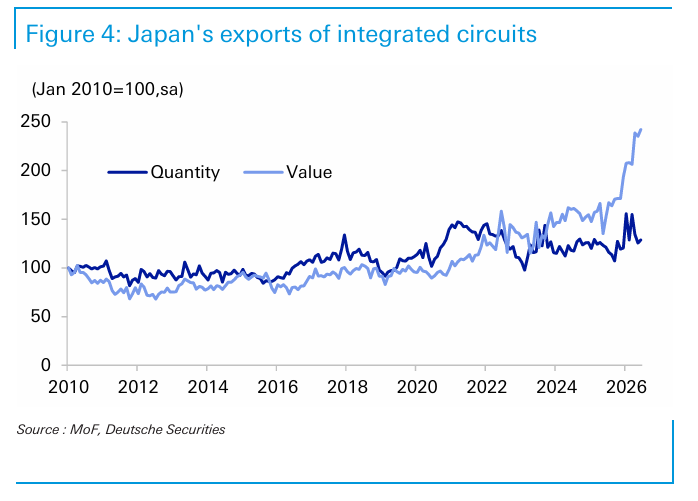
Trade data since 2025 shows that electronics export volumes from South Korea and China's Taiwan Province have grown substantially, while Japan’s export volumes have remained largely flat. Meanwhile, export prices in all three regions have trended upward, confirming the existence of genuine market demand. In the category of electronic components, Japan’s export price increases have even surpassed those of China's Taiwan Province. Even in integrated circuits, where Japan holds a relative advantage, export value has risen significantly, but export volume has stagnated.
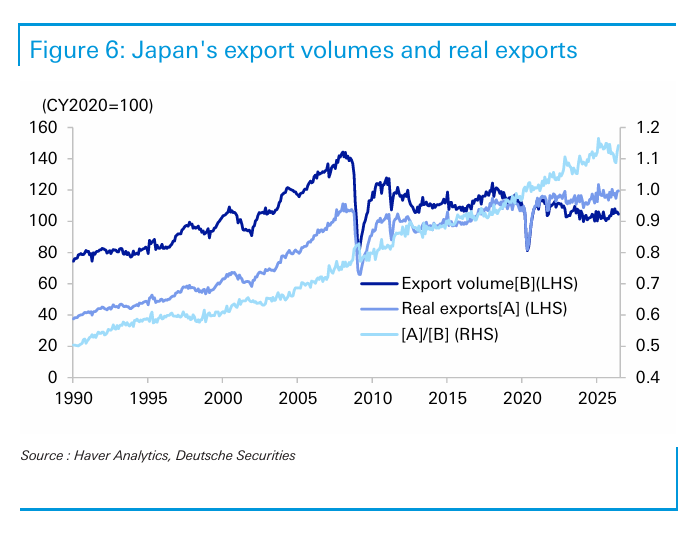
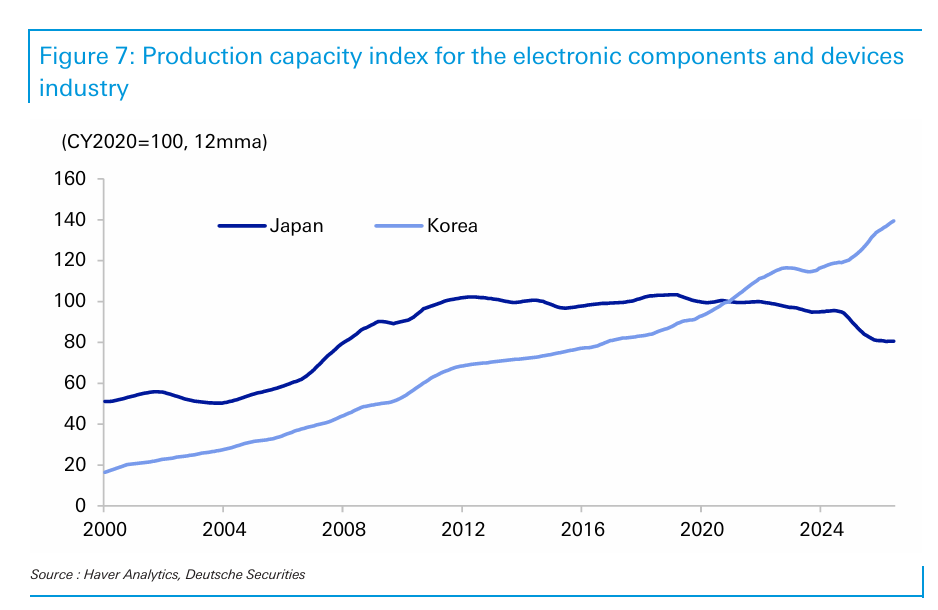
The divergence in production capacity is equally pronounced. Since 2024, the production scale of electronic components in South Korea and China's Taiwan Province has expanded rapidly, whereas Japan’s output remains below its 2021 peak. The report notes that the rise in Japan’s export prices precisely demonstrates that its products are indispensable within the global supply chain and possess pricing power, rather than suffering from lack of demand or product obsolescence. On the contrary, Japanese exporters are actively shifting their focus toward higher value-added products, adhering to a "low volume, high margin" strategy and deliberately avoiding the "high volume, low margin" approach.
Impeded Capacity Expansion: Insufficient Capital Investment as a Symptom
On the supply side, the issue of capacity accumulation in Japan’s electronic components industry has persisted for a long time. Data shows that the industry’s capacity index has been stagnant since the 2008 global financial crisis, and has even shown a downward trend in recent years. In contrast, South Korea has continued to expand its capacity investment.
The report suggests that Japanese companies’ cautious stance on capacity expansion is closely linked to painful historical lessons. In the 2000s, Japanese semiconductor firms made substantial investments, only to suffer huge losses following a market downturn and price collapse. This memory has left a deep imprint on management. Coupled with uncertainty regarding the sustainability of future demand, corporate willingness to expand capacity has been suppressed, reinforcing the inertia of sticking to the "low volume, high margin" strategy.
However, insufficient capital investment is not the entire problem. Even with existing facilities, companies have failed to fully tap into their potential. Although capacity utilization in the electronic components industry has recovered somewhat since 2025, it remains below historical peaks, revealing another, more critical constraint.
The Real Bottleneck: Labor Shortages
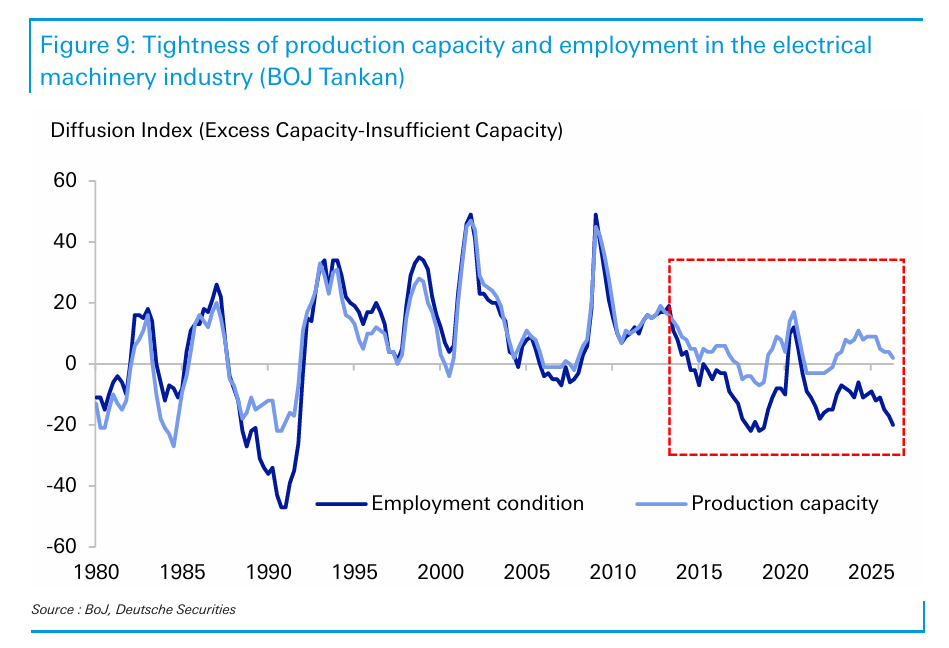
Data from the Bank of Japan’s Tankan survey reveals this underlying contradiction: in the electrical machinery industry, the index for excess equipment capacity has remained positive, while the employment conditions index has plunged deeply into negative territory, indicating a severe labor shortage. This gap has evolved into a chronic ailment since labor shortages intensified around 2015, with data overwhelmingly pointing to “labor,” rather than “equipment,” as the primary bottleneck.
The structural root of the problem lies in the extremely low elasticity of substitution between labor and capital in the electronics industry. According to the Bank of Japan’s January 2025 Outlook Report, the electrical machinery sector has one of the lowest capital-labor substitution elasticities within manufacturing. This makes capacity utilization highly susceptible to direct suppression by labor shortages. Furthermore, work-style reforms implemented since 2019 have reduced working hours without a commensurate rise in productivity, further constraining total output levels.
The spread of labor shortages extends beyond individual firms. Tight labor conditions across the entire supply chain, coupled with an acute shortage of construction workers responsible for building factories, have further hampered corporate production activities through delays in procurement and equipment installation. The Development Bank of Japan’s FY2026 Survey on Capital Investment Plans shows that for non-manufacturing firms, “alleviating supply-side constraints such as labor shortages” is the top factor for expanding domestic investment. In manufacturing, this factor ranks third in importance, behind only “improved growth expectations” and “technological and talent advantages,” and even surpasses expectations for government support. This structural dilemma means that labor shortages, rather than incentivizing companies to increase investment in labor-saving technologies, have directly suppressed overall corporate investment willingness.
Structural Malaise of Japanese Firms: Resource Misallocation
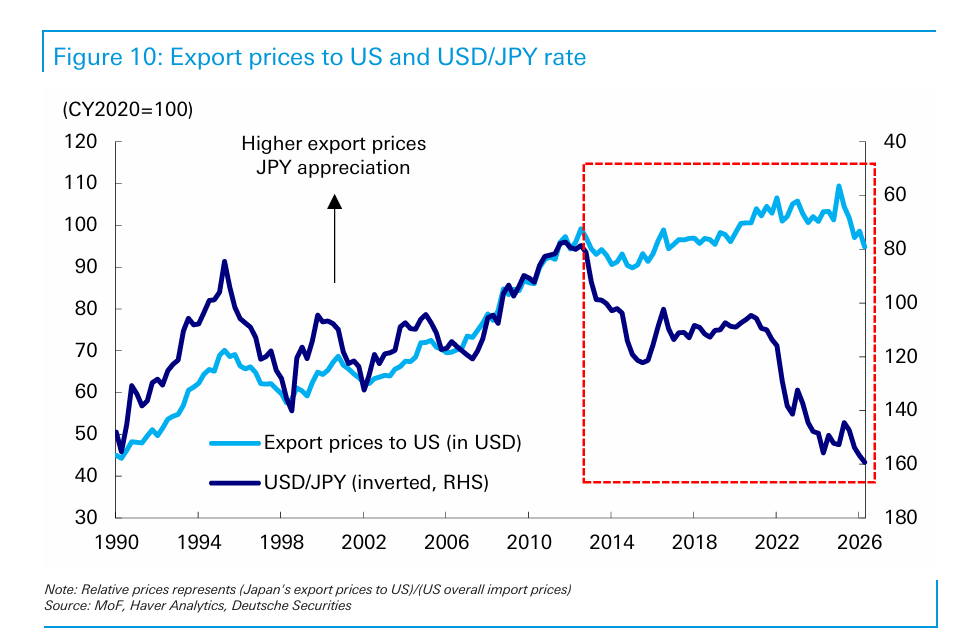
The report examines these phenomena from a broader macroeconomic perspective, noting that Japanese firms’ “inaction or inability to act” in the face of opportunities is not a new phenomenon. During the period of significant yen depreciation since 2013, Japanese exporters similarly missed the opportunity to lower export prices denominated in foreign currencies to expand market share. Instead, they maintained local currency prices to prioritize profit improvement, resulting in a situation where yen depreciation did not lead to an increase in export volumes.
Both scenarios highlight Japanese firms’ lack of momentum in seizing opportunities for scale expansion, with the fundamental issue being the structural inefficiency of labor resource allocation. From a macroeconomic perspective, even if the total labor force continues to shrink, overall economic output can still be increased by transferring labor from low-productivity sectors to high-productivity industries, such as those related to AI. The current AI boom presents an excellent opportunity to drive this industrial transformation.
In reality, however, dynamic cross-industry labor mobility remains extremely limited, constrained by two structural factors: the rigidity of the labor market, predicated on lifetime employment, which hinders cross-industry labor movement; and a corporate decision-making culture focused on short-term results, which makes management hesitant to take the risk of attracting talent through significant wage hikes amid uncertain demand prospects. Together, these factors have caused the mechanism for reallocating labor resources to growth-oriented industries to malfunction.
Deep-Seated Roots: The Triple Dilemma of Demographics, Industrial Structure, and Talent Supply
A cross-country comparison with South Korea further reveals the systemic roots of Japan's manufacturing labor challenges.
In terms of the scale of manufacturing employment, the number of workers in Japan’s manufacturing sector peaked in 1992 and has since declined by approximately 35%, stabilizing in recent years. In contrast, South Korea has maintained relatively stable employment levels since the 1997 Asian Financial Crisis. Both countries have followed similar trajectories in deindustrialization, with a continuous decline in the share of manufacturing employment. This reflects a common pattern wherein rising national income shifts demand from goods to services, while automation in manufacturing displaces labor.
Regarding demographic structure, Japan’s working-age population (aged 15 to 64) peaked in 1995, whereas South Korea did not reach its peak until 2017. South Korea’s current ratio of working-age population remains comparable to Japan’s historical peak, which partially explains the relatively moderate decline in South Korea’s manufacturing employment.
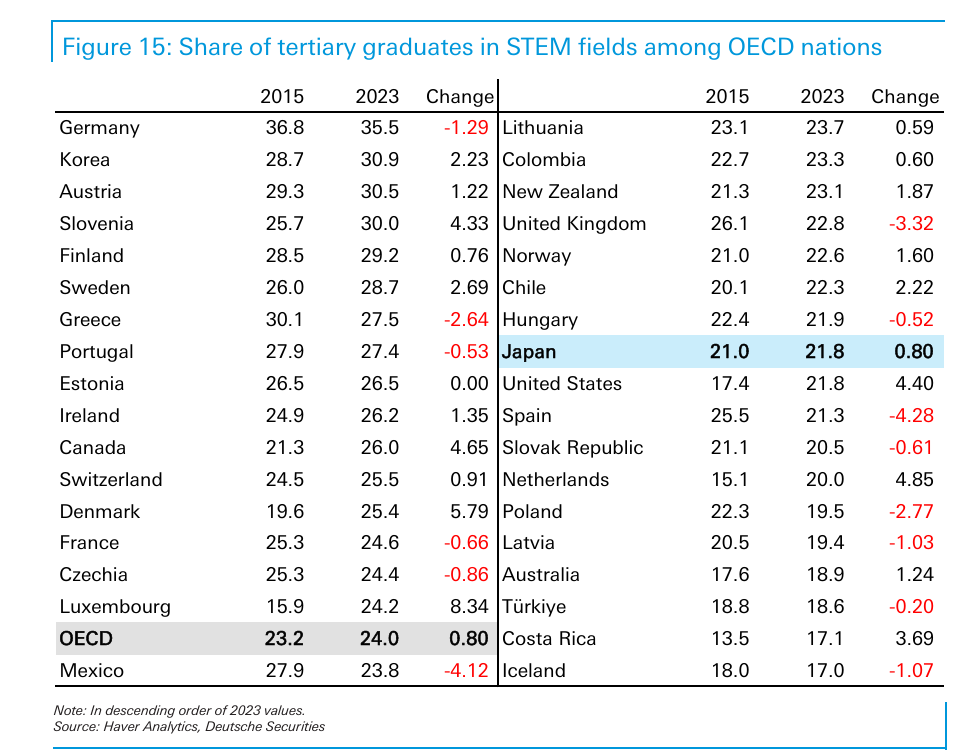
Significant disparities also exist in the supply of high-skilled talent. OECD data shows that South Korea ranks second among OECD member economies in the proportion of higher education graduates in STEM (science, technology, engineering, and mathematics) fields, while Japan’s proportion is below the OECD average. The report therefore points out that Japan’s manufacturing labor challenges are a deep-seated issue resulting from the interplay of demographic trends, deindustrialization, and educational system factors.
Editor/Deng