Citigroup’s currency strategy team has lowered its three-month forecast for the US Dollar Index from 102.12 to 98.34, shifting to a near-term bearish stance. Key drivers include the US Treasury’s announcement to double the scale of buybacks for 10- to 30-year Treasury bonds, which is expected to suppress yields and raise concerns about financial repression; continued cooling in expectations for Federal Reserve rate hikes; and political uncertainty stemming from the approaching midterm elections.
Cooling expectations for Federal Reserve rate hikes, the U.S. Treasury Department's expansion of its bond buyback program, and political uncertainty stemming from the approaching midterm elections are jointly weighing on the outlook for the U.S. dollar.
On Thursday, Daniel Tobon’s currency strategy team at Citigroup released a research report lowering their three-month forecast for the U.S. Dollar Index from 102.12 to 98.34, shifting from a previously neutral stance to a near-term bearish outlook.
 Citi characterized the U.S. Treasury Department's announcement to expand the scale of bond buybacks as "another factor bearing negatively on the U.S. dollar." Meanwhile, Citi raised its three-month forecast for the EUR/USD exchange rate to 1.1750, citing expectations that the European Central Bank will raise interest rates by 25 basis points in September, while market bets on Federal Reserve rate hikes continue to diminish.
According to Wall Street News, following the joint intervention in the yen by the U.S. and Japan, Bessent's latest move is to expand U.S. Treasury bond buybacks. The U.S. Treasury Department announced that it would "at least double" the scale of buybacks for 10- to 30-year U.S. Treasury bonds.
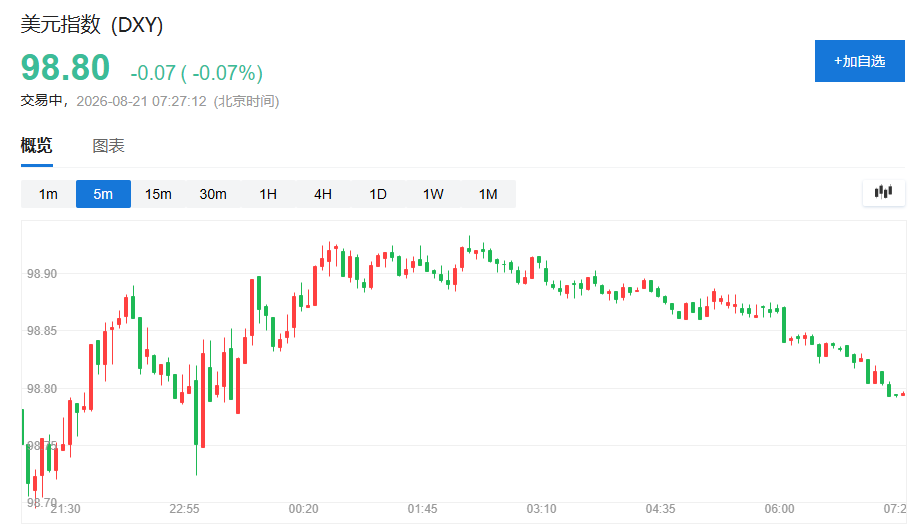
As of the Asia-Pacific session on Friday, the U.S. Dollar Index was quoted at 98.8, with the EUR/USD pair trading near 1.168.
U.S. Treasury Department expands buybacks
The direct trigger for Citi's shift in stance was the U.S. Treasury Department's announcement that it would double the scale of buybacks for 10- to 30-year Treasury bonds before November.
Strategists wrote in the report that Treasury Secretary Bessent's move aims to lower long-term borrowing costs but is likely to come at the expense of a weaker U.S. dollar.
According to Citi's analysis, this operation creates negative pressure through two channels: first, by pushing down U.S. Treasury yields; and second, by raising market concerns about financial repression.
The backdrop to the Treasury Department's expansion of buybacks is the recent continuous rise in U.S. government borrowing costs, with auctions for 10-year and 30-year Treasury bonds in August both recording the highest interest rate levels since the 2000s.
The Federal Reserve and Political Risks
In addition to Treasury operations, Citi strategists noted that market expectations for Federal Reserve rate hikes, which had previously bolstered the U.S. dollar, are being priced out.
On the political front, strategists warned that with the November midterm elections approaching, investors may be inclined to avoid long positions in the U.S. dollar due to "rising U.S. political uncertainty and the tail risk of electoral disputes."
However, Citi has not changed its long-term view on the U.S. dollar, maintaining that the U.S. economic growth outlook remains superior to that of other G10 economies.
The team also outlined potential risks to this new outlook: a U.S.-Iran conflict that disrupts oil shipments through the Strait of Hormuz, or a significant expansion in AI-related capital expenditure, could reignite inflationary pressures, prompting the Federal Reserve to resume rate hikes and challenging the bearish case for the U.S. dollar.