
U.S. Treasury Secretary Scott Bessent’s efforts to lower yields by expanding long-term Treasury repurchase agreements are facing an unexpected test from Japan: Next week, Japan will sequentially auction 10-year and 30-year government bonds.
Zhitong Finance APP reports that U.S. Treasury Secretary Scott Bessent’s efforts to suppress yields by expanding long-term Treasury buybacks are facing an unexpected test from Japan: next week, Japan will auction 10-year and 30-year government bonds in succession. Against a backdrop of lingering global fiscal concerns and a collective rise in long-end bond yields across major economies, weak demand in these auctions could further push up Japanese government bond (JGB) yields. Through the increasingly tight linkage between the U.S. and Japanese bond markets, this pressure may transmit to U.S. long-end yields, which are already hovering near their highest levels in nearly two decades.
Recently, major global debt markets have faced renewed selling pressure. Concerns over fiscal deficits and inflation are forcing investors to demand higher risk premiums. The yield on the U.S. 30-year Treasury note fell by 4 basis points to 5.24% on Monday, but it had briefly risen to 5.34% last week, marking its highest level since 2007. The yield on the 10-year U.S. Treasury note has risen by approximately 70 basis points since March, reaching around 4.70%.
 Europe has not been spared either. Yields on German government bonds with comparable maturities issued this month hit a 15-year high, while France’s borrowing costs rose to their highest level since 2008. Long-term JGB yields are also approaching historical records; the 10-year JGB yield has climbed to approximately 2.90%, a 30-year high, while the 20-year JGB yield is hovering near its highest level since 1996.
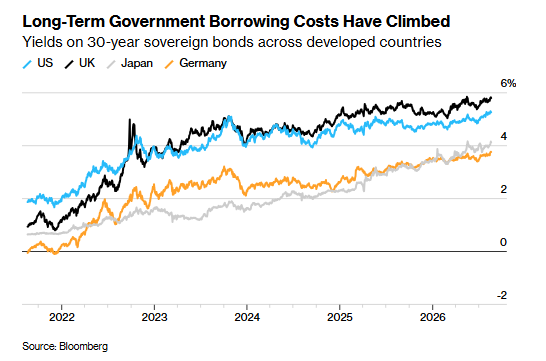
Currently, U.S. national debt has surpassed $40 trillion, and borrowing costs are rising rapidly. Markets are beginning to worry about a so-called "doom loop," wherein a heavier debt burden pushes up yields, and rising yields further exacerbate fiscal pressure.
Naoya Hasegawa, Chief Bond Strategist at Okasan Securities, stated: "Fiscal concerns and inflationary pressures are common themes facing Japan, the United States, and Europe. A rise in Japanese yields could have global implications."
Bessent’s “Buyback Play” Temporarily Falters
In response to soaring long-end yields, Bessent unexpectedly announced last week that the U.S. Treasury would expand the scale of its long-term Treasury buybacks. Under the plan, starting September 9, the U.S. Treasury will purchase at least $4 billion in government securities per buyback operation, significantly higher than the current $2 billion. Buyback operations are scheduled quarterly, conducted once or twice a week, and executed based on duration, with bonds of various maturities included once or twice a month.
Although the U.S. Treasury stated that the expansion of buybacks aims to provide better liquidity to the market, many analysts believe the move is essentially an attempt to control rising long-term bond yields. However, the market did not embrace this “buyback play.” Following the announcement, Treasury prices rose only briefly, with yields resuming their upward trend a day later. Many analysts and investors viewed Bessent’s maneuver as a failure, akin to previous joint U.S.-Japan interventions in the foreign exchange market, as bond prices quickly gave back their gains.
U.S. President Trump subsequently stated that Bessent expanded the buybacks on his "own initiative" and not under his instruction. This somewhat weakened market confidence in the continuity of the policy. Next, Bessent is scheduled to speak on Monday local time, while Federal Reserve Chair Kevin Warsh will appear at the Jackson Hole Global Central Bank Symposium on Friday. These statements may provide further clues for the short-term bond market.
Japanese Auctions Become the “Next Threat”
For Bessent, a more immediate challenge comes from Japan. Japan will auction 10-year government bonds on September 1, followed by an auction of 30-year bonds two days later on September 3. This timing coincides with global investors demanding higher compensation for holding sovereign debt; any signs of weak demand could have spillover effects on the U.S. Treasury market.
Andrew Ticehurst, Senior Interest Rate Strategist at Nomura Holdings in Sydney, stated: "The market will closely monitor the upcoming Japanese government bond auctions. If the auctions perform poorly, Japanese government bond yields will rise, potentially making the Japanese market more attractive to local investors and thereby exerting further upward pressure on U.S. Treasury yields."
In fact, there is precedent for such linkage. Last year, the surge in yields on Japan’s ultra-long-term government bonds directly transmitted to the U.S. Treasury market. Today, with the United States facing a massive debt burden and high borrowing costs, the risks may be even greater.
Rinto Maruyama, Senior FX and Rates Strategist at SMBC Nikko Securities in Tokyo, remarked: "If next week’s Japanese government bond auctions fail and trigger another round of selling, I would not be surprised to see spillover effects impact U.S. Treasuries. Despite Bessent’s efforts, U.S. Treasury yields could still be pushed higher."
It is worth noting that demand for Japan’s 20-year government bonds was decent during the auction on August 20, the day after Bessent announced the buyback program. Nevertheless, yields for this maturity have since hovered near their highest levels since 1996, indicating that market demand has not been strong enough to reverse the upward trend in yields.
From Forex to Bond Markets: Rising Expectations for U.S.-Japan Coordination
Bessent’s maneuvers in the bond market may represent more than just unilateral U.S. efforts. Some analysts believe that U.S. attempts to curb bond yields could be a prelude to enhanced U.S.-Japan coordination aimed at jointly restoring market stability, with a focus on fiscal sustainability in both countries.
Kyohei Morita, Chief Economist at Nomura Securities, stated: "The U.S. and Japan may agree to jointly commit to fiscal sustainability and convey this signal to the market." In late July this year, the U.S. and Japan joined forces to intervene heavily in the foreign exchange market to support the yen, but the currency subsequently gave back most of its gains. At the time, Bessent noted that intervention requires follow-up policy measures; otherwise, it merely sends a signal.
From the perspective of the bond market, the linkage between the U.S. and Japan is becoming increasingly tight. The U.S. may increasingly view Japan as one of the "epicenters" of global bond market volatility. Takahide Kiuchi, Executive Economist at Nomura Research Institute, pointed out in a report that the Trump administration may pay closer attention to Japan in order to curb the strengthening of the U.S. dollar, the weakening of the yen, and the rise in long-term bond yields.
He wrote in the report: "If the yield on 10-year Japanese government bonds touches 3% and the yen falls again to 160 against the U.S. dollar, the U.S. may request the Sanae Takaichi government to change the direction of its fiscal policy."
It is reported that Japanese Prime Minister Sanae Takaichi has previously made multiple statements supporting stimulus policies, advocating for expanded investment in crisis management and growth. However, against the backdrop of Japanese households already facing cost-of-living pressures, such spending could further exacerbate inflation, raising market doubts about its fiscal discipline.
Although some Japanese officials argue that Sanae Takaichi’s fiscal policy is not “expansionary,” emphasizing that fiscal sustainability is also a priority, the government has yet to provide adequate funding for major economic initiatives, such as plans to reduce the consumption tax on food. This has heightened market concerns regarding Japan’s fiscal outlook.
Morita believes that if yields on Japanese long-term government bonds rise due to inflation concerns, a certain degree of interest rate hikes will be necessary, and the Bank of Japan will take such action. However, he also pointed out: “Some action is also required on the fiscal policy front to support the Bank of Japan’s rate hikes.” In other words, monetary tightening alone may be insufficient to stabilize long-term yields; Japan also needs more credible commitments to fiscal consolidation.
Editor/Deng