
① In comparative tests against NVIDIA's GB300, OpenAI's Jalapeno chip demonstrated advantages in two key metrics: AI workload processed per unit of power consumption, and response speed; ② Richard Ho, an executive at OpenAI, stated that while some chips offer stronger processing power for AI tasks and others excel in rapid response, Jalapeno combines the strengths of both.
Cailianshe, August 26 (Editor: Zhao Hao) – OpenAI claims that its new "Jalapeno" chip outperformed NVIDIA's current product lineup in tests, highlighting the progress made in the company's independent development of AI processors.
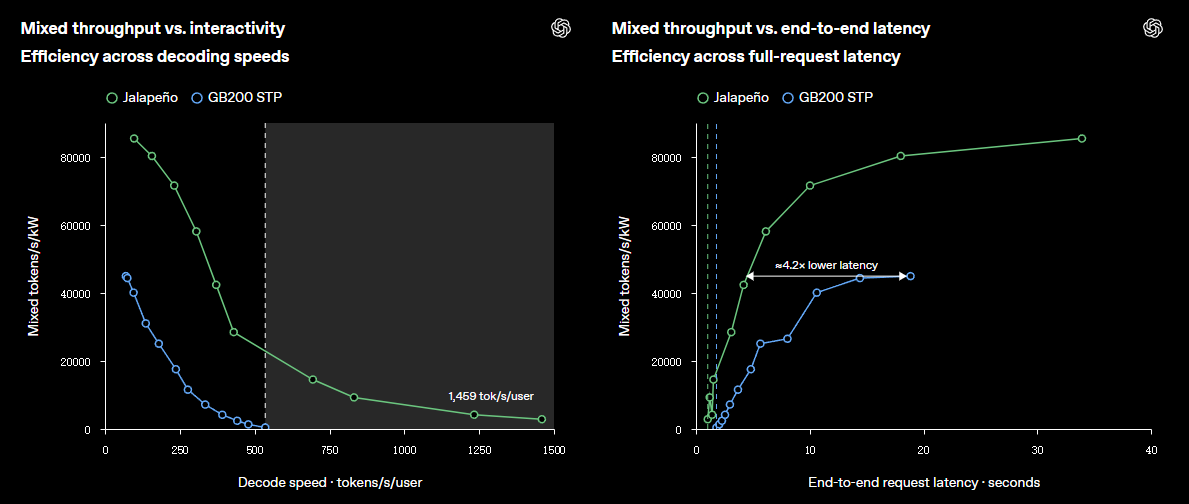
Richard Ho, head of OpenAI's chip business, stated in an interview that the chip was benchmarked against NVIDIA's GB300, which is regarded as the most advanced product currently available. In these tests, Jalapeno showed superior performance in two areas: AI workload handled per unit of power consumption, and response latency.
 During this public test of Jalapeno, OpenAI utilized its own smaller-scale open-source model, GPT-OSS 120B, as well as third-party models from DeepSeek and Moonshot AI. The advantages of Jalapeno were particularly pronounced when running Moonshot's Kimi K2.5 1T model.
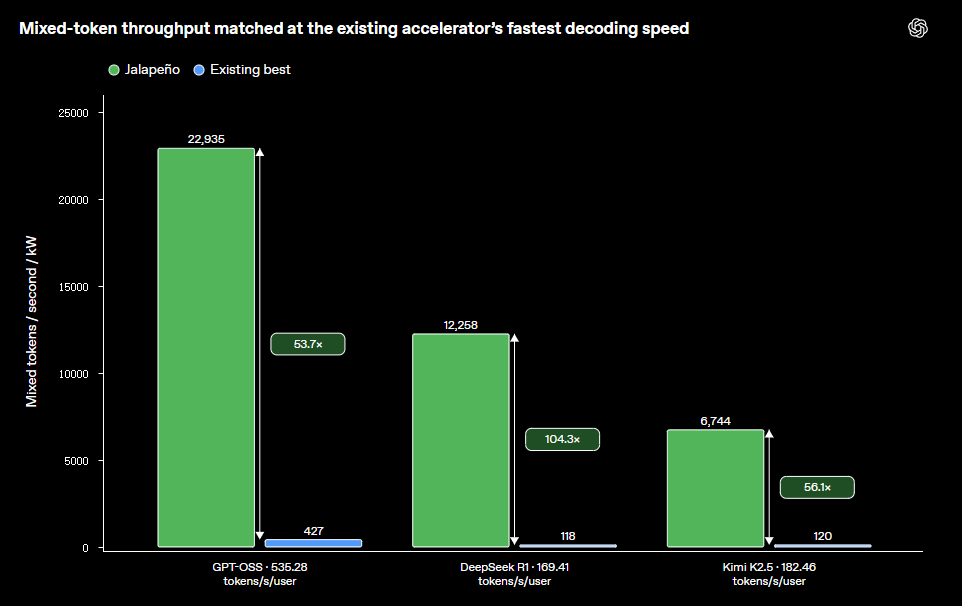
OpenAI stated that in internal testing, Jalapeno also performed well when running certain large, advanced models that have not yet been released. This suggests that as workloads become larger and more complex, the "value proposition of the chip design will further increase."
OpenAI developed Jalapeno in collaboration with Broadcom. The company plans to begin using this chip to support its AI models later this year, as part of its strategy to build proprietary AI infrastructure and expand its in-house chip development initiatives.
Broadcom produces custom chips for numerous clients. The two companies announced their partnership last year and heavily promoted the development speed of this processor in June of this year, claiming it was completed at a record-breaking pace.
Currently, an increasing number of companies are developing their own AI chips, although this sector remains dominated by NVIDIA.
Ho noted that typically, some chips possess greater processing power for running AI tasks, while others are better suited for fast response times; however, Jalapeno offers advantages in both aspects.
OpenAI will determine which AI models run on Jalapeno, thereby allowing customers to choose between lower-cost or higher-performance options based on their needs.
Ho stated, “In laboratory testing, Jalapeno demonstrated strong performance in high-throughput scenarios, meaning it can serve a large volume of customers at a lower cost. Meanwhile, it also excelled in low-latency areas, implying that for customers prioritizing response speed, the response times will be extremely fast.”
Ho indicated that because Jalapeno delivers robust performance at a relatively low power consumption of 700 watts, it can help OpenAI reduce data center operating costs. For data centers, electricity is one of the most significant cost components.
It should be noted that Jalapeno was not tested against NVIDIA’s latest generation Vera Rubin chips, which have only just begun shipping. Furthermore, Jalapeno is not designed for AI model training, an area where NVIDIA’s technology holds a distinct advantage.
Jalapeno is primarily targeted at the AI inference phase, during which models generate responses and execute tasks based on user prompts after training is complete. Its speed advantages enable OpenAI to achieve results that previously required processors with different memory types and chip architectures.
OpenAI currently still relies on NVIDIA's technology to run some of its models, which are better suited for smaller-scale models. $Cerebras Systems (CBRS.US)$ In contrast, Jalapeno is capable of handling larger-scale models. Ho stated that OpenAI's technology will not replace suppliers such as Cerebras in the near term.
Ho said, “Our demand for computing power is immense, which is why we have contracted with so many different suppliers. This situation will persist for some time.” He added that OpenAI aims to publicly showcase its R&D achievements to drive innovation in the AI chip sector.
Other startups are exploring similar directions. Etched announced last week that it had secured a valuation of approximately $21 billion in a funding round and began shipping a low-voltage chip. MatX, founded by two former Google chip business employees, is currently developing a semiconductor product also targeting both high throughput and low latency.
OpenAI also stated that it has leveraged its own AI models to accelerate chip development. The second-generation chip is now in an advanced stage of R&D. Ho indicated that the company expects to complete the tape-out of this chip—marking the finalization of the chip design—within the “coming months.”
Meanwhile, OpenAI has already begun designing its third-generation chip, aiming to further reduce the costs of the AI infrastructure it is building on a global scale. Ho stated, “We have currently reached a level of cost and power efficiency that allows for reduced infrastructure costs. This is only the first step.”
Although OpenAI is actively promoting its self-developed chips and comparing their performance with NVIDIA’s products, Ho specifically emphasized that OpenAI continues to regard NVIDIA as a key chip supplier.
"NVIDIA is an excellent partner, and we continue to rely heavily on its chips."
Editor/Stephen