
With the widespread adoption of spot Bitcoin ETFs, as well as various structured ETFs and Bitcoin-related products, investors now have significantly more channels to gain Bitcoin exposure than in the past.
Author: Zhou, ChainCatcher
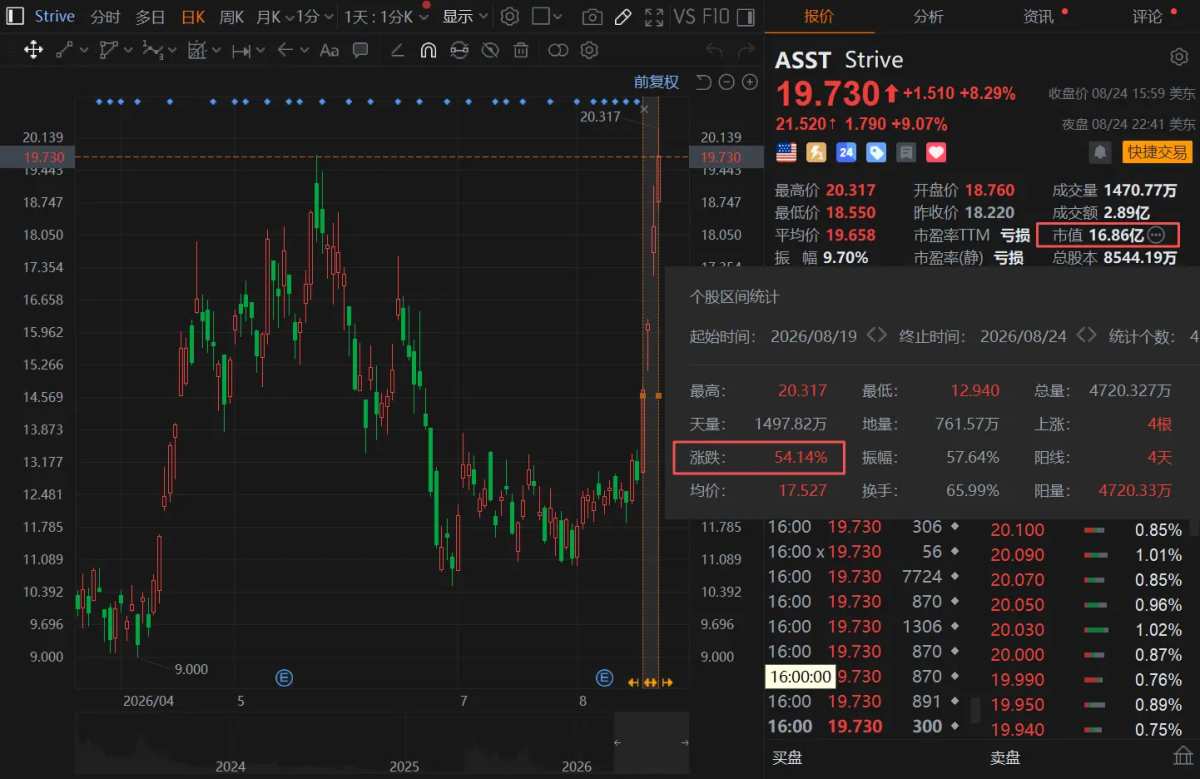
Recently, Bitcoin rebounded from around $62,000 to above $80,000, triggering a sharp rally in the stocks of several publicly listed companies with Bitcoin treasury strategies: over the past four trading sessions, Strive rose by approximately 54%, Strategy by about 32%, while smaller players such as Twenty One Capital also recorded double-digit gains.
 In fact, by 2026, companies employing Bitcoin treasury strategies entered a period of clear divergence. The largest player, Strategy, shifted from a pure accumulation strategy, having sold nearly 7,000 Bitcoins cumulatively since late June this year. Meanwhile, the share prices of nearly 40% of companies in the sector fell below their net asset value, prompting many to deleverage or halt large-scale additional purchases.
Against this backdrop, Strive has become one of the few public market participants that continues to disclose ongoing Bitcoin purchases, currently holding a cumulative total of 21,356 Bitcoins.
The company issued perpetual preferred shares, ticker SATA, with a 13% annualized dividend rate. In June 2026, it was adjusted to become the first listed security in U.S. stock market history to distribute dividends on a daily basis.
Although the company's scale is far smaller than that of Strategy, its current buying pace and capital structure choices give Strive greater potential for differentiation. CEO Matt Cole has also made multiple public statements recently, repeatedly emphasizing his long-term conviction in Bitcoin.
From Anti-ESG Funds to Bitcoin Treasury Strategies
Many people know Strive through its label as a Bitcoin treasury company, but it initially had little to do with cryptocurrencies.
In 2022, Vivek Ramaswamy and former Anheuser-Busch executive Anson Frericks co-founded Strive. The company started with an anti-ESG energy index fund called DRLL, promoting an investment philosophy that disregards environmental, social, and governance factors, which quickly attracted capital aligned with these values.
In February 2023, Ramaswamy resigned as Executive Chairman to run for U.S. President. In April of the same year, Matt Cole took over as CEO, becoming the actual helmsman of the company's strategy in the following years.
The true turning point occurred in 2025. By then, Strategy’s Bitcoin accumulation model had largely been reflected in its stock price. From May to September of that year, Strive transformed itself into a publicly listed company focused on a Bitcoin treasury strategy through a reverse merger with Asset Entities, a Dallas-based listed company. The transaction also completed a $750 million PIPE financing, retaining the ticker symbol ASST for trading on Nasdaq.
Following the transformation, Strive rapidly expanded. Between September 2025 and January 2026, it acquired another Bitcoin treasury company, Semler Scientific, in an all-stock deal, immediately consolidating approximately 5,000 Bitcoins held by the latter onto its balance sheet. Upon completion of the acquisition, the merged entity held approximately 12,798 Bitcoins, ranking 11th among global publicly listed companies in terms of Bitcoin holdings.
Concurrent with this acquisition, Strive established its management team. Avik Roy was appointed Chief Strategy Officer, Eric Semler, former Chairman of Semler Scientific, joined the Board of Directors, and Joe Burnett assumed the role of Vice President of Bitcoin Strategy, becoming another key spokesperson for the company.
Market sentiment fluctuations were also evident in the stock price. In the initial phase following the announcement of the transformation, ASST surged to over $200, but subsequently experienced a reverse stock split and valuation normalization, declining to its current range in the teens.
As of August 21, the company held a cumulative total of 21,356 Bitcoins, along with 505,000 shares of Strategy’s STRC preferred stock with a fair value of approximately $48.57 million, and approximately $171.9 million in cash.
Beyond Bitcoin accumulation, Strive’s product and financing structure
Strive’s financing instruments are relatively conventional. First is the at-the-market (ATM) offering of common shares under the ticker ASST. Second is the perpetual preferred stock SATA. In May this year, alongside its first-quarter earnings report, the company announced it had repurchased and retired all long-term notes, achieving zero debt, zero margin requirements, and zero pledged Bitcoin.
The company’s SATA is the first listed security in the U.S. market to distribute dividends daily. With a par value of $100 and an annualized dividend rate of 13%, it pays approximately $0.0516 per share per trading day. Over 252 trading days in a year, the cumulative payout amounts to approximately $13, corresponding exactly to the 13% coupon rate.
SATA fell to approximately $75, or three-quarters of its par value, twice earlier this year—in early January and June—but has since recovered above par value in tandem with the rebound in Bitcoin prices.
As perpetual preferred stock, SATA, like Strategy’s STRC, has no maturity date. Dividend payments are at the company’s discretion and may even be deferred. There are no mandatory redemption or liquidation clauses triggered if the Bitcoin price falls below a certain threshold. This year, Strive increased the capacity of the ATM programs for both ASST and SATA by $2.1 billion each.
During the sharp decline in SATA in the first half of this year, Strive’s accumulation was interrupted for more than two months. It only resumed increasing its Bitcoin holdings in August, when SATA returned to par value and the channel reopened.
As a Bitcoin treasury company, Strive is inevitably compared with Strategy by the market. There are four main differences between the two companies.
The first difference is the type of debt. Between 2020 and 2024, Strategy accumulated a significant stock of convertible bonds, such as a $3 billion zero-coupon convertible bond issued in November 2024 and maturing in 2029. In the past two years, Strategy has not continued to issue large volumes of convertible bonds; instead, it has shifted towards share buybacks and debt reduction. Strive, on the other hand, has no convertible bond debt. Ben Werkman, the company’s Chief Investment Officer, stated that relying solely on equity financing and avoiding the issuance of convertible bonds allowed the company to continue operations during the bear market.
The second difference is the Bitcoin accumulation strategy. Strategy is deleveraging by repurchasing convertible bonds and buying back STRC shares, having sold nearly 7,000 Bitcoins this year. Strive, however, is still expanding,issuing SATA, and buying Bitcoin.
The third difference is the interest payment structure. STRC currently offers an annualized yield of 12%, with semi-monthly distributions of $0.50 per share. Strive’s SATA distributes dividends daily, with a coupon rate of 13%.
The fourth difference is cross-holdings. Strive has purchased approximately 505,000 shares of Strategy’s STRC preferred stock, with a book value of about $48.6 million. This means it holds preferred shares of a competitor as an interest-generating reserve, using the approximately 12% return from STRC to support the dividend payments for its own SATA.
Shift in Narrative and Management Conviction
The narrative surrounding the Bitcoin treasury business is changing.
The core commitment in recent years was to buy only and not sell, locking Bitcoin onto the balance sheet indefinitely. In 2026, this commitment was broken by Strategy itself, the largest player. Although the volume sold accounted for less than 1% of its total holdings of 840,000 coins—a negligible proportion—the symbolic significance is considerable.
Strive is currently at an earlier stage in the cycle and has not yet reached the point of selling coins. CEO Cole has repeatedly emphasized his long-term conviction in Bitcoin, citing the structural weakening of the U.S. dollar, capital chasing scarce assets in the AI era, and the Bitcoin-to-gold price ratio leading the bottoming process. He also noted that even ifBitcoin falls to 1 centand remains there for 18 months, Strive would not need to sell a single BTC.
Compared to this macro narrative, insiders putting their own money on the line is a more weighty signal.Cole stated in a postthat February 19 marked the bear market bottom for ASST. At that time, the company's CFO, CLO, and several executives and directors bought shares in the open market, and three independent directors transitioned to full-time roles within six months. The team maintains high confidence in their Bitcoin exposure, leverage structure, and mutual coordination.
However, beyond the team's conviction, there is a more pragmatic question: How much Bitcoin have common shareholders actually gained from such high-profile purchases?
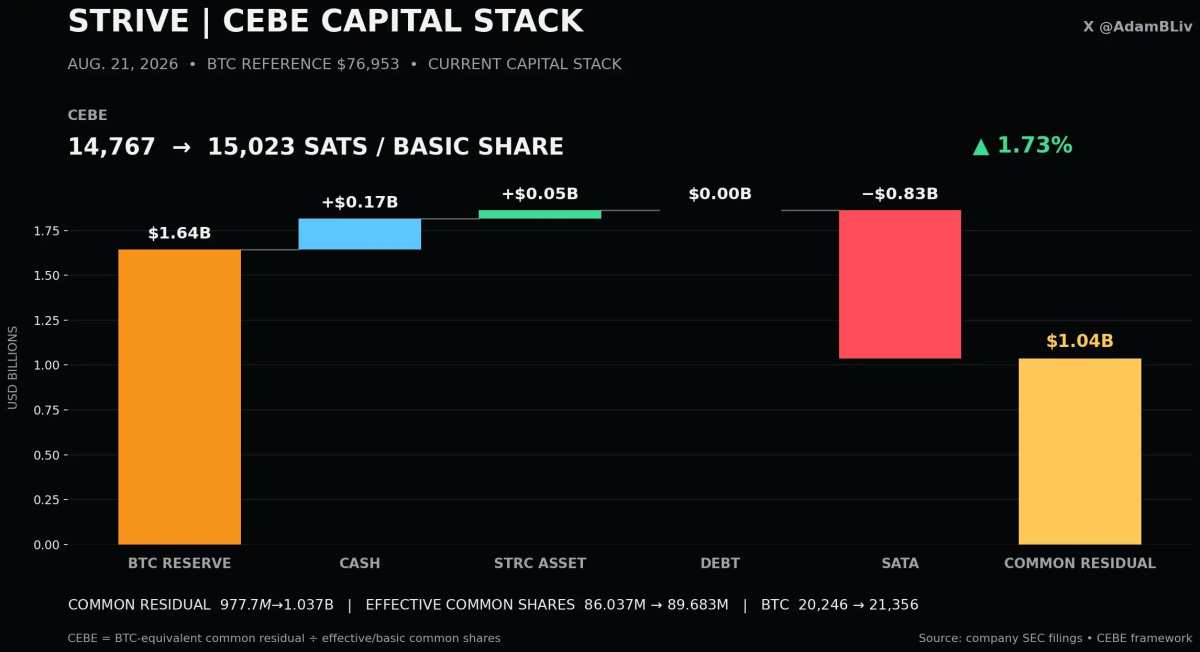
Looking solely at the growth rate of holdings may lead to overestimation. For example, during the week of August 17–21, the company's Bitcoin reserves grew by approximately 5.48%. However, the funds for purchasing Bitcoin came primarily from issuing new shares. During the same period, common shares expanded from approximately 86.04 million to 89.68 million, resulting in a one-time dilution of about 4.24%. Meanwhile, the volume of SATA preferred shares, which have priority over common shares in repayment, also increased simultaneously.
After accounting for dilution and the seniority of preferred shares, according to CEBE The metric—specifically, the Bitcoin value per share of common stock—actually grew by only about 1.73% this week, rising from approximately 14,767 sats to 15,023 sats. The actual figures are not always as impressive as they may appear on the surface.
How can one limit downside risk while amplifying upside potential?
In fact, Strive faces a common challenge across the corporate treasury sector: the deceleration of the flywheel during bear markets.
Strive’s solution is digital credit. It treats Bitcoin as a credit asset capable of generating stable yields, rather than merely betting on price appreciation.
Chief Investment Officer Burnett cites Saylor’s algorithm, noting that if Bitcoin achieves an annual growth rate of just 3.3%, capital gains would be sufficient to cover preferred stock dividends. In this model, holding the asset itself becomes a sustainable income-generating business, with SATA’s daily dividend distribution representing the productization of this strategy.
Cole argues that to maximize the expected total return of $ASST, the company should increase its exposure to Bitcoin’s upside as much as responsibly possible, while maintaining strict capital discipline.
The real challenge lies in accounting for both bull and bear market scenarios. On the downside, how much decline can it withstand? On the upside, if Bitcoin truly rallies, will excessive conservatism cause missed gains?
During bear market downturns, the company avoids hard liquidation risks by using no debt, setting no margin requirements, and adopting no financing structures that could trigger forced liquidation. However, its financing relies heavily on SATA and ASST trading above par or net asset value. In the first half of this year, SATA fell sharply to three-quarters of its par value,suspension of additional purchasesThe past two months have served as a rehearsal for this very dependency.
Regarding the upside potential, Cole describes ASST’s capital structure as an amplification framework. It leverages three mutually reinforcing mechanisms to magnify the company’s exposure to Bitcoin’s price appreciation: expanding the asset base of scarce assets, increasing the proportion of Bitcoin holdings, and adding another layer of structural leverage within ASST.
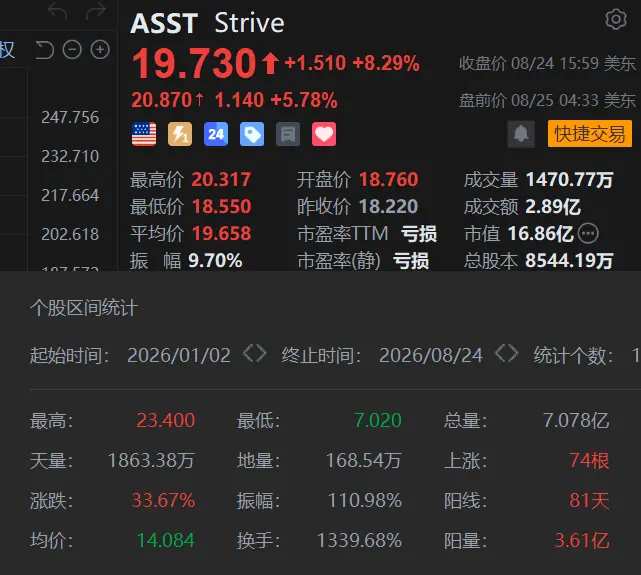
With a smaller scale and thinner liquidity, Strive indeed offers greater elasticity and higher beta exposure to Bitcoin. Year-to-date, ASST has risen by approximately 34%, whereas Strategy’s MSTR has declined by about 19% over the same period. In terms of price range volatility, ASST registered approximately 111%, compared to roughly 76% for MSTR.
Conclusion
Overall, Strive has introduced certain differentiating features based on Strategy’s model, including a debt-free balance sheet, daily dividends, and digital credit facilities. While these elements appear safer and more innovative, stripping them away reveals that it remains essentially a high-volatility exposure to Bitcoin.
Moreover, this exposure is facing an increasing number of substitutes. With the emergence of spot Bitcoin ETFs and various structured ETFs and Bitcoin-related products, investors now have far more channels to gain Bitcoin exposure than in the past, intensifying competition for targets such as treasury companies.
For a small-cap company like Strive, these limitations are even more pronounced. Its small market capitalization and thin liquidity make it difficult for large capital flows to enter or exit, thereby restricting the pool of eligible investors.
Its advantages are equally clear: high elasticity and elevated beta. For those willing to endure high volatility and specifically seek out such exposures, this is precisely its appeal.