
On August 31, $Z.AI (02513.HK)$ The company will release its financial report for the first half of 2026, marking its first interim report since listing on the Hong Kong stock exchange. According to Bloomberg data, market expectations for Zhipu's H1 revenue stand at RMB 1.355 billion, with adjusted comparable net profit expected at a loss of RMB 2.75 billion.
Beyond conventional metrics such as revenue and net profit, the market will closely scrutinize Zhipu's Annual Recurring Revenue (ARR) figures and management guidance in this report. This assessment aims to determine whether the company's commercialization narrative of "rising API volume and pricing" can be sustainably realized.
Key Focus: ARR and Token Volume and Pricing
Currently, global large language model (LLM) companies are generally in a phase of burning cash to drive growth. Consequently, the market places greater emphasis on the slope and sustainability of revenue growth rather than profitability.
 Historical data shows that Zhipu achieved revenue of RMB 724 million in 2025, representing a year-on-year increase of 131.85%. Entering 2026, this growth momentum has further accelerated. According to reports by the Science and Technology Innovation Board Daily, Zhipu's ARR had reached USD 1 billion by July 2026. While it took Anthropic approximately 15 months to grow from USD 100 million to USD 1 billion, Zhipu achieved the same milestone in only about 5 months.
However, the flip side of high growth is widening losses. Zhipu reported a net loss attributable to shareholders of RMB 4.698 billion in 2025, a year-on-year increase of 58.91%; cumulative losses over the four years from 2022 to 2025 approached RMB 8.6 billion. Therefore, whether losses narrow remains another key focus of this financial report.
In terms of specific business operations, Zhipu is primarily divided into four segments:
Open Platform and API: Leveraging general-purpose large model capabilities, this segment provides standardized cloud services to developers and enterprises via APIs, SDKs, and Model-as-a-Service (MaaS) platforms, transforming underlying algorithmic capabilities into ready-to-use products.
Enterprise Agents: With large models as the core control unit, this segment integrates enterprise knowledge bases and tool-calling capabilities to build autonomous intelligent systems for complex business scenarios.
The aforementioned two business segments are becoming new growth engines for Zhipu, with revenue growth rates exceeding 248% in 2025.
Enterprise-grade general-purpose large models: A self-developed matrix of pre-trained models delivered via private, on-premises deployment. This constitutes Zhipu's traditional core business, accounting for 50.4% of its revenue in 2025.
Technical services and others: Specialized technical services provided to AI developers and corporate clients, leveraging the underlying technology of general-purpose large models.
Furthermore, against the backdrop of rising competitiveness and enhanced pricing power among domestic large model vendors, Zhipu's token pricing trends and changes in call volume warrant close monitoring. The simultaneous rise in both volume and price is the clearest signal of growth driven by "genuine model competitiveness" and "high-value workloads," serving as a key criterion to distinguish between "trading price for volume" and "growth driven by genuine demand."
Following a significant pullback in share price, what factors should be watched for a recovery?
On January 8 this year, Zhipu listed on the Hong Kong Stock Exchange, becoming the "first large model stock." Zhipu's IPO price was HK$116.2. Market reaction was muted initially, but the share price subsequently entered an acceleration phase; it surged more than 26% in a single day on June 18, breaking through HK$2,000, and skyrocketed over 40% during intraday trading on June 22 to hit a historic high of HK$2,980. Its total market capitalization approached HK$1.4 trillion, with a cumulative maximum gain of over 19 times in the six months since listing.
However, impacted by events such as lock-up expirations and placements, Zhipu's share price subsequently underwent a significant correction, accumulating a decline of over 54% within two months. As of the close on August 27, Zhipu's latest share price was HK$1,160, with a total market capitalization of HK$540.123 billion.
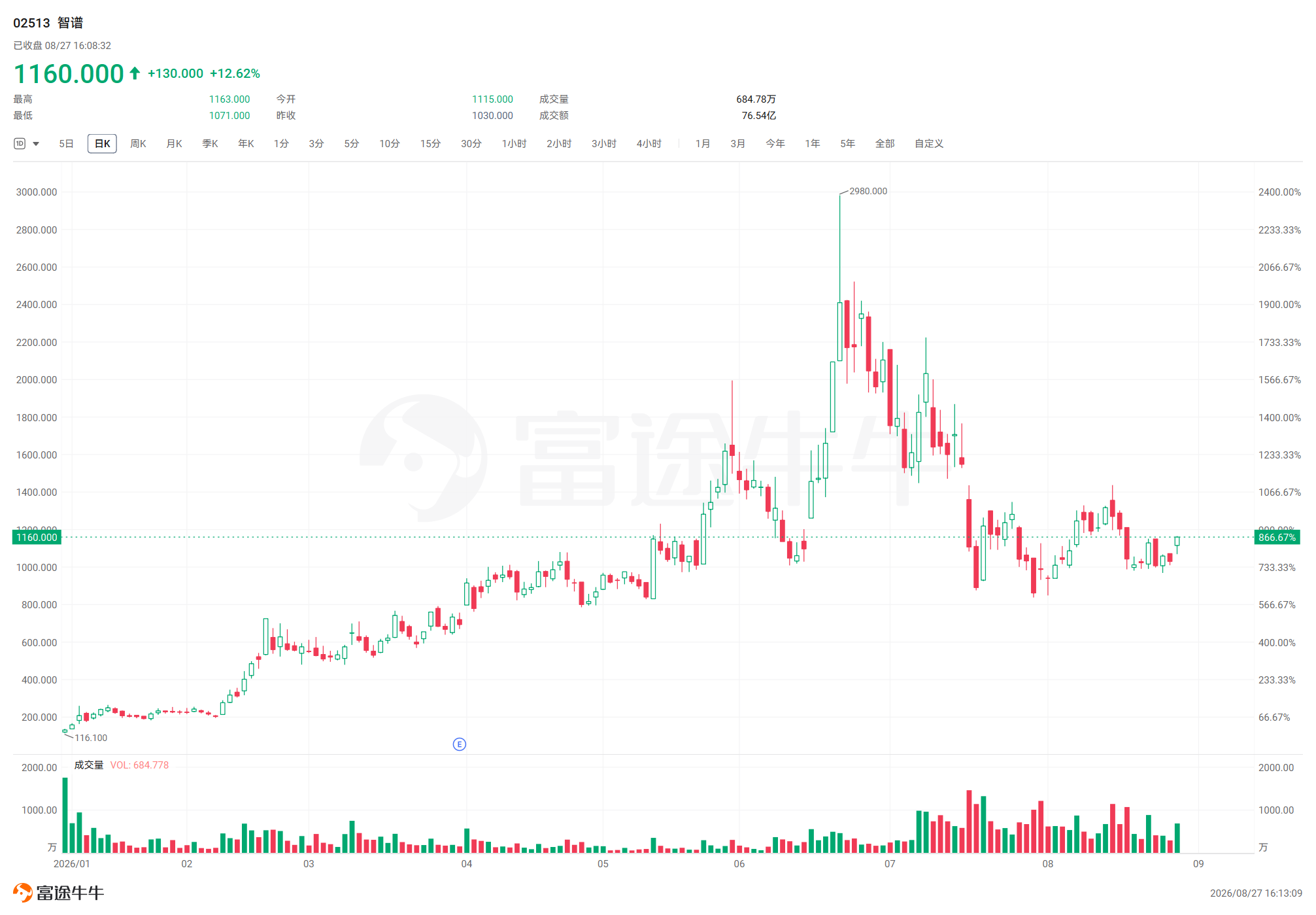
Looking ahead, can Zhipu's share price recover? This can be observed from the following four dimensions:
First, whether the competitiveness of its large models can maintain a leading position—this is the most critical variable. On August 14, Zhipu officially released GLM-5.3, a model whose capabilities are on par with closed-source flagships such as Claude Fable 5 and GPT-5.6 Sol, and which ranks first among open-source models alongside Kimi K3. On August 26, Zhipu claimed ownership of the mysterious model "Niu Lai," confirming it to be the newly released GLM-5.3-Flash—the first native multimodal model in the GLM-5 series. Continuous technical iteration capability is the foundation supporting its high valuation.
Second, how long the scarcity premium can be sustained. Currently, the only pure AI large model companies listed in the global market are Zhipu and $MINIMAX-W (00100.HK)$ With only two comparable peers, scarcity has served as one of the anchors for its valuation. However, both Anthropic and OpenAI have disclosed their IPO plans, while domestic players such as DeepSeek and Moonshot AI have also circulated news regarding potential listings. Once a cluster of similar targets emerges, the "uniqueness" premium enjoyed by Zhipu will gradually dilute.
Third, whether the wave of share lock-up expirations can be managed smoothly. On July 8, the lock-up period for 25.68 million shares held by cornerstone investors expired, expanding the free float from less than 3% to approximately 8%. A greater test awaits in January 2027, when approximately 40% of shares will become tradable, significantly expanding the free float and creating potential selling pressure that cannot be ignored.
Fourth, progress on the dual "A+H" listing. On June 1, Zhipu announced its intention to apply for an initial public offering of A-shares and list on the STAR Market. The status of its pre-listing tutoring has now been updated to "tutoring completed." The proposed A-share IPO aims to raise RMB 15 billion, with RMB 12 billion allocated to the research and development of general-purpose foundational large AI models, RMB 2 billion to the construction of a one-stop MaaS (Model-as-a-Service) platform, and RMB 1 billion to supplement working capital. If the A-share listing proceeds smoothly, it will provide the company with additional financial resources, though it may also divert some trading volume from its Hong Kong-listed shares.
In summary, Zhipu's short-term stock price trajectory will depend on the quality of this earnings report, while its medium- to long-term performance will hinge on whether the company can restore market confidence through tangible commercialization data.
 AI-powered earnings snapshot highlights key takeaways—build your options strategy! Open Futubull > Stock Page > Click [Company] >Earnings Snapshot
Editor/KOKO