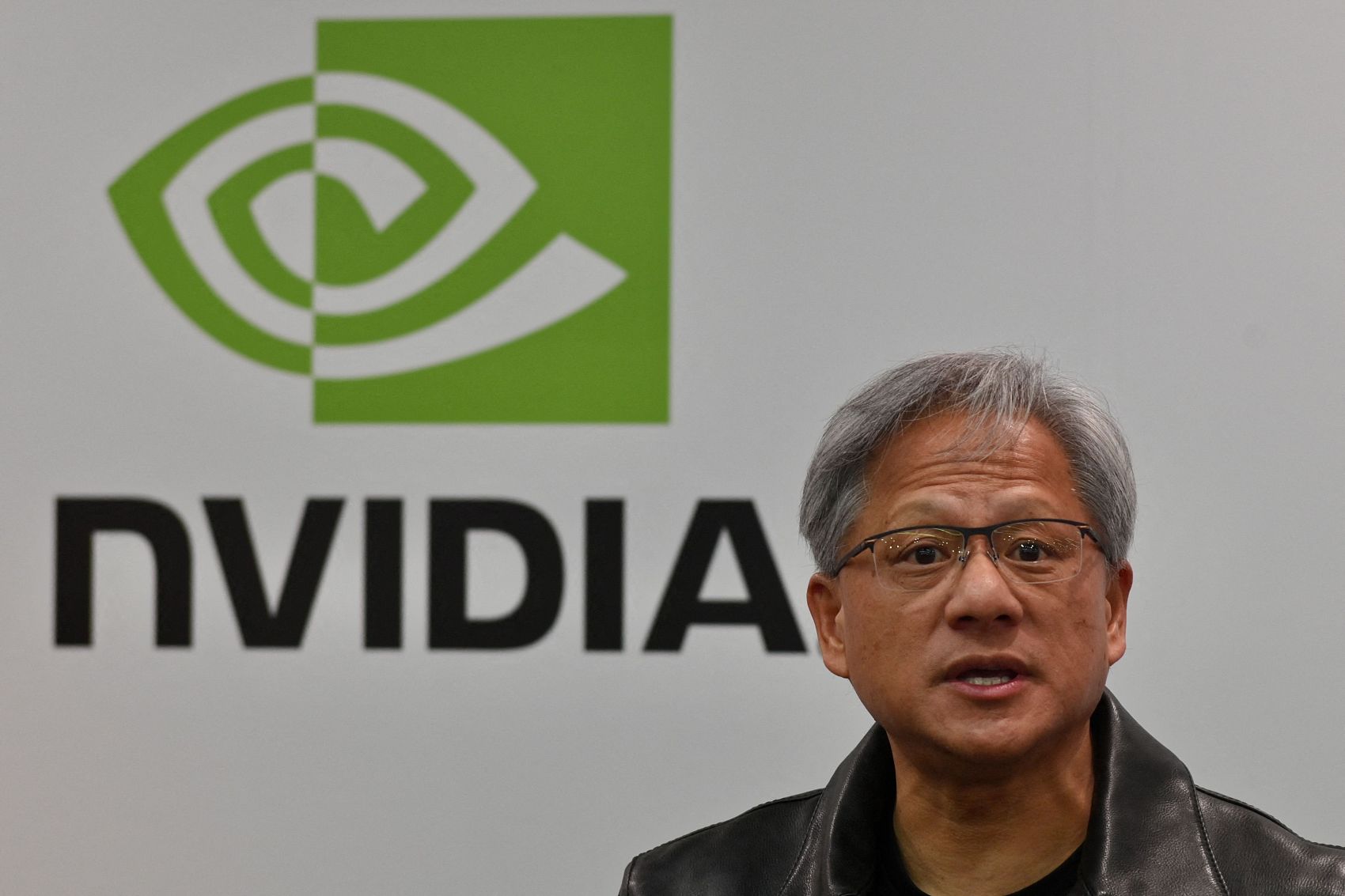
NVIDIA's latest quarterly results, once again exceeding market expectations by a wide margin, have reaffirmed its unassailable dominance in the AI chip sector. This performance directly drove a sharp pre-market surge in its stock price and prompted multiple analysts to raise their target prices.
Against the backdrop of surging demand for artificial intelligence (AI) computing power, $NVIDIA (NVDA.US)$ the company’s latest quarterly results once again demonstrated its unassailable dominance in the AI chip sector, with figures far exceeding market expectations. Even more striking to Wall Street was the company’s full-year revenue guidance for fiscal 2028, which came in nearly $200 billion above the consensus estimate. This directly propelled its share price up by more than 7% in early trading today and prompted multiple analysts to raise their target prices.
Data shows that in the quarter ended July 2026 (the company's second fiscal quarter), NVIDIA achieved revenue of $96.2 billion, a year-on-year increase of 106%, far exceeding Wall Street's expectation of approximately $92 billion. Net profit reached $59.69 billion, or $2.46 per share, compared to net profit of $26.42 billion and earnings per share of $1.08 in the same period last year, representing a year-on-year increase of over 125%. The gross margin remained at a high level of 75%, though slightly below previous market expectations.
 In terms of business structure, the data center business remains the absolute core driver, with single-quarter revenue reaching $89 billion, a year-on-year increase of 117%. The company stated that demand for the Blackwell Ultra platform remains strong, with significant increases in revenue from sovereign AI, AI-native enterprises, and corporate clients. In addition, edge computing business revenue was $7.2 billion, up 13% quarter-on-quarter and 27% year-on-year. Operating expenses rose 55% year-on-year to $8.41 billion, reflecting the company's continued high investment in research and development and market expansion.
Jensen Huang, founder and CEO of NVIDIA, stated in the earnings report: "AI has reached an inflection point; it is doing useful work, tokens are becoming productive and profitable. Now, computing power itself is revenue." He further pointed out that the expansion of AI infrastructure is "operating at full speed," with the next-generation Vera Rubin platform already in full production, achieving the fastest product ramp-up speed in the company's history.
For the current quarter (August to October), NVIDIA provided revenue guidance of approximately $108 billion, higher than analysts' expectations of $103.9 billion, representing a year-on-year increase of about 89%. At the same time, the company expects the gross margin for the quarter to be around 74%, slightly lower than Wall Street's expectation of 75%, mainly due to product mix and initial ramp-up costs.
What truly ignited the market was the company's full-year outlook for fiscal year 2028. Colette Kress, CFO of NVIDIA, stated during the conference call that the company expects revenue for fiscal year 2028 to grow by 70% year-on-year, whereas the previous Wall Street consensus expectation was only 44%. More importantly, Kress emphasized that this 70% growth rate is still constrained by supply limitations, with actual demand growth exceeding triple digits. Calculated based on fiscal year 2027 revenue of approximately $396 billion, fiscal year 2028 revenue will reach approximately $673 billion. This figure would surpass Apple (AAPL.US) and Alphabet (GOOGL.US), ranking second only to Amazon (AMZN.US) as the tech company with the second-highest global revenue.
New Financial Forecast Shocks Wall Street: NVIDIA Stages a "Back to the Future"-Style Comeback
Jefferies analyst Blayne Curtis directly cited the classic title from Star Wars in his report, even describing this guidance as "The Emperor Strikes Back" to characterize NVIDIA's staggering performance guidance.
He pointed out: "The key takeaway from this earnings report is the guidance for 70% full-year revenue growth in fiscal 2028, compared to Wall Street's expectation of only 44%. This corresponds to $700 billion in revenue, versus a consensus of $570 billion, and is $200 billion higher than the previous $1 trillion framework for Blackwell plus Rubin. The 70% growth is merely the baseline, with unconstrained demand approaching 100%. Based on this foundation, we clearly see a path to $1 trillion in revenue for fiscal 2029, which is an astonishing figure for a company of this scale." Curtis maintained his "Buy" rating on NVIDIA with a target price of $300.
Other institutions were equally lavish in their praise, with Evercore ISI being one of them.
Evercore ISI analyst Mark Lipacis significantly raised his price target from $413 to $465, maintaining an "Outperform" rating. He believes the upside in revenue prospects is sufficient to offset the impact of lowered gross margin guidance (72%-73% for calendar year 2027, previously in the mid-70% range) and the $160 billion in multi-year guarantees and commitments provided by the company to help customers secure land, power, and housing capacity.
Lipacis wrote, "We see two catalysts for NVIDIA: first, entering a positive capital return cycle, and second, the potential to stabilize or even increase market share in 2027. At 13 times our calendar year 2027 earnings per share estimate, NVIDIA offers one of the most attractive risk-reward profiles in our coverage universe."
Bank of America analyst Vivek Arya reiterated NVIDIA as his top pick with a "Buy" rating, arguing that management presented a "compelling vision"—including guidance, off-balance-sheet disclosures, supply conditions, and the temporary decline in gross margins—that should silence skeptics for some time. "Management clearly demonstrated how strategic investments will help NVIDIA consolidate its dominant position in the 'once-in-a-generation' AI build-out wave; this vision is convincing," Arya wrote in his report.
JPMorgan raised its price target from $280 to $320, maintaining an "Overweight" rating. The bank noted accelerating data center growth, strong demand for Blackwell Ultra, and the commencement of shipments for the Vera Rubin platform, which has secured purchase orders from major hyperscalers, AI cloud providers, and system OEMs. The company described this as the fastest product ramp-up in its history. JPMorgan expects gross margins to bottom out in the fourth quarter of fiscal year 2027 before recovering in fiscal year 2028. The gross margin outlook for fiscal year 2028 is supported by HBM supply commitments, with the company having locked in HBM supply at known prices for the majority of its demand.
Mizuho raised its price target from $300 to $315, maintaining an "Outperform" rating. The bank forecasts fiscal year 2028 revenue to reach approximately $700 billion, representing a year-over-year increase of over 70%, significantly higher than the current consensus of $574 billion. Mizuho also expects Blackwell Ultra to continue its ramp-up, with Vera Rubin potentially contributing about 20% of revenue in the October quarter. Regarding gross margins, they are expected to decline to approximately 74% in the October quarter, down 100 basis points quarter-over-quarter, reaching a low of 71%-72% in the January quarter, before stabilizing at 72%-73% in fiscal year 2028. The $315 price target is based on approximately 20 times the earnings multiple for fiscal year 2028.
Goldman Sachs raised its price target from $285 to $300 but maintained a "Neutral" rating. Analyst James Schneider believes that given the strong outlook for calendar year 2027, the stock price is expected to maintain its recent gains, though it may trade in a range as better-than-expected guidance meets already high market expectations. He specifically noted that management's commitment to return more than 50% of excess free cash flow to shareholders could provide additional support for the stock price. Furthermore, the medium-term gross margin guidance of 72%-73% for calendar year 2027 helps alleviate investor concerns about rising input costs, while more transparent disclosures regarding customer financial guarantees and commitments allow investors to better assess potential financial risks.
Options Market: One-Month Target Points to $260
The options market was equally active following the earnings release. According to options trading data, the implied volatility priced into the options market before NVIDIA's earnings report was approximately ±6.1%, and the 7% pre-market gain on Thursday fell almost precisely within this predicted range.
As the dust settled on the earnings trade, market attention quickly shifted to the option chain expiring on September 25. The implied volatility of this option chain indicates that the market expects NVIDIA's price to fluctuate by approximately ±10.1% over the next month, corresponding to a price range of roughly $202 to $247 (based on pre-market prices).
However, what truly stands out is the distribution of open interest in call options. The open interest for $260 strike call options reached 31,842 contracts, making it the single largest position in the entire option chain, representing a level approximately 15.7% above Thursday's pre-market price. This implies that a significant number of traders had already targeted the $260 level before the earnings announcement. Open interest for $250 calls stood at 28,914 contracts, $240 calls at 25,731, and $230 calls at 22,619, presenting a stepwise bullish pattern extending up to 15,847 contracts for $300 calls—the latter being approximately 33% above the pre-market price. Since the $260 call options lie well beyond the volatility range implied by the September 25 option chain, traders holding these contracts are clearly betting on momentum continuation rather than a slow drift post-earnings.
In terms of downside protection, the $200 put option has emerged as the largest put contract with an open interest of 24,107 lots, trading approximately 11% below pre-market levels. This strike is regarded as a critical defense line where "the bullish thesis begins to unravel post-earnings." Further down, the $195, $190, $185, and $180 strike prices form a protective ladder, while the 18,847 lots of open interest in the $170 put options are being used by traders to hedge against extreme tail risks.
The sole bearish view: Seaport argues that "sold-out" status limits upside potential
Amid a chorus of bullish sentiment, Jay Goldberg, an analyst at Seaport Research Partners, stands as the only analyst on Wall Street maintaining a "Sell" rating. In an interview following NVIDIA's earnings release, he stated that although the chip giant's quarterly performance was "very impressive," it "matters little" because the company's chips are already sold out. Supply constraints imply virtually no room for upside surprises for the remainder of the year.
Goldberg pointed out that NVIDIA's reliance on Taiwan Semiconductor represents a constraint that is difficult to alleviate in the short term. He believes that NVIDIA's chip capacity allocation for the year is already fully locked in. "When your products are sold out, where does the upside come from? This situation will not change within the year." He specifically highlighted that NVIDIA's dependence on Taiwan Semiconductor is a structural constraint that cannot be eased in the near term.
He also mentioned that NVIDIA's acquisition of Groq could add production capacity outside of Taiwan Semiconductor next year, and revenue from software and new cloud services may bring additional growth, but these developments will take time.
Furthermore, he emphasized the competitive threats posed by AMD's Instinct chips, Google's TPUs, and in-house chips developed by OpenAI and Anthropic. Nevertheless, he expects NVIDIA to maintain its largest market share.
Editor/lambor