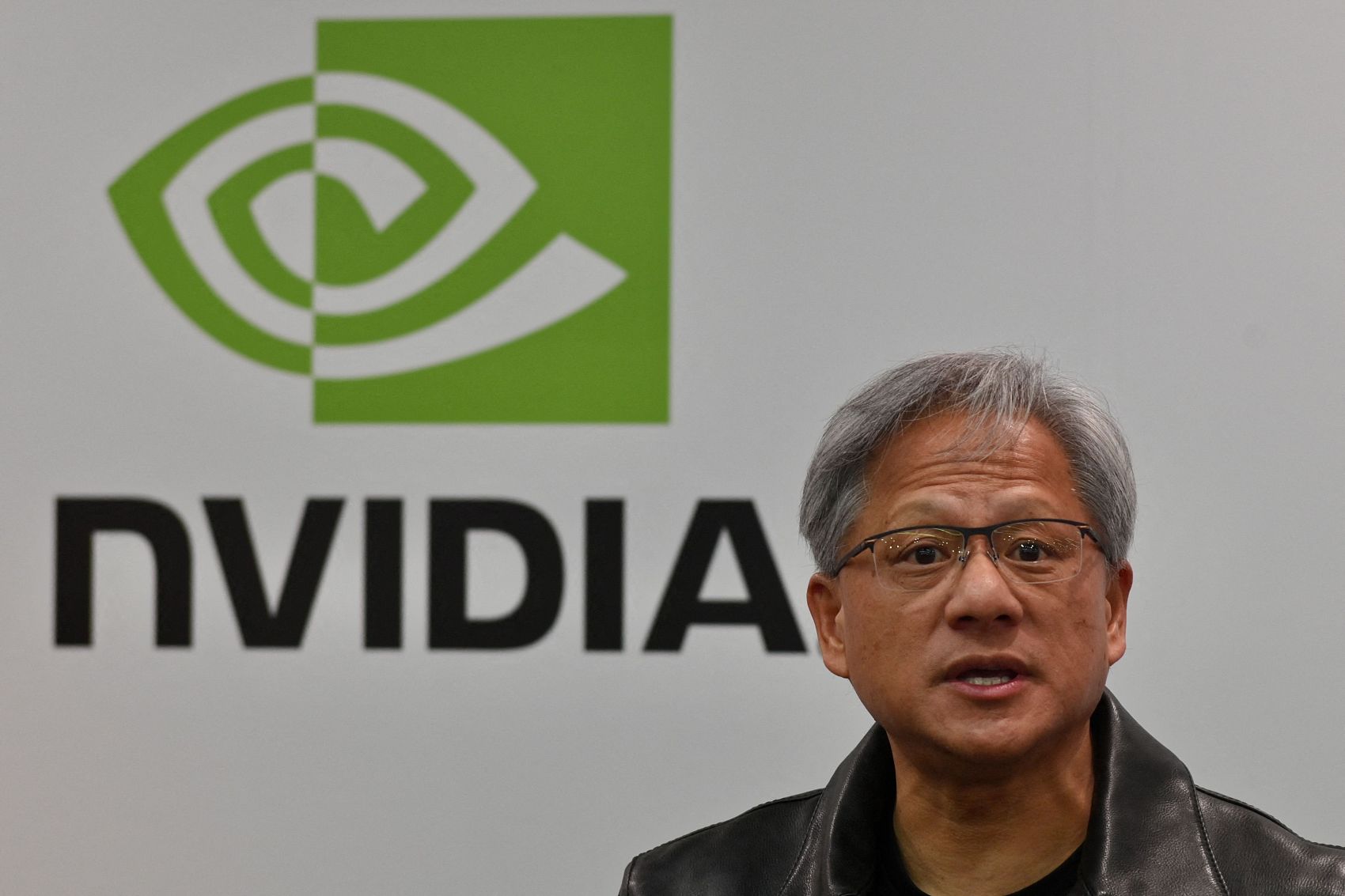
NVIDIA’s blockbuster earnings report drove a single-day market capitalization surge of $442 billion, marking the second-largest one-day increase in history and thoroughly dispelling the “post-earnings dip” curse. Strong performance results have cleared the air over AI trade concerns, catching short sellers off guard and lifting the entire technology sector. JPMorgan noted that although the company’s guidance already far exceeded expectations, it may still be conservative; NVIDIA explicitly characterized the current phase as “supply-constrained,” indicating that actual demand would be significantly higher if supply were not restricted.
$NVIDIA (NVDA.US)$ A blockbuster earnings report has dispelled the gloom hanging over AI trades.
On Thursday, NVIDIA's stock surged 8.7% in a single day, marking its largest daily gain since April 2025, with its market capitalization soaring by $442 billion in one day. This increase was second only to$Microsoft (MSFT.US)$the $450 billion single-day market cap gain recorded in July this year—the latter being the largest single-day market capitalization increase on record.
 NVIDIA's strong second-quarter results and optimistic outlook for semiconductor sales next year drove the S&P 500 Information Technology sector up 3.4%, making it the only sector to close higher for the day and lifting the broader market indices.
NVIDIA had previously issued strong forward guidance, projecting revenue growth of approximately 70% for the next fiscal year, significantly exceeding the market’s prior expectation of around 45%. Following the announcement, Wall Street institutions widely upgraded their ratings and price targets, describing the guidance as "stunning" and indicating over $100 billion of upside potential relative to current market expectations. JPMorgan noted that although the outlook far surpassed expectations, it might still be conservative, as the company explicitly characterized the current phase as "supply-constrained," suggesting that actual demand momentum would be significantly higher if supply were not limited.
Previously, concerns about the return on investment for AI, the complexity of data center financing structures, and the sustainability of chip demand had shaken some Wall Street investors’ confidence in the longevity of the AI trade. NVIDIA’s earnings report delivered a powerful rebuttal with a nearly half-trillion-dollar increase in market capitalization, catching options traders who had bet on a price decline off guard.
Breaking the "Earnings Day Curse"
NVIDIA’s extraordinary growth has become so deeply embedded in Wall Street’s collective consciousness that investors generally expect its performance to beat estimates, which paradoxically led to the stock falling in six of the eight trading sessions following previous earnings releases. This week, many options traders continued to bet on a post-earnings price decline.
However, on Thursday, NVIDIA once again defied these expectations. Its stellar second-quarter results caught short sellers off guard, sending the stock up 8.7% in a single day and adding $442 billion to its market capitalization. According to The Wall Street Journal, this increase was slightly below Microsoft’s record single-day market cap growth of $450 billion set in July of this year.
Divergent Performance in Tech Stocks: Software Shares Lead Gains
While NVIDIA's strong performance lifted the broader market, performance within the technology sector was mixed.$Nasdaq Composite Index (.IXIC.US)$rose 1.6%, and the Dow Jones Industrial Average increased by 0.2%, or approximately 106 points.
At the individual stock level, $Microsoft (MSFT.US)$ 、$SpaceX (SPCX.US)$and$Oracle (ORCL.US)$also registered gains, with Intel rising 4.4%;$Amazon (AMZN.US)$、 $Meta Platforms (META.US)$ and $Alphabet-C (GOOG.US)$ closed lower.
The software sector performed particularly strongly.$Salesforce (CRM.US)$surged 23% in a single day after the company announced a deepened partnership with Anthropic, boosting market confidence in its AI integration capabilities. Cybersecurity firm$CrowdStrike (CRWD.US)$The company raised its performance guidance in its financial report, citing a 21% increase driven partly by new business growth stemming from the ongoing spread of AI-related security risks.$Palo Alto Networks (PANW.US)$、$ServiceNow (NOW.US)$and$Synopsys (SNPS.US)$Share prices of software companies also rose in tandem.
NVIDIA’s Role Quietly Shifts: From Chip Vendor to Financial Backer
Despite the broad boost in market sentiment, several financial figures disclosed in NVIDIA’s earnings report have drawn analysts’ attention. As of July 26, NVIDIA held $99 billion in equity investments, with an additional $25 billion in committed but unfunded equity investments; meanwhile, its long-term debt has risen sharply to $33 billion.
Furthermore, NVIDIA is collaborating with several major Wall Street banks to plan financing guarantee support of up to $500 billion for potential customers, though these initiatives remain in their preliminary stages.
Dan Hanbury, Global Equity Portfolio Manager at investment management firm Ninety One, stated: "These figures do not suggest that demand is fictitious; demand is clearly real at present. However, they do indicate that NVIDIA is increasingly shouldering the working capital requirements of its own customer base."
Market Focus Shifts to Jackson Hole
Beyond the boost from NVIDIA’s earnings, the market’s next focus has shifted to the macroeconomic landscape. On Friday, investors will turn their attention to Jackson Hole, Wyoming, awaiting further guidance from Federal Reserve Chair Walsh on the path of interest rate policy.
Recently, stubborn inflationary pressures, a renewed deterioration in the U.S. fiscal outlook, and bond sell-offs triggered by massive debt financing from AI giants have collectively pushed U.S. Treasury yields to multi-year highs. On Thursday, the yield on the 10-year U.S. Treasury note remained largely flat, hovering around 4.671%.
Analysts at Standard Chartered Bank expect that Walsh will attempt to rebuild market confidence in the Federal Reserve’s commitment to controlling inflation and persuade investors that a more low-profile central bank will not pose risks to the economy. "Both tasks are quite challenging, and we are becoming increasingly skeptical about his ability to succeed," the analysts wrote in their report.
Editor/rice