Elon Musk personally refuted Morgan Stanley: While the investment bank projected SpaceX’s revenue to reach $3.5 trillion by 2040, Musk responded that this figure could be achieved as early as 2033, seven years ahead of schedule. Morgan Stanley set a target price of $300, arguing that the current stock price assigns nearly zero valuation to corporate AI. However, the new multi-billion-dollar base in Louisiana and the nearly tenfold reduction in Starship costs over the past decade may rewrite the commercial logic of the entire space economy.
$SpaceX (SPCX.US)$ Elon Musk publicly responded to Morgan Stanley's latest research report, arguing that the bank's timeline for forecasting the company's revenue scale is overly conservative. This public debate surrounding SpaceX's valuation and growth potential has once again brought the commercial prospects of this private aerospace company into the market spotlight.
In its latest report, Morgan Stanley analyst Adam Jonas assigned an "Overweight" rating to SpaceX with a target price of $300, predicting that the company's revenue will reach $3.5 trillion by 2040. Following the report's release, X platform user Aaron Burnett pointed out that Morgan Stanley's projections are based on assumptions representing barely half of SpaceX's own targets, with a timeline lagging approximately ten years behind the company's internal planning. Musk promptly responded on X, stating: "I personally estimate that revenue of roughly $3.5 trillion will be achieved around 2033."

 This statement implies that Musk believes the company will achieve this revenue scale approximately seven years earlier than Morgan Stanley's forecast. For investors, if Musk's assessment proves closer to reality, the valuation discount implied by the current share price would be even more significant. The Morgan Stanley report noted that SpaceX's current share price is approximately $138, corresponding to a price-to-sales ratio of about 10 times its projected 2028 revenue, while the implied valuation for its enterprise AI business is nearly zero.
Morgan Stanley: SpaceX Is Undervalued, Sets $300 Target Price
Morgan Stanley maintained its "Overweight" rating on SpaceX in its latest report, setting a target price of $300, which implies more than double the upside from the current share price of approximately $140.87. The report employs a sum-of-the-parts valuation method, breaking down SpaceX into four business segments: space launch, Starlink connectivity, AI (including X and Grok), and enterprise AI, with corresponding valuations of $8, $118, $8, and $165 per share, respectively.
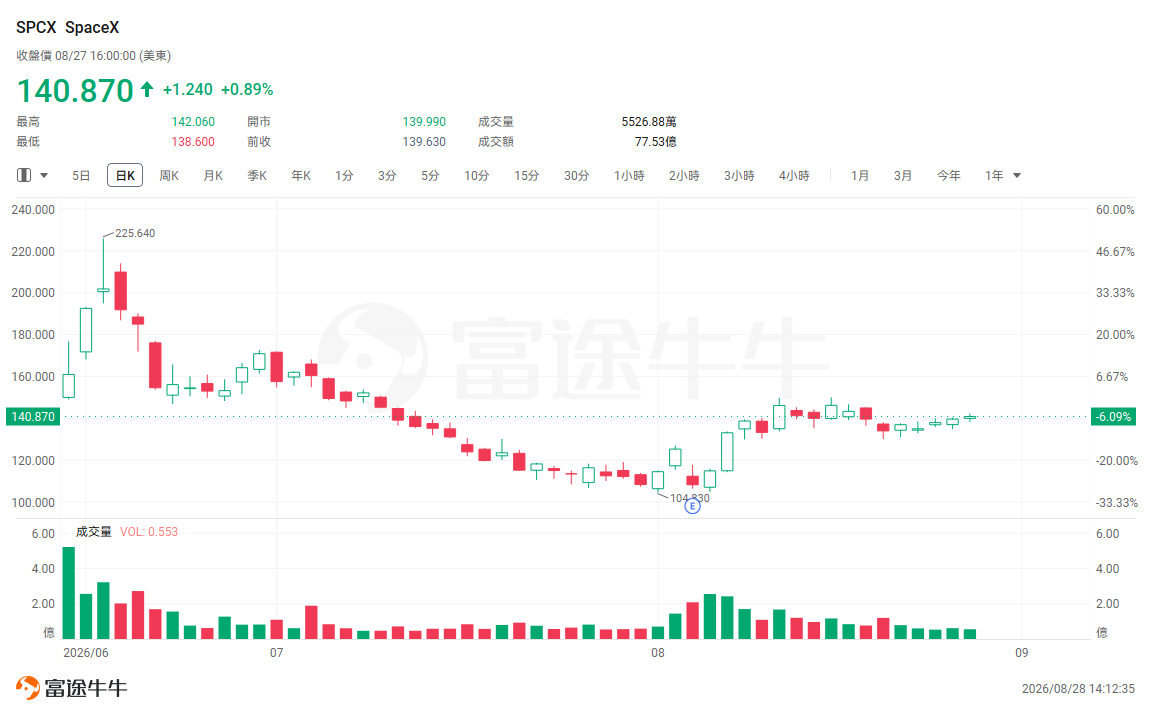
The report argued that the current share price assigns a value close to zero to the enterprise AI business, and similarly fails to account for the option value of orbital computing capabilities. Morgan Stanley calculated that each additional 1 GW of orbital computing capacity (based on $50 per watt, a 70% incremental profit margin, and a 10x EBITDA multiple) would contribute approximately $27 to the share price, equivalent to about 20% of the current price.
The report also noted that SpaceX is currently trading at approximately 10 times its projected 2028 price-to-sales ratio, corresponding to a revenue growth rate of about 70%; and at approximately 25 times its projected 2028 EV/EBIT ratio, corresponding to a profit growth rate of about 113%. Morgan Stanley considers this valuation level attractive for a company with such a steep growth trajectory.
Louisiana's Multi-Billion Dollar Base: A Strategic Leap in Launch Capacity
The direct trigger for the report was SpaceX's announcement of a new launch site, Starbase LA, in Vermilion Parish, Louisiana, with a total investment of $100 billion. Construction is scheduled to begin in 2027, with the first launch planned for 2029. The base will feature up to ten launch pads (five launch complexes, each equipped with two pads), along with supporting propellant production facilities, power plants, and employee housing, and is expected to create approximately 3,000 direct jobs.
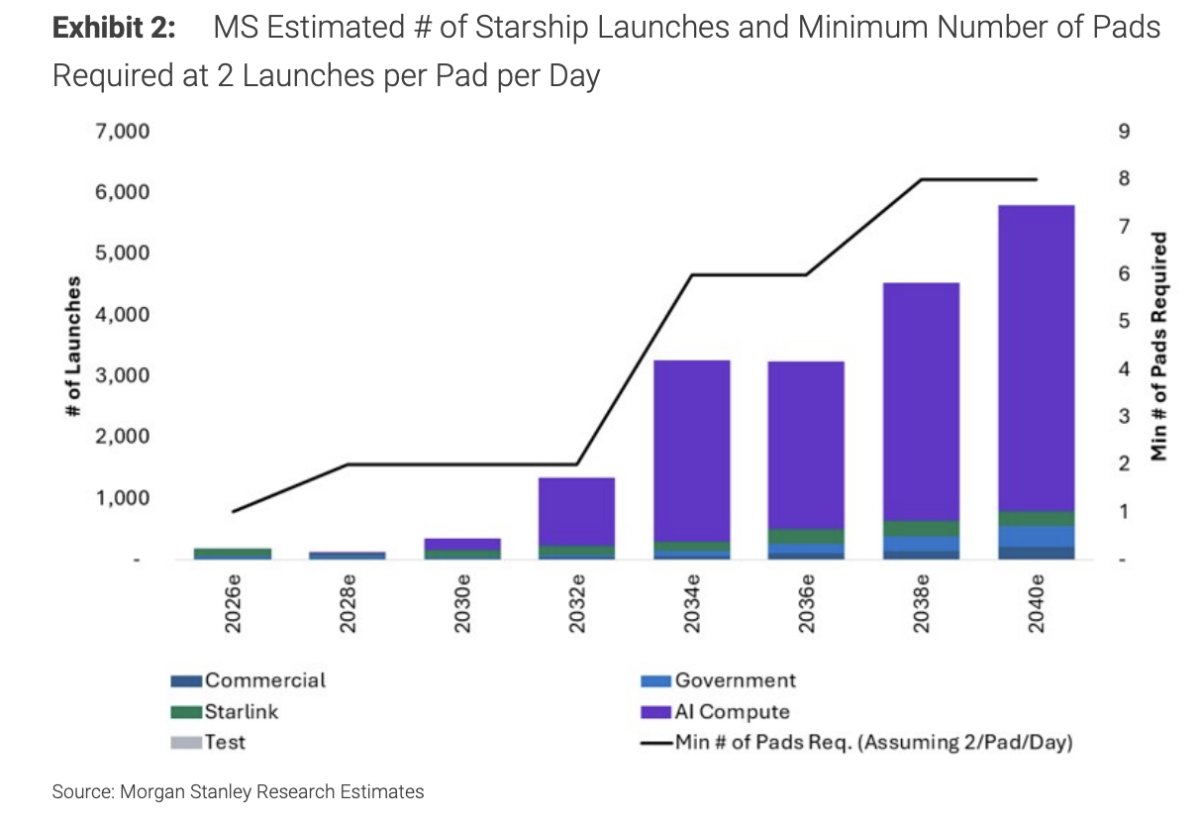
Morgan Stanley pointed out that even without relying on the full operational capacity of the Louisiana base, its forecast of approximately 5,800 annual Starship launches by 2040 would require only about eight launch pads. Currently, SpaceX has a total of 15 launch pads planned across Texas, Florida, and Louisiana.
The selection of Louisiana as a site involves multiple strategic considerations. First, the state's geographic location allows for polar orbit launches southward across the Gulf of Mexico, enabling access to dawn-dusk sun-synchronous orbits that are difficult to achieve from Texas, Florida, or California, which holds direct value for orbital computing businesses. Second, Louisiana is the third-largest natural gas producer in the United States, and each Starship launch consumes over 1,000 tons of liquid methane. Third, against the backdrop of bipartisan resistance to data centers and AI infrastructure in several states, dispersing launch facilities across different jurisdictions helps mitigate regulatory risks. Furthermore, Louisiana has tailored a series of incentive policies for SpaceX, including sales tax rebates for large aerospace facilities, extending industrial tax exemptions to aerospace manufacturing, and liability protection clauses for specific litigation.
Starship: The Core Support for Cost Reduction Logic and Launch Scale
Morgan Stanley's valuation logic relies heavily on Starship's cost reduction trajectory and increased launch frequency. The report forecasts that Starship's launch cost per kilogram will decrease from approximately $1,000 in 2025 (based on Falcon 9 internal costs) to around $500 in 2030 (corresponding to 341 launches), drop below $200 by 2035 (corresponding to approximately 2,600 launches), and further decline to below $150 by 2040 (corresponding to approximately 6,000 launches).
Morgan Stanley analogizes reusable rockets to an "elevator to space," arguing that Starship, with a maximum payload capacity more than five times that of Falcon 9 and a fully reusable design featuring recoverable first and second stages, has the realistic potential to compress launch costs by nearly another tenfold.
Regarding specific assumptions, Morgan Stanley has adopted a relatively conservative stance. The report assumes that the Starship spacecraft will have an effective service life of fewer than two flights between 2027 and 2029, three flights in 2030, four flights in 2031, and will only reach approximately 43 flights by 2040. For the booster, the report assumes that SpaceX will require about eight years to achieve a reuse level of over 30 flights, which is broadly consistent with the historical iteration pace of Falcon 9.
The report also notes that SpaceX has announced the completion of its final Starlink launch mission using Falcon 9 in Florida, with all future Starlink launches from Florida to be conducted exclusively by Starship. Since each Starship launch offers a downlink capacity up to 25 times that of Falcon 9, this transition will have a relatively limited impact on overall launch frequency.
Orbital Computing: The Next Trillion-Dollar Growth Engine
Morgan Stanley positions orbital computing as a core variable in SpaceX's long-term valuation and identifies it in the report as the primary driver of launch demand after 2032. The report argues that the core competitive advantage of orbital computing lies not in absolute cost parity with ground-based computing, but in its scalability and speed of deployment.
Citing two new cloud computing contracts signed by SpaceX, the report points out that customers are willing to pay a significant premium for immediate access to large-scale, high-end GPU clusters. This aligns with the logic of SpaceX's launch business, which continues to raise prices periodically even as costs decline. Morgan Stanley predicts that SpaceX's orbital computing capacity will reach 4.9 GW by the end of 2027, while the company's own target is approximately 10 GW.
Morgan Stanley also highlights that the $100 billion investment in the Louisiana base will be disbursed in phases over ten years. This scale is equivalent to the total capital expenditure for SpaceX's space business in its model from 2026 to 2035, but represents only about 2% of total capital expenditures during the same period, including AI-related spending. The report acknowledges that while large-scale capital expenditure plans are easy to announce on paper, growth must be genuinely realized to continuously justify the investment to both SpaceX and the debt markets.
Editor/rice