
Bank of America forecasts that spot prices for DRAM and NAND could rise by another 10% to 20% in September, driven by the combined impact of memory supply shortages and peak seasonal demand. Samsung, SK Hynix, and Micron are prioritizing capacity allocation for AI customers, leaving channel supply fulfillment rates below 50%. NVIDIA's strong growth guidance has further reinforced expectations for memory demand, suggesting that industry momentum is likely to persist.
The supply-demand imbalance in the spot market for memory chips continues to intensify. Coupled with the approach of the traditional peak consumer season, Bank of America expects spot prices in September to have further upside potential of 10% to 20%.
According to a report released by Bank of America Global Research on August 27, channel surveys indicate that the supply sufficiency ratio in the spot market for September is below 50%. Module manufacturers and white-label OEMs generally report an inability to secure sufficient volumes of commodity DRAM and NAND products from major memory chip manufacturers, as companies such as Samsung Electronics, SK Hynix, and Micron are prioritizing capacity allocation to large technology clients.
 The report points out that although current spot prices have pushed most IT products into negative gross margin territory, the resonance between supply shortages and peak-season effects will continue to drive prices higher.
This assessment is underpinned by NVIDIA’s latest fiscal 2027 revenue growth guidance of approximately 70%, which far exceeds market expectations. Bank of America believes this provides a positive boost to investors in the memory sector who had previously turned bearish. The report also notes that NVIDIA’s growth forecast already incorporates assumptions of memory shortages; if demand further exceeds expectations, the memory industry could exhibit even greater growth elasticity.
Spot Prices: Multiple Categories Hit Record Highs, with Supply Gap as the Core Driver
According to data from DRAMeXchange, as of the report's release date, the spot price for 16Gb DDR5 was quoted at $54, representing a year-to-date increase of 85% and hitting a record high. The spot price for 16Gb DDR4 was quoted at $91, up 879% year-over-year, while 8Gb DDR4 was quoted at $44, up 803% year-over-year.
In the NAND segment, the spot price for 1Tb wafers was quoted at $31.9, up 526% year-over-year. The price for 256Gb wafers was quoted at $16.8, up 6% week-over-week and surging 979% year-over-year.
Bank of America’s channel survey shows that the supply sufficiency ratio in the spot market for September is below 50%. This figure corroborates information disclosed by Samsung Electronics during a virtual roadshow, which indicated that even by next year, the supply sufficiency ratio for DRAM used in high-end GPUs and CPUs will remain only around 50% to 60%. The report emphasizes that although current spot prices have rendered gross margins negative for most IT products, the combination of supply shortages and peak-season demand still supports a 10% to 20% upside potential for spot prices in September.
NVIDIA Fiscal 2027 Guidance: Memory Growth Potential May Exceed 80%
Bank of America’s report views NVIDIA’s fiscal 2027 revenue growth guidance of approximately 70% as a significant catalyst for the memory industry, and accordingly has raised its growth expectations for global DRAM sales.
The report indicates that if the average selling price (ASP) is assumed to rise by 10% quarter-on-quarter in each quarter of 2027, coupled with approximately 19% growth in shipment volume, global DRAM sales revenue in 2027 could increase by more than 80%, significantly higher than the previously forecasted 48% (based on a 24% ASP increase and 19% shipment growth).
Bank of America identified three key drivers:
First, approximately 70% of NVIDIA’s own growth forecast is already based on assumptions of memory shortages. If demand for chip orders strengthens and adoption of the Rubin/Vera platforms expands, there will be further upside potential.
Second, the ASIC/TPU camp is competing more aggressively for HBM, DRAM, and NAND resources and is willing to pay higher prices than NVIDIA.
Third, if NVIDIA and hyperscale cloud providers absorb the new capacity added by the three major memory manufacturers, Apple, Chinese OEMs, and **** module makers may propose higher memory pricing for 2027 under long-term agreement frameworks. In such a scenario, the ASP could potentially rise by more than 10% quarter-on-quarter in a single quarter.
Supply Chain Roadshow: Supply Expansion Constrained; Long-Term Agreement Share Increases
This week, Bank of America held virtual roadshows covering more than ten memory and South Korean technology companies, with an overall optimistic tone.
Samsung Electronics stated that even under Long-Term Agreements (LTAs), DRAM ASPs remain negotiable on a quarterly basis. Currently, about 60% to 70% of wafer capacity is managed under LTAs. The capacity of the new fabrication plant (P4) is primarily dedicated to HBM. There are no instances of de-specification for high-end GPUs/CPUs, and the supply fulfillment rate for next year is expected to remain at only about 50% to 60%.
SK Hynix noted that although construction of the new Yongin facility is progressing, overall wafer capacity expansion is constrained due to HBM capacity allocation, and the company is not interested in expanding production of legacy DRAM and NAND. Even with an increased LTA share, there remains significant room for near-term ASP increases.
Nanya Technology pointed out that demand for legacy DDR4 is very strong. Installation of equipment at its new fabrication plant is expected to begin in the first quarter of 2027, with an initial target capacity of 30,000 wafers per month, aiming to reach full production by 2028. Silicon Motion reported that annualized revenue from enterprise solutions has doubled from approximately $1 billion a year ago to nearly $2 billion. FADU expects eSSD controller sales to grow by over 100% from the second half of 2026 through 2027.
South Korea's Semiconductor Exports Hit Record High in First 20 Days of August
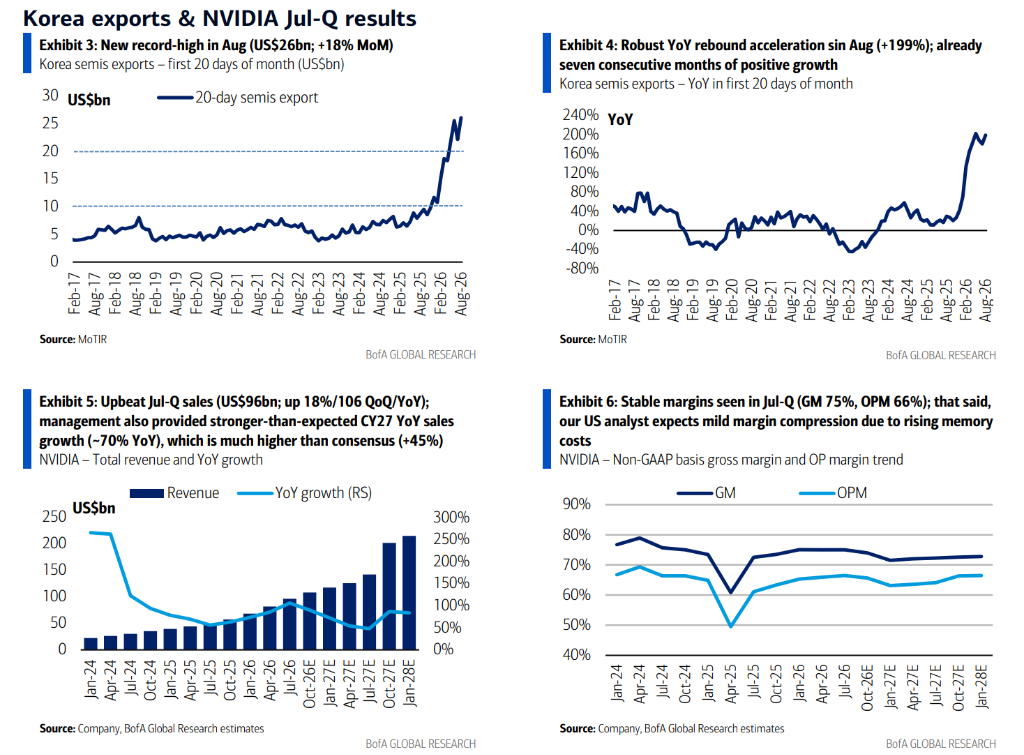
Data from South Korea's Ministry of Trade, Industry and Energy shows that semiconductor exports reached $26 billion in the first 20 days of August, an 18% increase month-on-month, setting a new historical record. The year-on-year growth rate accelerated to 199%, marking seven consecutive months of positive growth.
NVIDIA reported revenue of $96 billion for the July quarter, representing a 106% year-on-year increase and an 18% month-on-month rise. Data center revenue reached $89 billion, up 117% year-on-year, accounting for 93% of total revenue.
Bank of America analysts project that NVIDIA's gross margin will experience mild compression as memory costs rise, but the data center gross margin is expected to remain above 70%.
Valuation of Memory Stocks: Significant Outperformance Persists Despite July–August Pullback
Although DRAM and NAND-related stocks experienced a pullback between July and August, their year-to-date gains remain substantial.
According to Bank of America data, the share prices of Samsung Electronics, SK Hynix, Micron, and Nanya Tech have all risen by two to three times compared to the beginning of 2026; SanDisk and Kioxia have achieved year-to-date returns exceeding 400%.
From a valuation perspective, most DRAM stocks are currently trading at price-to-earnings ratios in the range of 4x to 8x, which Bank of America considers not expensive.
The report notes that the share prices of SK Hynix and Samsung Electronics saw a significant rebound on August 27 following NVIDIA's earnings release. Regarding contract prices, those for 16Gb DDR5 and DDR4 are both in the $35–$40 range, with month-on-month increases in August narrowing to low single digits, down from 10%–15% in July. The contract price for 512Gb NAND wafers is currently around $26, approximately ten times higher than the low point in February 2025.
Editor/lambor