
The U.S. labor market is cooling, and the latest preliminary annual benchmark revisions indicate that previously reported employment growth figures may have overstated actual job gains. However, compared to the record downward revision last year, this year's adjustment is markedly more moderate.
According to preliminary estimates released by the U.S. Bureau of Labor Statistics (BLS) on Friday, total nonfarm payrolls in the United States will be revised down by approximately 79,000 for the year ending March 2026. By comparison, the median forecast among 20 economists was an upward revision of 183,000, with a prediction range spanning from a downward revision of 100,000 to an upward revision of 350,000. For context, the final benchmark revision for 2025 resulted in a substantial downward adjustment of 862,000 jobs.
This indicates that the magnitude of the current preliminary revision is significantly lower than last year’s and far smaller than the market’s prior expectation of a substantial upward revision. Based on the revised data, the average monthly job gain over the year ending this March was approximately 11,000, which is below the level indicated by the pre-revision figures.
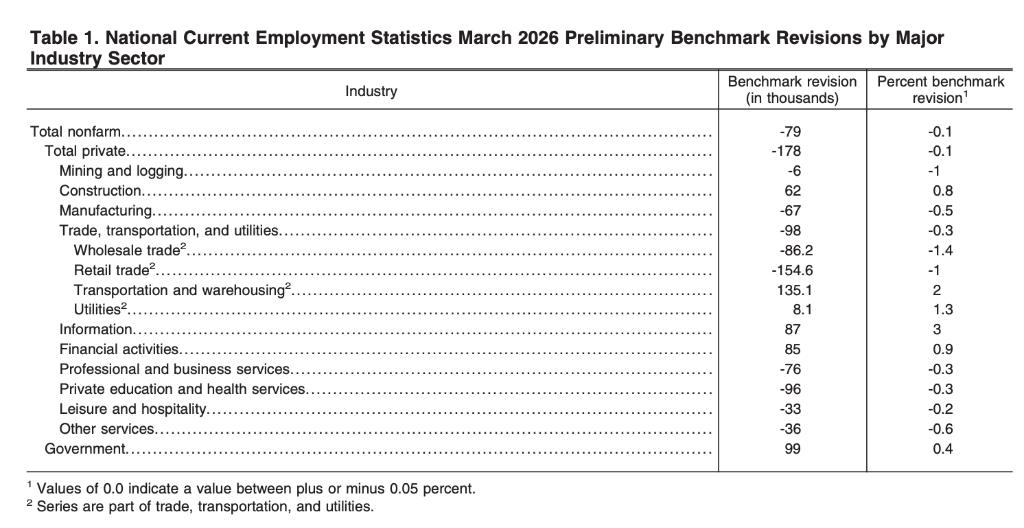
Private-sector employment revised downward as labor market continues to cool
 Structurally, private-sector employment was revised down by 178,000, primarily concentrated in retail trade, education and health services, manufacturing, and professional and business services. Conversely, employment in transportation and warehousing, information, financial activities, and construction saw upward revisions. Government employment was also revised upward.
Overall, this revision further confirms that the U.S. job market is cooling, but it does not indicate the severe deterioration in job growth that had previously concerned market participants. While corporate hiring intent has weakened, layoffs remain limited, and the labor market overall remains in a relatively balanced state.
Each year, the BLS uses the Quarterly Census of Employment and Wages (QCEW) to benchmark nonfarm payroll data through March. The QCEW, which is primarily based on state unemployment insurance tax records and covers the vast majority of U.S. jobs, is regarded as a more comprehensive data source than the monthly nonfarm payroll survey.
These figures remain preliminary estimates; the final benchmark revision will be published in February 2027 alongside the January 2027 employment report. Against the backdrop of recent BLS statistical releases drawing significant market attention, the scale of this revision will serve as an important reference for assessing the true strength or weakness of the U.S. labor market.
Editor/lambor