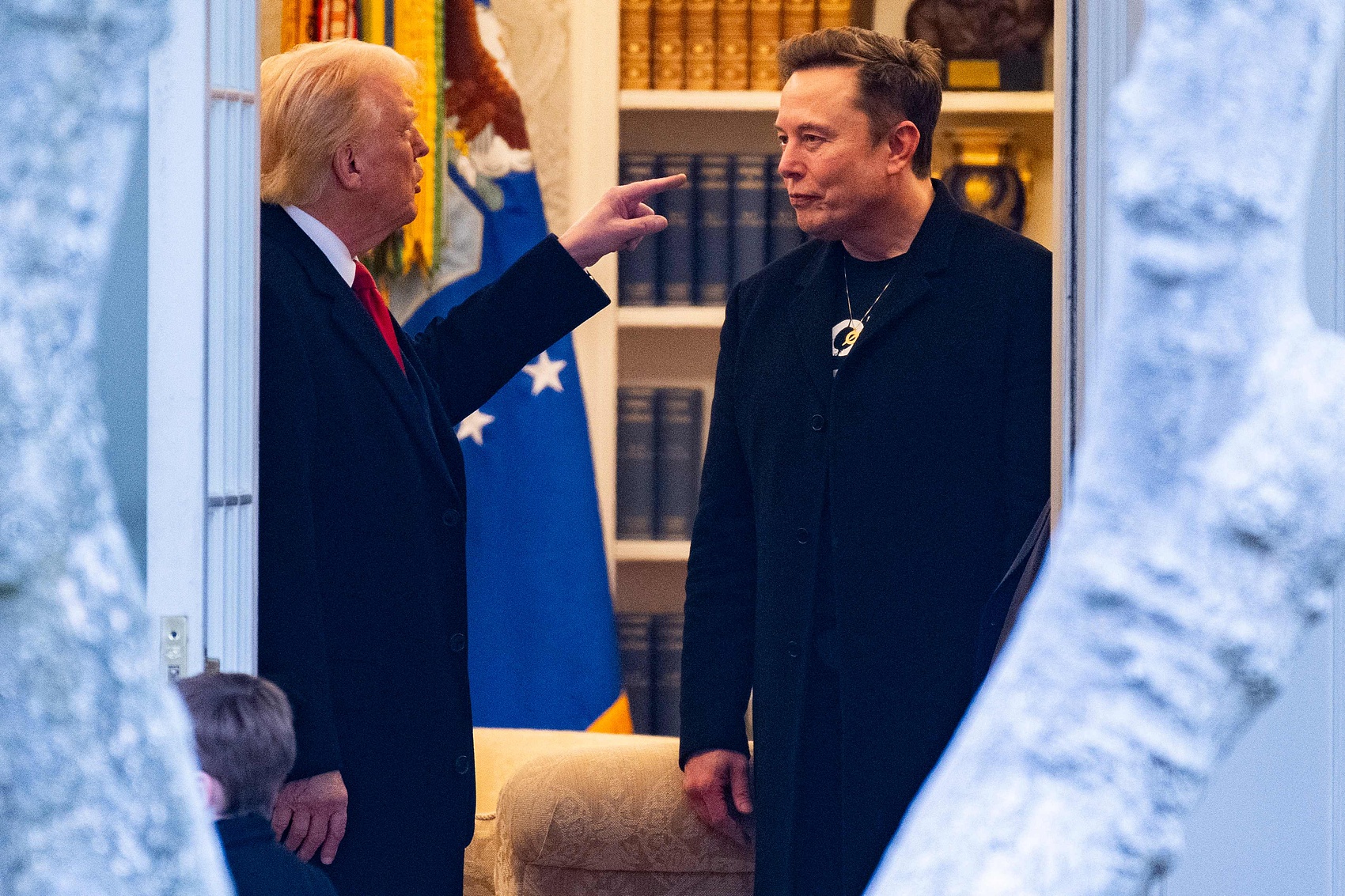
According to reports, SpaceX is establishing a foundry in Bastrop, Texas, to manufacture gas turbine blades and vanes in-house. Musk personally confirmed the plan on social media, stating that it could accelerate turbine deployment by up to 18 months. Morgan Stanley noted that the foundry will also meet casting demands for Raptor rocket engines, thereby achieving cost synergies between aerospace and AI operations.
In response to the industry-wide pain point of power shortages for AI data centers, Elon Musk is applying his characteristic vertical integration strategy to tackle the bottleneck by addressing the weakest link in the supply chain.
On August 30, tech media outlet The Information reported that SpaceX is establishing a foundry in Bastrop, Texas, dedicated to producing blades and vanes for large gas turbines—core components with the highest technical barriers and scarcest production capacity within the global turbine supply chain.
 Following the report, Musk personally confirmed the plan on the social platform X, stating that $SpaceX (SPCX.US)$ in-house casting of blades and vanes could advance the commissioning timeline for gas turbines by up to 18 months, calling it "a profound game-changer."
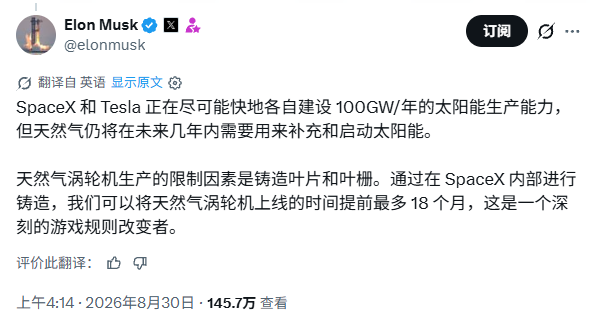
Musk also stated that SpaceX and Tesla are each building solar production capacity of 100 GW per year at the fastest possible pace, but noted that "natural gas will remain a necessary option to supplement and firm up solar power in the coming years."
Meanwhile, research by Morgan Stanley analyst Adam Jonas corroborated the report, pointing out that the foundry will also meet the casting needs for the Raptor engine turbopumps used in SpaceX rockets, thereby achieving cost sharing between aerospace and AI operations.
Blades: The "invisible bottleneck" constraining the global expansion of AI computing power
The report stated that gas turbine blades and vanes must operate under extreme temperatures of 3,000 to 3,600 degrees Fahrenheit (approximately 1,650 to 1,980 degrees Celsius), which is about 800 degrees Fahrenheit higher than the melting point of the materials themselves, imposing extremely stringent requirements on casting processes.
Currently, only four foundries worldwide possess this technology, creating a highly monopolized landscape. This oligopolistic structure has directly led to order backlogs extending to 2030 for major turbine manufacturers such as GE Vernova, becoming one of the core obstacles to accelerating AI infrastructure development.
In a podcast earlier this February, Musk explicitly stated that blades and vanes are the "limiting factor" for faster turbine delivery, warning that based on current production capacity, "I am not sure there is enough available electricity to power all the AI chips currently being produced."
Bastrop: From Satellite Factory to Turbine Casting Hub
According to reports, SpaceX has established multiple industrial facilities in Bastrop, located approximately 30 miles from Austin. The company had previously been operating a factory in the area related to its Starlink satellite business.
Corey Trinetti, a due diligence expert at Measured AI, an AI infrastructure research newsletter, disclosed that SpaceX purchased approximately 830 acres of surrounding land between March and June this year. Satellite imagery shows that two new buildings adjacent to the Starlink factory appeared in July, whereas no structures existed at that location a year ago.
In terms of recruitment, SpaceX recently posted several job openings, including Senior Operations Engineer, Senior Materials Engineer, Automation Engineer, and Senior Tooling Engineer roles responsible for the 'construction, expansion, and operational ramp-up' of the new foundry. Additionally, the company is seeking a programmer to handle high-temperature superalloy milling programming for a new 'Industrial Gas Turbine (IGT) blade and vane manufacturing line' to be built in Bastrop.
However, Trinetti noted that no permits or construction filings for the foundry have been found in Texas environmental or building records, leaving it unclear whether SpaceX has initiated the approval process.
Dual-Use: The Cost-Sharing Logic Between Aerospace and AI
Adam Jonas of Morgan Stanley pointed out in a report this month that SpaceX’s establishment of a turbine component foundry in Texas serves both data center demands and the production of castings for Raptor rocket engine turbopumps.
"Raptor turbopump castings and data center turbine airfoil components use the same alloys, furnaces, and skilled workers. A single foundry can allocate fixed costs across both aerospace and AI businesses," Jonas stated.
This dual-use logic significantly enhances the commercial viability of the foundry, while also leading observers to remain cautious about whether SpaceX can truly replicate the casting processes that industry leaders like Precision Castparts have accumulated over decades.
Transition Period: Securing Bridge Power Through Acquisitions and Partnerships
Before his self-built foundry capacity comes online, Musk is seeking transitional power supply in the gigawatt range through multiple channels. According to The Information, Musk has recently engaged in low-profile cooperation with Fortress Investment Group, a Wall Street hedge fund that has invested in at least two turbine suppliers.
According to filing documents with the U.S. Federal Trade Commission from May this year, Fortress has sold mobile industrial turbine supplier APR Energy to Musk personally. In January of this year, APR Energy stated that its fleet comprises approximately 1 GW of turbines, implying that these assets will be accessible to Musk.
Additionally, SpaceX may also be procuring turbines from FTAI Aviation, a company specializing in the modification and refurbishment of commercial aviation engines.
FTAI was spun off from another Fortress-affiliated entity. In July this year, it announced a $1.465 billion turbine sales contract through its Chinese joint venture partner, with the buyer identified as "a leading international cloud service provider." Adam Jonas has listed FTAI as a potential supplier for SpaceX.
Morgan Stanley estimates that Musk could secure approximately 3 to 4 GW of electricity by the end of 2027 through a series of procurement agreements.
Carbon Emissions Controversy and Industry Divisions
However, reports also indicate that Musk's move to further unlock fossil fuel power generation capacity has raised concerns among advocates for low-carbon energy.
BloombergNEF estimates that if all planned off-grid natural gas projects for data centers are implemented, U.S. carbon dioxide emissions would increase by 20%.
This figure does not yet include Musk's latest plans but already accounts for the 2 GW of off-grid natural gas capacity scheduled to become operational by year-end at a data center in the Memphis, Tennessee area, under SpaceX's xAI division.
There is significant divergence within the industry regarding whether Musk can truly realize this ambitious plan. Dylan Patel, founder of semiconductor research firm SemiAnalysis, expressed confidence that Musk can achieve it; whereas Jigar Shah, a clean energy entrepreneur who previously led the Biden administration's Loan Programs Office, directly countered: "This is because you simply do not know how to build infrastructure."
Elon Musk previously stunned the industry with the rapid deployment of the Memphis Colossus data center. Although the facility’s quality is not top-tier, SpaceX has already generated substantial revenue by leasing it to Anthropic. Analysts note that the market is closely watching whether this speed can be replicated in the current high-stakes bet on power infrastructure.