
1) Driven by rising crude oil prices, market expectations for Federal Reserve rate hikes have intensified significantly, with the yield on the US 10-year Treasury note breaking through the 4.75% threshold overnight for the first time since January 2025; 2) Selling pressure rapidly spread to other maturities of US Treasuries: the yield on the 5-year Treasury note climbed to a new high since early last year, while the yield on the 30-year Treasury note surged past its previous week's peak.
Cailianshe, September 1 (Editor: Xiao Xiang) The sell-off in the US Treasury market continued to spread on Monday. Driven by rising crude oil prices, market expectations for Federal Reserve rate hikes have intensified significantly, with the yield on the US 10-year Treasury note breaking through the 4.75% threshold overnight for the first time since January 2025.
Selling pressure also rapidly spread to other maturities of U.S. Treasuries: $U.S. 5-Year Treasury Notes Yield (US5Y.BD)$ rising to a new high since the beginning of last year, $U.S. 30-Year Treasury Bonds Yield (US30Y.BD)$ surging past last week’s peak. Earlier, U.S. President Trump told the media that the U.S. military would launch additional strikes in response to Iran’s attacks on U.S. forces. As a result, major crude oil benchmarks continued to climb during the New York session, ultimately closing up nearly 3%.
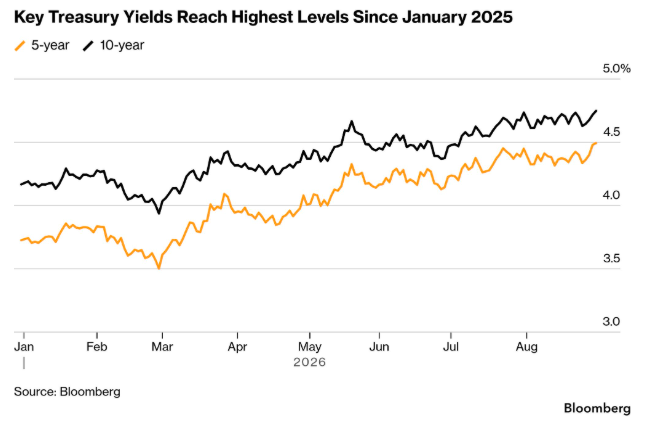
 Monday's movements have exacerbated the already weak condition of the US Treasury market in recent times.
Currently, bond market investors are concerned about the persistently high level of government debt, while also closely assessing how aggressive the Federal Reserve's rate-hiking strategy needs to be to curb inflation. After Federal Reserve Chair Kevin Warsh sent strong signals at the Jackson Hole central bank symposium regarding potential actions to stabilize prices, short-term US Treasury yields surged first on Friday.
Sean Simko, Head of Fixed Income Investment Management at SEI Investments, stated, "The Federal Reserve is ready to act if necessary."
He pointed out that although the US non-farm payrolls report for August to be released this Friday and the US CPI data to be published on September 11 are crucial, "as long as the labor market remains robust and inflation stays elevated, it is highly likely to prompt the Federal Reserve to lean towards a rate hike at its monetary policy meeting on September 16."
Following Warsh's remarks, economists at Barclays and Societe Generale have predicted that the Federal Reserve will raise interest rates in September and December.
Mark Spindel, Chief Investment Officer at Potomac River Capital, stated that the rise in long-term yields also reflects an "impending surge in supply" and a "grim outlook for inflation." Particularly in the investment-grade corporate bond market, September is traditionally a peak period for issuance. It is estimated that $10 billion in new bonds will enter the market this week alone, with the total issuance volume for the entire month of September expected to reach a record $215 billion.
Spindel noted that despite Warsh's comments at Jackson Hole, the "debate over whether he truly intends to tighten policy in September" continues, thereby fueling ongoing inflation concerns.
Key defensive line breached
Notably, Monday’s sell-off in U.S. Treasuries also caused $U.S. 10-Year Treasury Notes Yield (US10Y.BD)$ it to break above the closely watched 4.75% threshold—a level regarded by many market participants as a key barrier before the 5% mark.
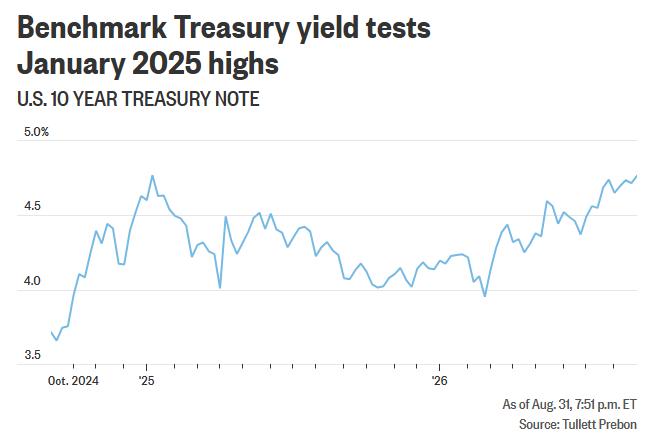
Robert Pavlik, Senior Portfolio Manager at Dakota Wealth Management, stated that 4.75% is a critical psychological threshold “sufficient to trigger genuine alertness among investors.” He added that once yields approach the 5% mark, concerns about a deep correction in U.S. equities would rapidly spread across the market.
In fact, despite the pullback on Monday, U.S. stocks still recorded substantial gains for August: the Dow Jones Industrial Average rose 1.3% for the month—marking its fifth consecutive monthly increase—while the S&P 500 Index gained 2.6%, and the Nasdaq Composite Index climbed 3.9%.
However, if funding costs continue to rise, both the equity and bond markets may face more severe tests in September.
Movements in U.S. Treasury yields directly impact households, as the 10-year Treasury yield serves as the benchmark for 30-year mortgage rates. The bond market was already under significant strain when the U.S. national debt surpassed the $40 trillion mark in August. Currently, U.S. Treasuries are also competing with technology giants for market capital, as the latter issue substantial volumes of long-term bonds to fund massive artificial intelligence infrastructure projects.
In mid-August, the U.S. Treasury Department unexpectedly announced plans to increase buybacks of 10-year to 30-year Treasury securities starting in September. However, as shown in the chart below, the benchmark 10-year Treasury yield has currently reached its highest level during Trump’s second term.
On Monday, the 30-year Treasury yield rose another 4 basis points to 5.248%. Looking back at August, it was only after this yield broke through the 5.3% threshold to hit a new high since 2007 that the U.S. Treasury urgently announced its buyback program. Based on current policy signals, the U.S. Treasury and the Federal Reserve appear to believe that maintaining basic stability in the bond market is sufficient, with no intention of forcibly guiding yields lower.
Drew Matus, Chief Market Strategist at MetLife Investment Management, offered a different interpretation of the current environment: “Compared to the anomalous conditions of recent years, we are now in a much more normal interest rate environment. This is essentially a pricing adjustment reflecting the normalization of interest rates.”
Nevertheless, Matus warned that once the 10-year Treasury yield breaks out of the “golden comfort zone” of 3.5% to 4.5%, it could easily force households to passively increase savings, thereby exerting downward pressure on the overall economy. He added that the AI boom has driven up stock markets this year, enabling households benefiting from the wealth effect to maintain their consumer spending.
As the yield on the 10-year U.S. Treasury note touched 4.75%, Chris Galipeau, Chief Market Strategist at Franklin Templeton Institute, stated that he is advising clients to moderately extend bond duration and allocate capital to the five- to eight-year segment of the yield curve.
In an interview, Galipeau noted that "U.S. equities are fully capable of digesting current interest rate levels." He even suggested that investors seize opportunities to buy on dips during market pullbacks. However, he also cautioned that once the yield on the 10-year U.S. Treasury breaks above 5%, "U.S. stocks could face significant trouble."
Editor/KOKO