
U.S. Treasury Secretary Bessent stated that "Abenomics may have reached its end" and hinted at support for the Bank of Japan's rate hikes to stabilize the yen, drawing significant attention to his upcoming meeting with BOJ Governor Kazuo Ueda during the G20 summit. Market expectations point to a consensus on addressing the yen's undervaluation and accelerating rate hikes, fueling speculation of a September rate hike in Japan and pushing the neutral interest rate indicator close to the 3% threshold.
During the G20 Summit, the meeting between U.S. Treasury Secretary Bessent and Bank of Japan Governor Kazuo Ueda has become a focal point for global foreign exchange and interest rate markets. The core issue attracting market attention is singular: whether both sides can reach a public consensus that the yen is undervalued and that the Bank of Japan needs to accelerate its pace of interest rate hikes, thereby bringing "Abenomics" to an end.
According to Zhuifeng Trading Desk, citing the latest research report by Nomura Securities' Naka Matsuzawa, Bessent used unusually direct language in an interview with Reuters on the eve of the meeting, stating, "I believe Abenomics—a reflation program—may have run its course," and expressing confidence that the Bank of Japan would "do the right thing" regarding monetary policy. This marks Bessent's most explicit public statement to date, representing a significant escalation from his previous subtle hints.
 Market expectations for a Bank of Japan interest rate hike on September 18 continue to intensify. According to Nomura Securities, the market is currently pricing in a 68% probability of a rate hike before the September FOMC meeting. The neutral rate proxy for Japan's 10-year government bond yield—the 5-year forward OIS rate—has risen to 2.97%, approaching the 3% threshold, a level rarely seen in decades.
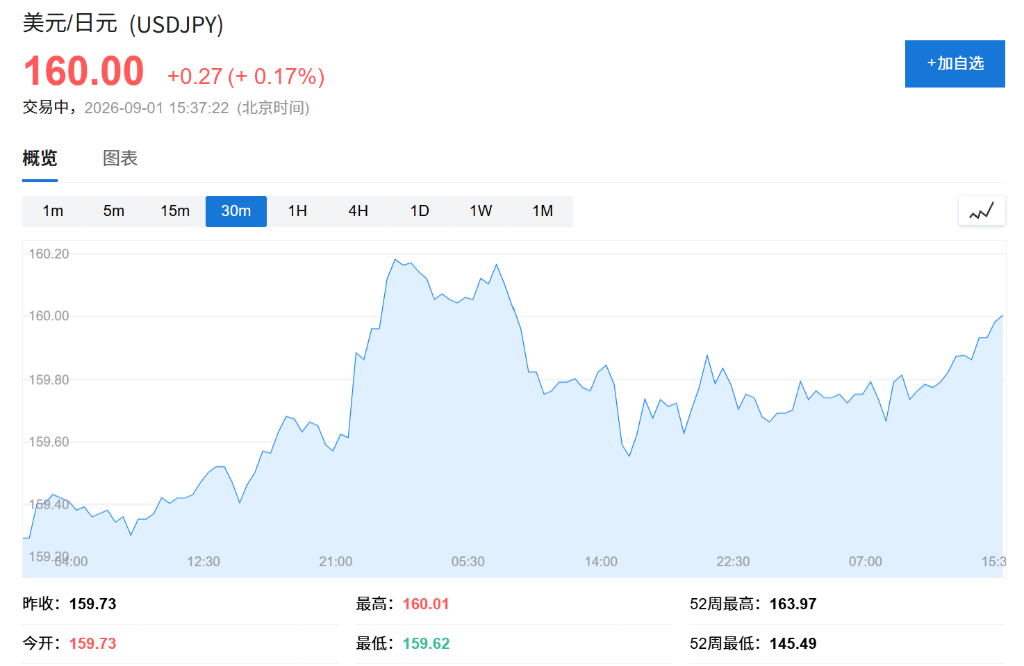
Against this backdrop, both Japanese equity and bond markets are under pressure. Banking stocks are nearing cyclical highs due to benefits from rising interest rates, but nearly all other domestic demand-oriented stocks remain weak, indicating that expectations of rate hikes are beginning to exert tangible pressure on the real economy. In the currency market, the USD/JPY pair is hovering around the 159.5 to 160 range, as the impact of the previous record-sized intervention has largely faded.
Bessent Escalates Stance: Explicitly Calls for Japan to Bid Farewell to Reflation
Bessent's remarks in the Reuters interview represent the publicization and systematization of his consistent stance. Over the past year, he had repeatedly hinted, albeit subtly, that he preferred the Bank of Japan to raise interest rates to fundamentally support the yen, rather than relying on repeated market interventions by the Ministry of Finance. His direct statements at the G20 mark a shift in the nature of U.S. pressure—from coordinated operations at the market level to open endorsement at the policy level.
In an interview with CNBC, Bessent also stated, "I cannot influence the natural equilibrium exchange rate; what we can do is send signals. I possess information that the market does not, and I believe the Japanese government and the Bank of Japan will take actions conducive to strengthening the yen," noting that "the market has already priced in expectations of rate hikes." He also mentioned in the Reuters interview that recent yen movements were "largely under control" and not the "disorderly" conditions that had previously triggered intervention.
The market interprets these statements as a unified signal: the U.S. hopes the Bank of Japan will replace foreign exchange market interventions with policy actions to structurally correct the undervaluation of the yen.
Kazuo Ueda's Role: Not a Direct Counterpart, Yet Influential
Bessent's direct policy counterpart is Japanese Finance Minister Satsuki Katayama, but the market is more focused on the private talks between Bessent and Kazuo Ueda. As Naka Matsuzawa points out, although Ueda is not Bessent's formal counterpart, the two have known each other for many years, and Bessent has considerable confidence in Ueda as a policymaker. Following previous foreign exchange interventions, Bessent had publicly expressed his anticipation of meeting with Ueda.
The crux of these talks lies in whether Kazuo Ueda and Bessent can reach a clear mutual understanding on the "undervaluation of the yen" and the "need for the Bank of Japan to accelerate its rate-hike pace," and convey this signal to the market in some form. However, Matsuzawa also cautioned that it remains unclear how much of the substantive content of the discussions will be disclosed to the public through press conferences or media channels.
Hank Calenti, Chief Global Market Strategist at SMBC EMEA, stated, "The key lies in the narrative and how hawkish the Governor's wording is." He pointed out that subtle shifts in Kazuo Ueda's phrasing in subsequent public remarks could directly alter the shape of the Japanese government bond yield curve.
Doubts persist over intervention efficacy; rate hikes may be the only solution
Japan's Ministry of Finance disclosed last Friday that the scale of foreign exchange intervention over the past month reached JPY 15.4 trillion (approximately USD 96.4 billion), setting a historical record. However, July's experience fully exposed the limitations of such interventions: coordinated buying operations briefly pushed the USD/JPY exchange rate back toward the 155 level, but within just one month, the rate approached the 160 threshold again. The market repeatedly reverts to the same logic: strong momentum in carry trades, low exchange rate volatility, and Japanese monetary policy still lagging behind the curve.
The scale of U.S. participation in intervention is expected to be far smaller than that of Japan, and Bessent himself has admitted an inability to influence the "natural equilibrium level" of exchange rates. In this context, market consensus is becoming increasingly clear: without accompanying substantive monetary tightening, pure foreign exchange market intervention is unlikely to produce lasting effects.
Neutral rate approaches 3%: Japanese bond market faces structural revaluation
In a report, Nomura Securities' Matsuzawa noted that the market expectation for the neutral rate of Japan's 10-year government bonds, measured by the 5-year forward OIS rate, has risen to 2.97%. This level exceeds the sum of Japan's 5-year inflation expectations (breakeven inflation rate of 2.3% to 2.4%) and the Bank of Japan's estimated range for the real neutral rate (-0.9% to +0.5%), a gap that cannot be fully explained by domestic factors alone.
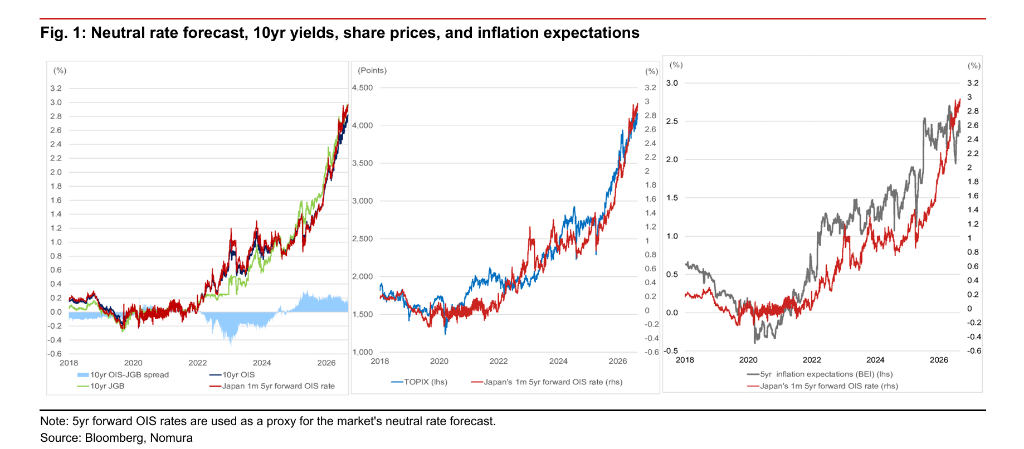
Matsuzawa pointed out that the synchronous rise in Japanese yields alongside U.S. yields is a significant driver widening this gap. Currently, both the U.S. market and the Federal Reserve are building momentum to revise up neutral rate expectations, thereby continuously pulling up long-end Japanese yields. Until the upward trend in long-end U.S. yields subsides, investor demand for long-term Japanese government bonds is unlikely to improve substantially.
However, the market is not without potential support. According to Bloomberg, a major life insurance company stated in an interview last week that a 10-year Japanese government bond yield of 3.0% would offer attractive investment value, at which point it might revise its plans to increase its holdings of Japanese government bonds. Since life insurance companies are primarily active in the ultra-long end of the curve, Thursday's 30-year bond auction may be more indicative than today's 10-year auction. Matsuzawa warned that if demand in the 10-year auction is weak, life insurers may choose to wait on the sidelines, making it difficult to boost demand for 30-year bonds as well.
Editor/Deng