
① PC DRAM price increases exceeded expectations, with third-quarter prices projected to rise 18%–23% quarter-on-quarter; spot prices remain significantly higher than contract prices. ② Demand from AI data centers has elevated the production priority for server DRAM and HBM, thereby constraining the expansion of traditional memory supply. ③ The momentum of mobile DRAM price hikes has cooled noticeably, but NAND flash continues to see substantial gains, with supply constraints continuing to support prices into 2027.
As the global semiconductor industry continues to evolve, driven by the artificial intelligence (AI) wave, the structural divergence and price resilience in the memory chip market are becoming focal points for capital markets.
In its latest memory price tracking report released on September 1, Goldman Sachs stated that the average selling price trends for DRAM and NAND in the third quarter of 2026 are largely consistent with previous expectations. The memory chip sector remains in an upward cycle, prompting the firm to maintain its coverage of South Korea's two memory giants—$Samsung Electronics (005930.KR)$ and $SK Hynix (000660.KR)$ —with a "Buy" rating.
 This round of memory price increases exhibits distinct structural characteristics: PC and server DRAM continue to demonstrate strong price momentum, while demand for mobile memory is weighed down by rising inventory levels. However, suppliers are consistently prioritizing limited capacity for server DRAM and High Bandwidth Memory (HBM), restricting growth in traditional memory supply. This has become a significant factor supporting prices into 2027.
PC DRAM price increases exceed expectations
PC DRAM is one of the strongest-performing segments in this report.
In August, the contract price for DDR4 8GB PC memory modules rose from $139 to $142, a 2% month-on-month increase; the price for DDR5 8GB modules similarly increased from $130 to $133, also up by 2%. As both experienced identical gains, DDR5 maintains a price discount of approximately 6% relative to DDR4, largely unchanged from July.
Against this backdrop, research firm TrendForce has further raised its forecast for third-quarter PC DRAM price increases from 15%–20% to 18%–23%, which is slightly higher than Goldman Sachs' previous prediction of a 17% quarter-on-quarter increase in average PC DRAM selling prices for Samsung Electronics and SK Hynix.
DRAM is a typical cyclical semiconductor product, with prices highly sensitive to changes in manufacturer capacity, customer inventory levels, and end-user demand. Following previous supply adjustments, if manufacturers remain restrained in expanding capacity while demand gradually recovers, prices often exhibit strong upward elasticity.
Spot market data in the report also indicates that prices remain robust. Currently, the spot price for DDR5 16Gb chips is approximately 16% higher than the latest contract price, while the premium for DDR4 8Gb spot prices reaches 43%.
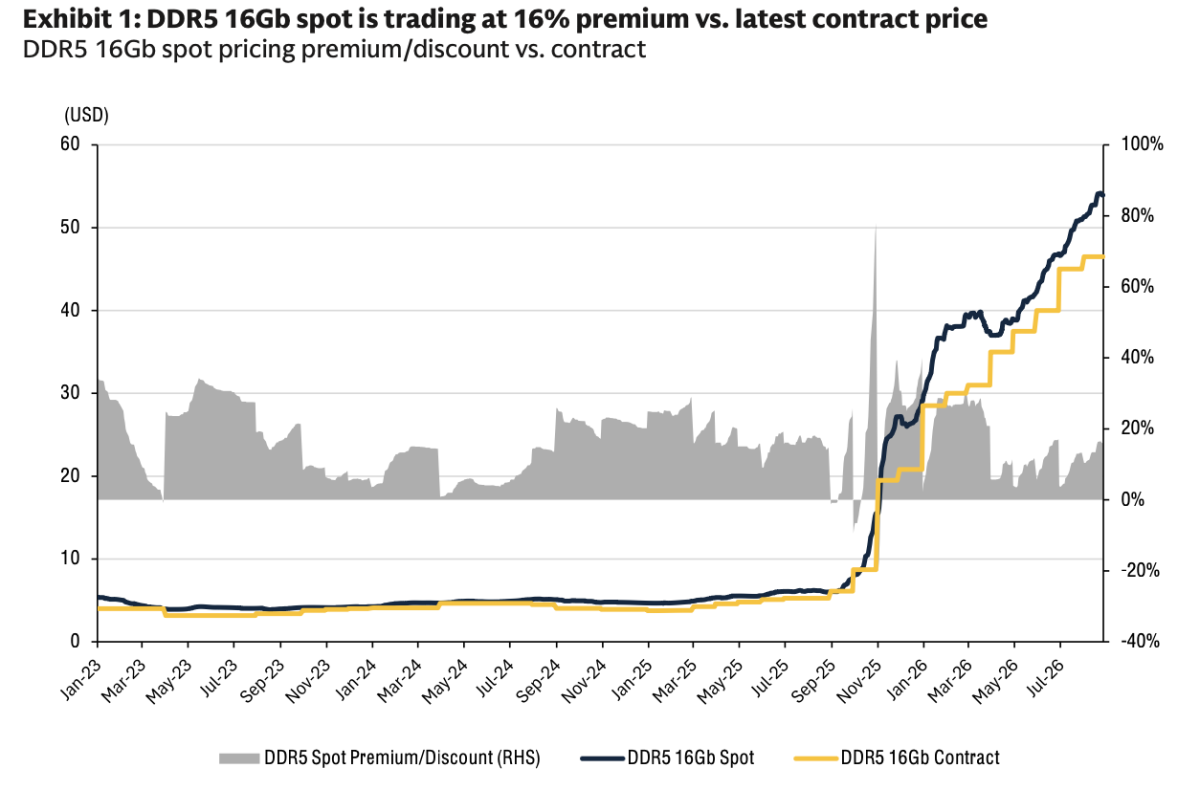
(Since the second half of 2025, spot prices for DDR5 16Gb chips have risen rapidly, currently trading at a premium of approximately 16% over the latest contract prices, reflecting continued tightness in spot market supply and demand.)
A higher spot premium indicates that short-term market prices are significantly above previously signed contract prices; however, whether this premium will be fully passed through to subsequent contract prices still depends on actual supply and demand dynamics and customer procurement patterns.
AI demand supports server DRAM
Compared with the PC market, server DRAM price trends remain robust, broadly aligning with Goldman Sachs' earlier expectations.
In August, the price of DDR4 64GB server memory modules remained unchanged at USD 1,295, while the price of DDR5 64GB modules rose by 1% month-on-month to USD 1,500. This widened the price premium of DDR5 over DDR4 from 15% in July to 16%.
TrendForce continues to forecast that server DRAM prices will rise by 13%–18% quarter-on-quarter in the third quarter, broadly consistent with Goldman Sachs' projection of an 18% quarter-on-quarter increase in the average selling price (ASP) of server DRAM for Samsung Electronics and SK Hynix.
Server storage is also a key component in the shifting supply-demand structure of the current memory industry. AI data centers are not only driving rapid growth in HBM demand but also raising requirements for traditional DRAM capacity and performance on the server side. More importantly, HBM and advanced server DRAM consume wafer capacity and production resources at memory manufacturers.
Therefore, even if demand for some consumer electronics fluctuates, as long as manufacturers such as Samsung and SK Hynix continue to prioritize meeting demand for server DRAM and HBM, the scope for expanding supply of traditional PC and mobile DRAM may be constrained. This report also views such shifts in capacity allocation as a significant support for future memory prices.
Mobile memory price hikes cool significantly, but supply constraints persist
Compared with the PC and server markets, the mobile DRAM segment is showing clear signs of cooling.
TrendForce projects that mobile DRAM prices will rise by 8%–13% quarter-on-quarter in the third quarter of 2026, a significant deceleration from the 70%–83% surge recorded in the second quarter. This forecast is also slightly below Goldman Sachs’ earlier projection of a 14% increase in the average selling prices for Samsung and SK Hynix.
The primary driver behind the slowing pace of price increases is not a substantial rise in supply, but rather elevated customer inventory levels, which have weakened short-term procurement momentum.
TrendForce expects the quarter-on-quarter growth rate for mobile DRAM to further decline to 0%–5% in the fourth quarter. Nevertheless, it maintains a positive outlook on price trends for 2027, primarily because memory suppliers are expected to continue prioritizing capacity allocation for server DRAM and High Bandwidth Memory (HBM).
This indicates that the current mobile DRAM market is characterized by a structure of "cooling demand amidst constrained supply."
Synchronous Price Increases in NAND
The report shows that contract prices for 256GB mobile NAND (eMMC/UFS) rose by approximately 20% quarter-on-quarter in the third quarter, broadly aligning with Goldman Sachs’ prior forecast of a 15%–20% sequential increase in overall NAND prices.
Although the report provides limited detail on NAND, the simultaneous sustained high growth rates for both DRAM and NAND suggest that the pricing environment for major memory manufacturers remains favorable.
Goldman Sachs Maintains "Buy" Ratings for Samsung and SK Hynix
Based on current memory price trends, Goldman Sachs continues to maintain positive ratings for the two South Korean memory leaders.
The 12-month target price for Samsung Electronics' common shares is set at KRW 490,000, and for preferred shares at KRW 360,000, with both retaining a "Buy" rating.
SK Hynix has a 12-month target price of KRW 350,000, corresponding to a target P/E ratio of 9x applied by Goldman Sachs to the average earnings for 2026–2027.
However, Goldman Sachs also warned that a significant deterioration in the supply and demand environment for memory chips remains a core risk for both companies.
Samsung also faces risks from shrinking smartphone profit margins and a declining market share in mobile OLEDs; SK Hynix needs to monitor weakening demand for PCs, smartphones, and servers, progress in Samsung’s HBM business, and potential pressure on HBM demand resulting from a decline in AI capital expenditure.
Editor/Deng