
Global bond yields are struggling to rise toward higher neutral interest rate levels.
Zhitong Finance APP has learned that a bond sell-off sweeping across the United States, Japan, Germany, the United Kingdom, and Australia is pushing global long-term borrowing costs to levels unseen since the financial crisis. Bond investors are demanding higher returns from governments, anticipating stronger economic growth, increased corporate borrowing and investment, and further interest rate hikes by central banks.
As summer draws to a close, the cool September air has once again chilled the sovereign bond market this week, while traders prepare for potential interest rate hikes in Japan, Europe, and possibly the United States over the next three weeks.
 Key Driver Behind the Surge in Global Bond Yields: The Rise in Neutral Interest Rates
The yield on the US 10-year Treasury note, which is more sensitive to economic conditions, has risen to its highest level since President Trump returned to the White House early last year. The yield on Japan’s 10-year government bonds surpassed 3% for the first time since 1996, while Germany’s 10-year bond yield hit a 15-year high. The UK’s 30-year gilt yield reached its highest level since 1998, and France’s 30-year bond yield soared to an 18-year peak.
However, as many economists have pointed out in recent months, a breakdown of these yields indicates that the latest movements are driven at least in part by "real," inflation-adjusted yields, rather than by inflation expectations themselves or by the more ambiguous "term premium" that reflects debt burdens or compensation for long-term inflation uncertainty.
The US 10-year real interest rate rose by approximately 40 basis points in just three months and surged again last week. During the same period, Japan’s 10-year real interest rate nearly tripled to 0.9%, while France’s 10-year real interest rate reached one of its highest levels since the inception of the euro.
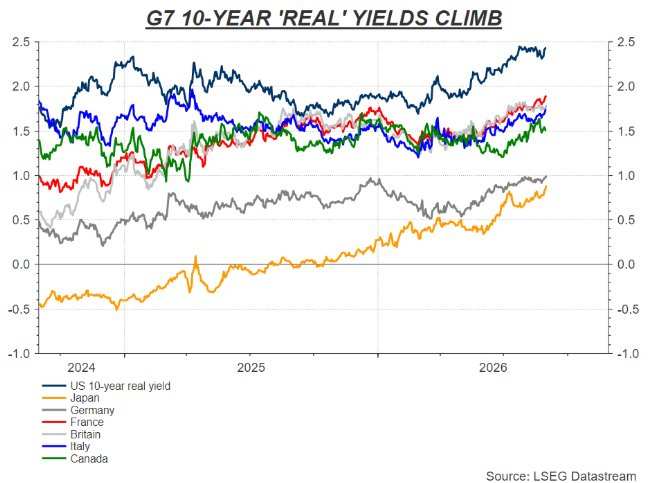
Regardless of the specific figures, the "neutral" interest rate that brings these economies into equilibrium appears to be rising. While this is not necessarily bad news, this shift could significantly increase borrowing costs over the coming years as central banks recalibrate policies to address the AI-driven investment boom and seek the point at which policy once again impacts the economy.
Federal Reserve Chair Kevin Warsh seemed to acknowledge this point at the Jackson Hole meeting last week. In his keynote speech, he repeatedly emphasized that current US monetary policy shows little to no sign of restraining loan or credit growth, and financial conditions remain accommodative. Warsh insisted that unless inflation falls substantially back to the 2% target—a scenario unlikely before the Fed’s meeting on September 16—the Federal Reserve still has "much work to do."
"I find it difficult to characterize overall financial conditions as restrictive," he said at the annual symposium held in Wyoming last Friday.
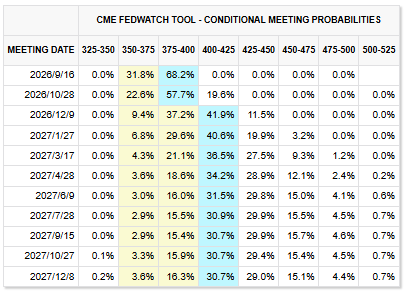
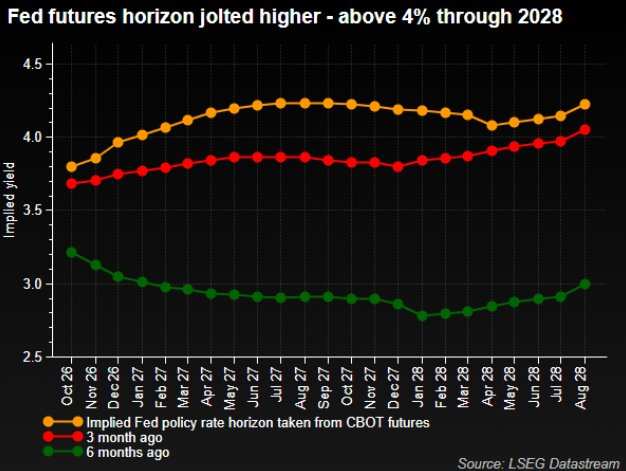
Fed funds futures reacted swiftly to the signal, indicating that the probability of a Federal Reserve rate hike this month is approaching 70%, up from just one-third previously. Perhaps most importantly, the market has fully priced in expectations for two rate hikes before March next year, and anticipates a 50% probability of a third hike within the following 12 months. Over the next two years covered by futures contracts, the policy rate (currently with a median of 3.625%) is not expected to fall below 4% before 2028.
This week, global crude oil prices climbed back above $90 per barrel amid renewed tensions in Iran, adding fuel to the fire. However, it is evident that the issue extends beyond just oil.
AI drives economic growth; Fed reassessment of the neutral rate may prompt further rate hikes
Walsh’s remarks as Chair were notable, as he outlined how policy affects the economy, challenging the long-held assumption among many Federal Reserve officials that interest rates remain slightly "restrictive." If the Fed reconsiders the "neutral" interest rate—defined as the level that neither stimulates nor drags down the economy—rates would almost certainly be higher than current levels, and markets might adjust their "real interest rate" expectations accordingly.
The long-term nominal policy rate projected by Federal Reserve policymakers in their quarterly summaries is 3.1%, widely regarded as representative of the "neutral" rate. However, this assessment could undergo substantial change: the rate has risen from 2.4% in 2022 and was as high as 3.8% in 2015. Fed models suggest the real neutral rate ("R*") lies between 1.0% and 1.65%. Adding the 2% inflation target implies that the neutral nominal rate is close to current levels, at the upper end of this range.
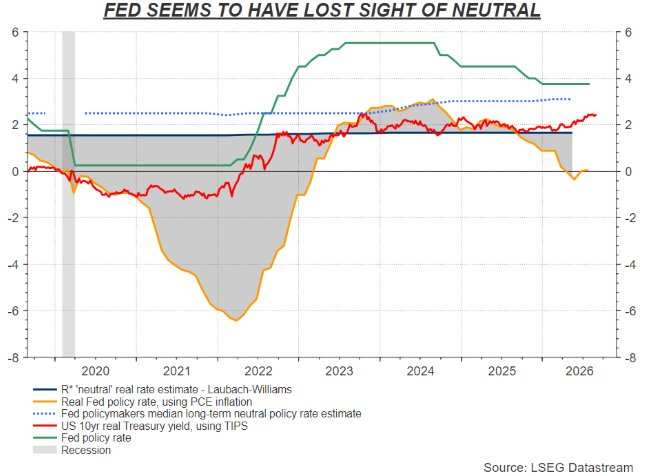
However, since the Fed’s real policy rate (measured against the current overall Personal Consumption Expenditures inflation rate) remains close to zero, the central bank does not appear to be tightening the economy in any substantive way—if anything, it may still be stimulating economic growth. This persists despite indications from AI-driven growth, inflation, investment, and financial conditions suggesting otherwise.
Chip giant NVIDIA (NVDA.US) stated last week that there are signs the artificial intelligence capital expenditure boom will last at least until next year, with sales projected to grow by another 70% by 2028. This suggests that the nature of the global economy may be shifting, forcing a reevaluation of neutral rate models. At the very least, corporate borrowing is rising sharply, and the U.S.-centric data center boom may spread to regions outside the United States in the coming years.
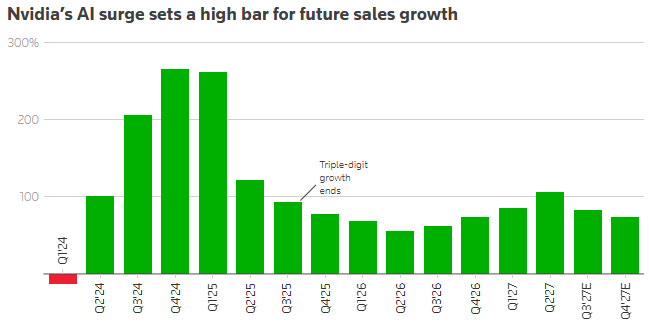
Even if one optimistically believes that productivity gains will drive faster economic growth, the construction and investment phases will push up capital costs due to the rebalancing of savings and investment. Walsh himself concurs, comparing the current boom to periods of stagnation caused by excess savings, when no one was willing to invest and interest rates fell to zero.
For instance, despite the ongoing U.S. trade war, the AI race continues to boost global economic activity, as evidenced by the Organization for Economic Co-operation and Development (OECD). Last week, the G20 reported an acceleration in goods trade growth in the second quarter. Quarterly import growth rose from 5.2% in the first quarter to 6.7%, with AI-related chips and computing equipment serving as the primary drivers of this growth.
It is highly likely that all major central banks are facing similar dilemmas to the Reserve Bank of Australia earlier this year, which acted swiftly to correct its policy direction. It had lost its bearings regarding the trajectory of the neutral rate but, given other economic indicators, knew that previous rate levels were too low. Its subsequent task was to steadily raise rates, groping in the dark toward neutrality—a judgment that itself may change over time. It effectively acknowledged that one may only truly understand the neutral rate while experiencing it. The Federal Reserve and other major central banks may be reaching the same conclusion.
Editor/Deng