
In the third fiscal quarter, Broadcom's revenue hit a new quarterly record, with year-on-year growth reaching a nine-year high, and EPS nearly doubling. AI semiconductor revenue surged 221% year-on-year, while infrastructure software revenue rose 29%. Revenue guidance for the fourth fiscal quarter came in slightly below market expectations; AI semiconductor revenue guidance increased by 236%, just marginally above consensus. During the earnings call, the CEO stated that the full-year AI revenue guidance has been raised to $58 billion, with potential to nearly double in the next fiscal year and reach $230 billion in fiscal 2028. The stock initially fell more than 6% in after-hours trading before turning positive, rising over 2% during the conference call.
Major AI custom chip manufacturer $Broadcom (AVGO.US)$ Performance in the previous fiscal quarter continued to surge well above expectations, while guidance for the current quarter showed some "imperfections," with total revenue guidance slightly underwhelming. AI chip revenue, a key focus for the market, was only marginally higher than expected. However, executives' optimistic forecast that AI revenue will accelerate significantly over the next three years has reversed market sentiment.
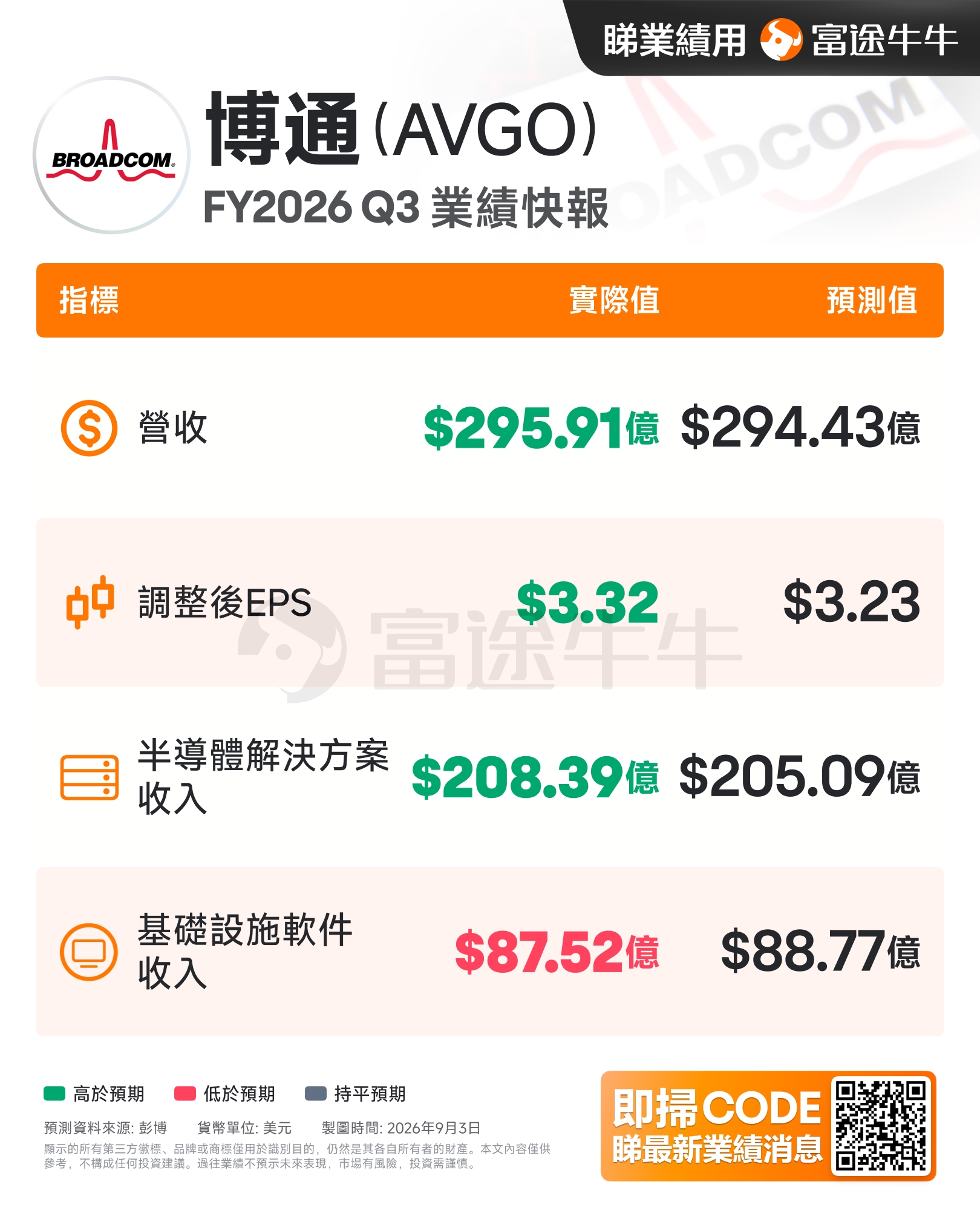
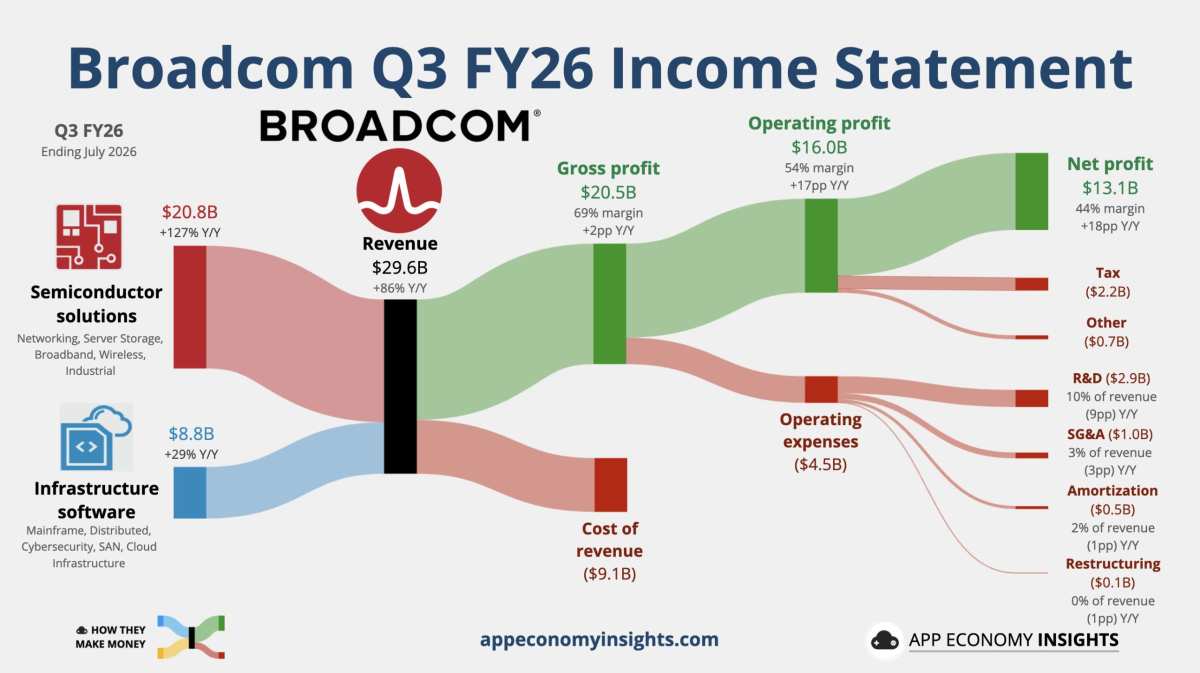
After U.S. markets closed on Wednesday, Eastern Time, Broadcom announced its financial results for the third quarter of fiscal year 2026, ended August 2, 2026. Net revenue rose 86% year-over-year to $29.591 billion, setting a new single-quarter record and slightly exceeding the market consensus of approximately $29.45 billion. This also surpassed the highest single-quarter growth rate recorded in over nine years during the previous quarter. Adjusted earnings per share (EPS) increased 96% year-over-year to $3.32, nearly 3% higher than market expectations.
 AI remains the core growth engine. In the third quarter, Broadcom’s AI semiconductor revenue more than tripled year-over-year to $16.7 billion, representing a 54% sequential increase and surpassing analysts’ expectations of $15.93 billion. CEO Hock Tan stated that demand for custom AI accelerators and networking products “remains very strong,” and projected that AI semiconductor revenue would accelerate further to $21.7 billion in the fourth quarter, representing a 236% year-over-year increase.
By segment, semiconductor solutions revenue reached $20.839 billion, up 127% year-over-year and exceeding the market expectation of $20.51 billion; infrastructure software revenue was $8.752 billion, up 29% year-over-year. Profitability metrics were equally impressive: non-GAAP operating profit for the third quarter amounted to $20.095 billion, a 92% year-over-year increase; free cash flow reached $13.665 billion, up 95% year-over-year, equivalent to 46% of revenue.
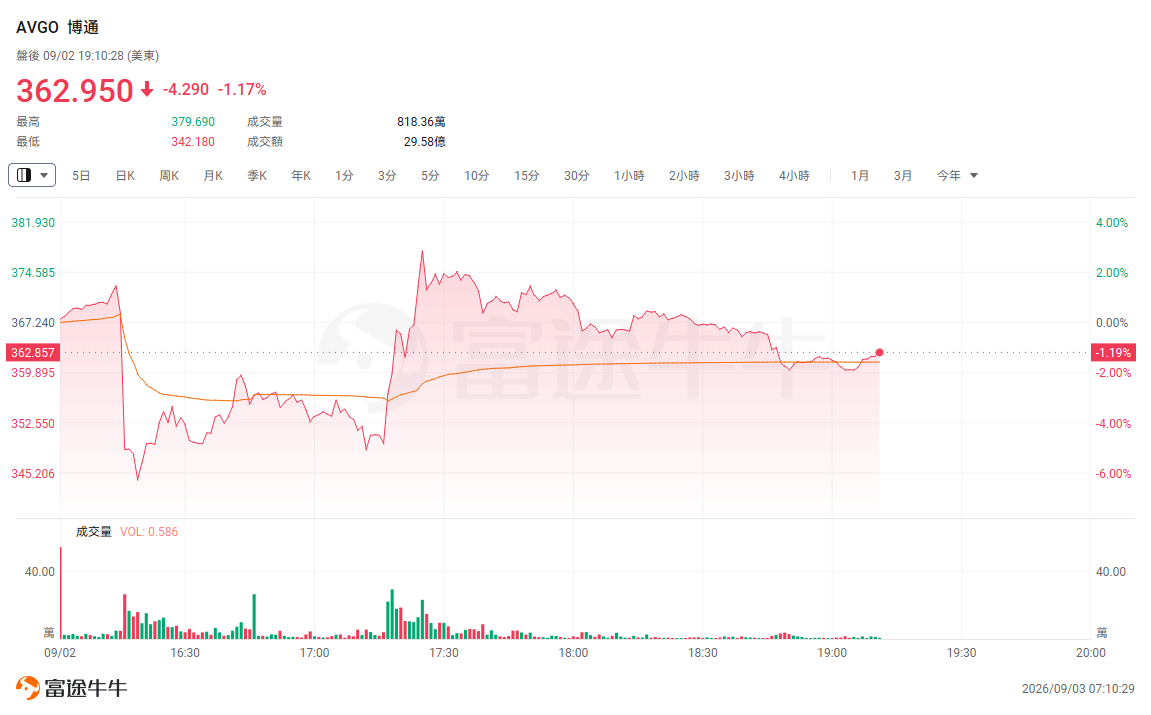
During regular trading on Wednesday, Broadcom's stock closed down nearly 0.7%. Following the earnings release, the share price plunged in after-hours trading, dropping more than 6% at one point, before turning positive. During the earnings conference call, the stock rose more than 2% in after-hours trading, but later resumed its decline and is currently down more than 1%.
Analysts attribute the after-hours reversal primarily to CEO Hock Tan providing the medium- to long-term AI guidance that the market was eager to hear: the company raised its fiscal 2026 AI semiconductor revenue guidance from $56 billion to $58 billion, and indicated that AI semiconductor revenue could rise to $115 billion in fiscal 2027 and further to $230 billion in fiscal 2028. Additionally, EPS for fiscal 2028 is projected to exceed $30, above the market consensus of $26.42.
AI Semiconductor Revenue Surges 221% Year-Over-Year, Becoming Broadcom’s Primary Growth Driver
In the third quarter, Broadcom’s AI semiconductor revenue reached $16.7 billion, a 221% year-over-year increase and approximately 55% higher sequentially compared to $10.8 billion in the second quarter. This implies that AI semiconductors now account for approximately 56% of Broadcom’s total revenue and about 80% of its semiconductor solutions business revenue.
This shift in proportion is critical. In the second quarter, AI semiconductor revenue accounted for nearly half of total revenue and about 70% of the semiconductor solutions business. By the third quarter, AI’s contribution to Broadcom’s semiconductor business had risen further, indicating that Broadcom’s growth trajectory is increasingly dominated by products such as custom AI accelerators and AI networking chips.
Hock Tan stated in the earnings report:
"Demand for our custom AI accelerators and networking products remains robust. AI semiconductor revenue in the third fiscal quarter rose 221% year-over-year and 54% quarter-over-quarter. This momentum is expected to continue into the fourth fiscal quarter, with AI semiconductor revenue projected to accelerate to $21.7 billion, representing a 236% year-over-year increase."
According to the guidance for the fourth fiscal quarter, AI semiconductor revenue is set to rise further from $16.7 billion in the third fiscal quarter to $21.7 billion, a quarter-over-quarter increase of approximately 30%, accounting for about 62% of the company's total revenue.
Semiconductor solutions revenue doubled, but the non-AI semiconductor business did not experience a similar surge.
In the third fiscal quarter, Broadcom's semiconductor solutions revenue reached $20.839 billion, up 127% year-over-year and exceeding market expectations of $20.51 billion, accounting for 70% of the company's total revenue. This segment was the absolute core driver of revenue growth for the quarter.
However, a breakdown reveals that AI semiconductor revenue amounted to $16.7 billion, representing approximately 80% of semiconductor solutions revenue; in other words, non-AI semiconductor revenue was approximately $4.1 billion, essentially flat compared to the roughly $4.2 billion recorded in the second fiscal quarter after excluding AI-related contributions.
This does not indicate a significant deterioration in the non-AI business, but rather highlights that Broadcom's marginal growth is currently driven primarily by AI, specifically custom AI accelerators, XPU/TPU-related projects, and AI networking chips. Traditional semiconductor businesses, including broadband, wireless, enterprise storage, and industrial sectors, have not demonstrated growth trajectories comparable to those of AI-related ASICs and networking chips.
This is also one of the reasons for the market's slight disappointment with the total revenue guidance for the fourth fiscal quarter: even if the AI business continues to exceed expectations, whether the non-AI segment and software business can expand in tandem will determine whether the company's overall revenue significantly outperforms market expectations.
Infrastructure software revenue grew by 29%, remaining the foundation for profits and cash flow.
In the third fiscal quarter, Broadcom's infrastructure software revenue totaled $8.752 billion, a 29% year-over-year increase, accounting for 30% of total revenue. As the semiconductor business, particularly the AI segment, expands rapidly, the share of software revenue has declined from 43% in the same period last year to 30%.
This segment has primarily benefited from the ongoing contributions following the VMware integration, providing Broadcom with a relatively stable base for profits and cash flow. Although its growth rate is far lower than that of AI semiconductors, the stability of the software business remains crucial for a highly leveraged company like Broadcom, which has undergone large-scale mergers and acquisitions.
However, the declining share of software revenue has introduced a new valuation challenge: Broadcom was previously viewed as a hybrid tech asset combining the cyclical elasticity of semiconductors with the stable cash flows of software. As the proportion of AI semiconductor revenue rises rapidly, the company’s investment thesis is increasingly aligning with that of AI chip stocks, leading the market to price it based on higher growth expectations and stricter criteria regarding customer concentration and competitive risks.
Profit margins remained at high levels, while free cash flow nearly doubled year-over-year.
In the third fiscal quarter, Broadcom reported GAAP operating income of $15.955 billion, a 171% increase year-over-year; non-GAAP operating income amounted to $20.095 billion, up 92% year-over-year, exceeding the market expectation of approximately $19.73 billion. On a non-GAAP basis, the operating margin stood at approximately 67.9%, remaining at an exceptionally high level.
Net income under GAAP was $13.088 billion, up 216% year-over-year; net income on a non-GAAP basis was $16.372 billion, up 95% year-over-year. GAAP diluted EPS was $2.68, while non-GAAP diluted EPS was $3.32, surpassing the market consensus of $3.23.
Cash flow performance was equally robust. Operating cash flow for the third fiscal quarter reached $14.197 billion, a 98% year-over-year increase. After capital expenditures of $532 million, free cash flow totaled $13.665 billion, up 95% year-over-year, equivalent to 46% of revenue. Although this figure fell slightly short of the market expectation of approximately $13.76 billion, the gap was minimal, and the absolute scale indicates that Broadcom’s AI-driven growth has not come at the expense of cash conversion efficiency.
As of the end of the quarter, Broadcom held $23.975 billion in cash and cash equivalents, up from $19.628 billion at the end of the previous fiscal quarter. The company paid $3.1 billion in cash dividends on common stock during the third fiscal quarter and announced that the quarterly dividend would remain at $0.65 per share, payable on September 30.
Why Did the Fourth Quarter Guidance Initially Spook the Market?
For the fourth fiscal quarter, Broadcom projected revenue of approximately $34.8 billion, representing a 93% year-over-year increase, but falling short of analysts’ expectations of around $35.05 billion. This miss was the most direct trigger for the post-earnings pressure on the stock price.
It is important to emphasize that this guidance is not weak in terms of absolute growth: $34.8 billion implies a sequential growth of approximately 18% from the third quarter’s $29.591 billion. Meanwhile, the guidance for AI semiconductor revenue stood at $21.7 billion, a 236% year-over-year increase, also slightly above the market expectation of $21.33 billion.
The issue, however, is that the market’s expectation for Broadcom has evolved beyond merely “rapid growth” to whether it can “consistently exceed expectations.”
Prior to the earnings release, Broadcom's stock price had fallen more than 20% from its all-time high set in early June, wiping out over $520 billion in market capitalization. Under the valuation framework for AI chip leaders, investors hoped management would provide long-term revenue visibility similar to NVIDIA's guidance last week, replicating NVIDIA's strong forward outlook.
However, Broadcom's latest earnings announcement provided only routine guidance for fourth-quarter revenue, with total revenue guidance slightly below expectations. This failed to fully meet market expectations for a clearer, more quantified long-term AI revenue trajectory. Consequently, in the low-liquidity after-hours environment, headline-driven and quantitative trading initially amplified selling pressure.
Furthermore, the non-GAAP operating margin guidance for the fourth quarter was approximately 66% of revenue, lower than the roughly 67.9% level in the third quarter. Although Broadcom emphasized that this was flat year-over-year, in an environment of high expectations, investors might interpret this as indicating that AI volume growth is accompanied by gross margin or supply chain cost pressures.
Why the Earnings Call Reversed the Stock Trend: CEO Provides "Hard Guidance" for FY27/FY28
Analysts believe the key turning point for Broadcom's significant after-hours rebound occurred during the earnings conference call.
Hock Tan stated that the company raised its fiscal 2026 AI semiconductor revenue guidance from $56 billion to $58 billion. More importantly, he further outlined a medium-to-long-term roadmap: AI semiconductor revenue is expected to grow from $58 billion in fiscal 2026 to $115 billion in fiscal 2027, reaching $230 billion in fiscal 2028.
This implies that:
AI semiconductor revenue in fiscal 2027 is nearly double that of fiscal 2026;
Fiscal 2028 is nearly four times that of fiscal 2026;
The compound annual growth rate for AI semiconductor revenue over the next two years approaches doubling.
Hock Tan also noted that Broadcom's AI networking revenue will grow as fast as its XPU business in the coming years. This is critical because the market had previously focused more on Broadcom's custom AI accelerator/ASIC revenue. If AI networking chips—such as high-speed switching chips, data center interconnects, and Ethernet solutions—also scale up simultaneously, Broadcom's AI revenue structure will no longer be just about "selling custom chips," but will cover both accelerators and networking in the expansion of AI clusters.
During the conference call, Hock Tan also mentioned that the company will deliver hundreds of billions of TPU-related products annually over the next few years. He projected that Anthropic will deploy 5GW of TPUs in 2027, potentially making it Broadcom’s largest chip customer by that year. OpenAI is also expected to deploy 5GW of chips in 2028, including Jalapeno and next-generation XPU products, and could become the company’s second-largest chip customer in 2028.
For the market, these statements addressed two core concerns: first, whether Broadcom’s AI growth can sustain beyond 2027; and second, whether the company is overly reliant on a handful of customers such as Google. The emergence of Anthropic and OpenAI provides investors with a rationale to reprice Broadcom’s customer landscape.
 AI-powered earnings snapshot highlights key takeaways—build your options strategy! Open Futubull > Stock Page > Click [Company] >Earnings Snapshot

Editor/rice