If historical data serves as a guide, the decline in the utilities sector may also signal broader pain for the stock market.
Zhitong Finance APP has learned that rising U.S. Treasury yields and the Federal Reserve's potential interest rate hikes are threatening to bring more volatility to utility stocks. Data shows that since the beginning of 2026, the utilities sector within the S&P 500 Index rose by more than 11% at one point by the end of February. However, the sector's year-to-date gains have now nearly vanished, ranking it second from the bottom among the 11 major industry sectors in the S&P 500 Index.
If historical data serves as a guide, the decline in the utilities sector could also signal broader pain for the stock market. Ed Clissold, Chief U.S. Strategist at Ned Davis Research, wrote in an August 24 report that in 21 of the past 30 bull market peaks since 1930, the Dow Jones Utilities Average peaked before the broader market. He added that in these 21 instances, the stock market fell by an average of more than 29%.
 Ed Clissold stated, "Utilities often act like canaries in the coal mine because they are highly sensitive to interest rates." "Currently, everyone seems extremely optimistic about everything, and you do not want to ignore these warning signals."
The lackluster performance of the utilities sector in 2026 is particularly notable given that the S&P 500 Index has cumulatively risen by 13%. This means that, relative to the broader market, 2026 is shaping up to be the worst-performing year for the sector since 2023.
From a technical perspective, the situation is also severe. The proportion of stocks in the utilities sector trading above their 200-day moving average—a technical indicator measuring long-term price trends—has dropped to approximately 26%, the lowest level since February 2024.
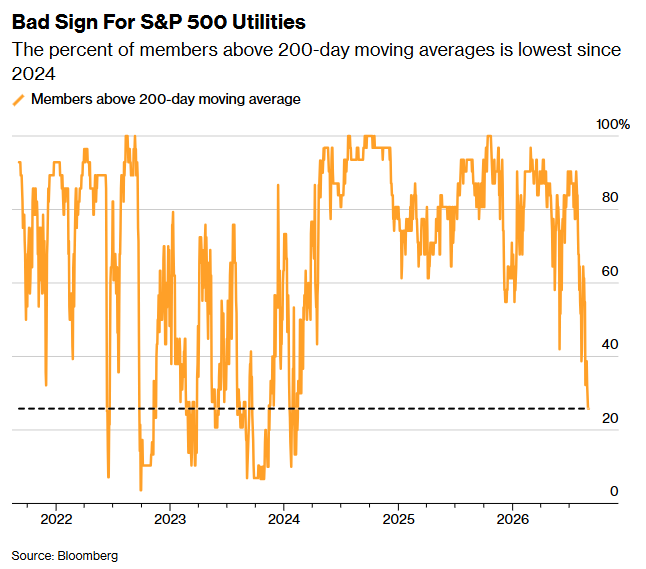
Ominous Signals Emerge in the S&P 500 Utilities Sector
The SPDR S&P Utilities Select Sector ETF (XLU.US) is currently trading significantly below its 200-day moving average. This is the first time this has occurred for the ETF since April 2025, when it was affected by tariff-related stock market sell-offs. Additionally, in the second quarter, the ETF experienced its largest quarterly net capital outflow since 2024. Ed Clissold wrote in his report, "The weakness in the utilities sector is a noteworthy exception in a market where overall technical performance remains decent."
One of the biggest headwinds currently facing the utilities sector is the rise in U.S. Treasury yields. On Tuesday, the yield on the 10-year U.S. Treasury note rose to near 4.80%, reaching its highest level since October 2023. Rising interest rates are particularly significant for stocks such as utilities, which typically require substantial borrowing.
More importantly, the rise in Treasury yields, combined with a 35% increase in utility stock prices over 2024 and 2025, has severely eroded the appeal of their dividend yields. Dividend income—coupled with recession-resistant business models—has traditionally been a key reason why utility stocks earned their reputation as a "safe haven" in the equity market. Currently, the 10-year U.S. Treasury yield is approximately 1.84 percentage points higher than the dividend yield of the S&P 500 utilities sector. In July this year, this spread briefly exceeded 2 percentage points, the widest gap since 2007.
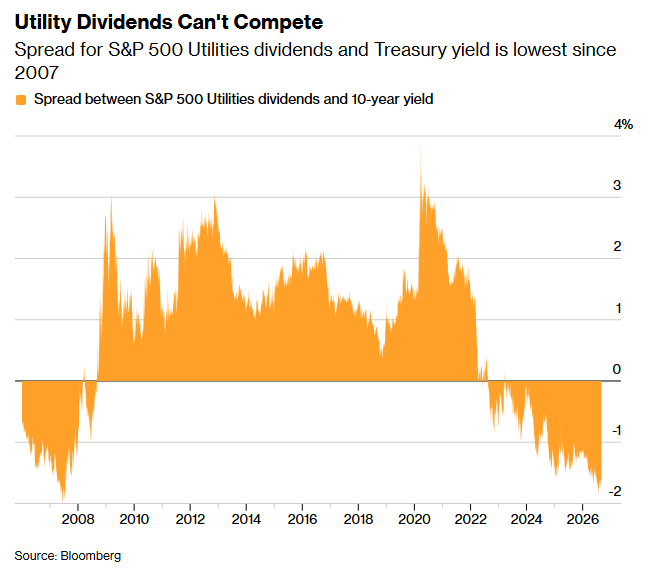
Spread Between S&P 500 Utilities Dividend Yield and Treasury Yield Hits Lowest Level Since 2007
Of course, although the current yield spread has reached extreme levels, the yield on 10-year U.S. Treasury bonds has remained higher than the dividend yield of the S&P 500 Utilities Sector since 2022. This period coincides with growing market enthusiasm for artificial intelligence (AI)-related trades, alongside increasing expectations that utility companies will provide substantial power supplies to data centers.
On the other hand, if the Federal Reserve raises interest rates, the utilities sector could face further distress. Sam Stovall, Chief Investment Strategist at CFRA, noted that in the first month following rate hikes in 1994, 1997, and 1999, the utilities sector declined by more than twice the magnitude of other market sectors.
However, Sam Stovall added that further weakness in the utilities sector is not a foregone conclusion; since 2004, the sector has demonstrated relatively stronger performance. Even after the rate hikes in 2022, the utilities sector rose by 7.3%, while the S&P 500 Index increased by only 0.8%.
It is worth noting that earnings growth in the utilities sector may have peaked. As opposition grows across the United States, some utility companies have begun lowering their pipeline forecasts for AI data center projects. Meanwhile, they are also reaching agreements with regulators to reduce their allowed return on equity.
Analysts expect earnings growth for the S&P 500 Utilities Sector to slow in the coming quarters—declining from 14% in the second quarter to 5.9% in the current quarter, rebounding to 12% in the fourth quarter, and maintaining single-digit growth through the first three quarters of 2027.
Although a higher interest rate environment is unfavorable for the utilities sector, the direction of AI-related trading trends may ultimately be the most critical factor. Sam Stovall stated, "The majority of the utilities sector's performance has been driven by utility companies associated with AI and power generation businesses."
Edited by Deng