
The prospect of Federal Reserve rate hikes has weighed on overall valuations and some software growth stocks, but the industrial logic driving demand for AI computing power, storage, and data center interconnects has not yet been undermined by interest rate expectations. Memory chip stocks$SK hynix (SKHY.US)$closed up more than 8%, while optical communication stocks$Coherent (COHR.US)$rose 6.6%. Market participants stated that the strong performance of chip stocks on Friday had "nothing to do" with the non-farm payroll data, but was primarily driven by the ongoing rotation between semiconductors and software.
The U.S. non-farm payrolls report for August was unexpectedly strong, putting pressure on the broad U.S. equity market on Friday. However, capital did not withdraw comprehensively from technology stocks; instead, it flowed noticeably into the hardware supply chain for AI infrastructure.
All three major U.S. stock indices ended their two-day winning streak. By Friday's close, the Dow Jones Industrial Average fell 0.51%, the S&P 500 dropped 0.38%, and the Nasdaq Composite declined 0.29%. Meanwhile,$PHLX Semiconductor Index (.SOX.US)$closed up approximately 3.4%, becoming one of the standout sectors of the day.
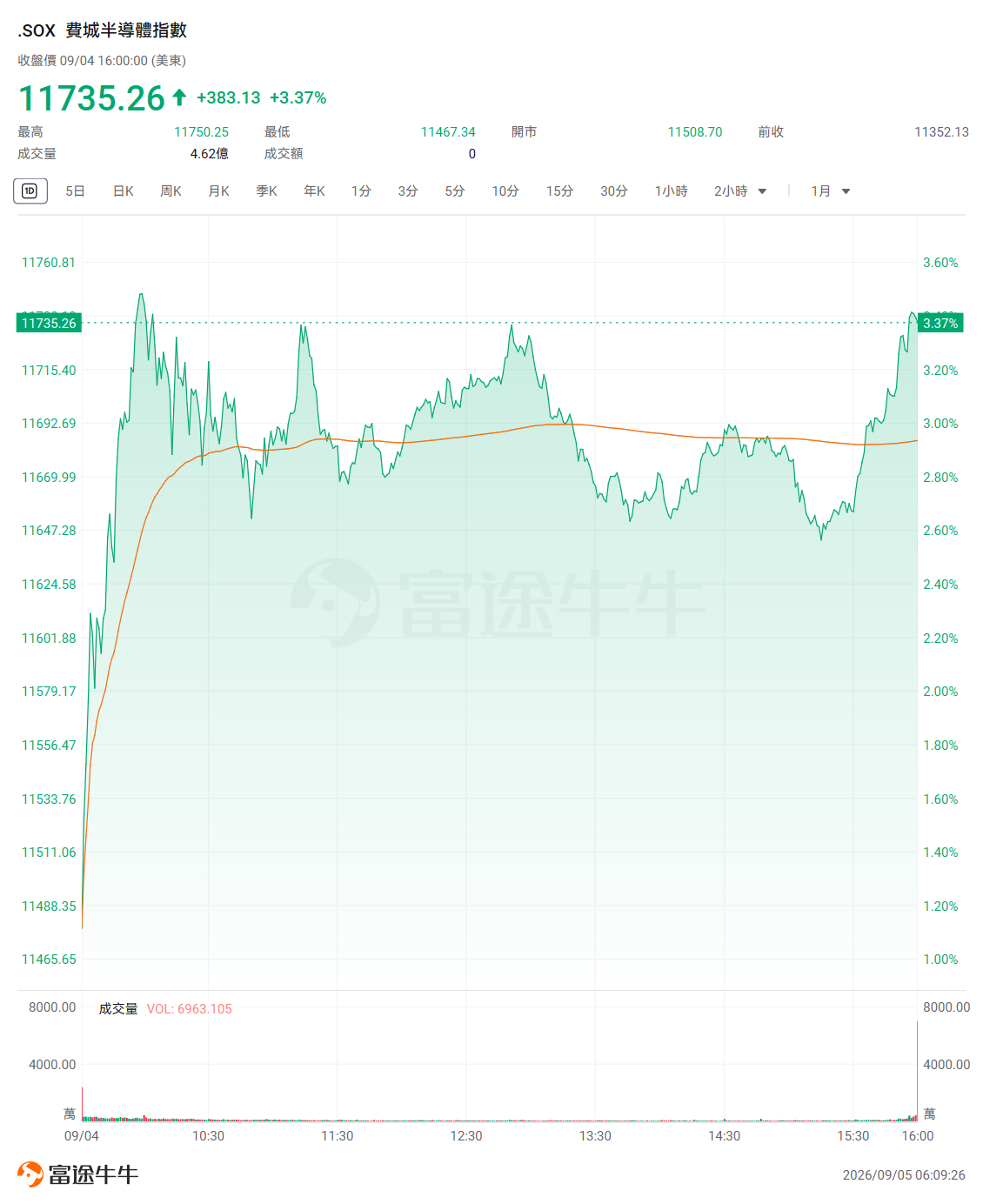
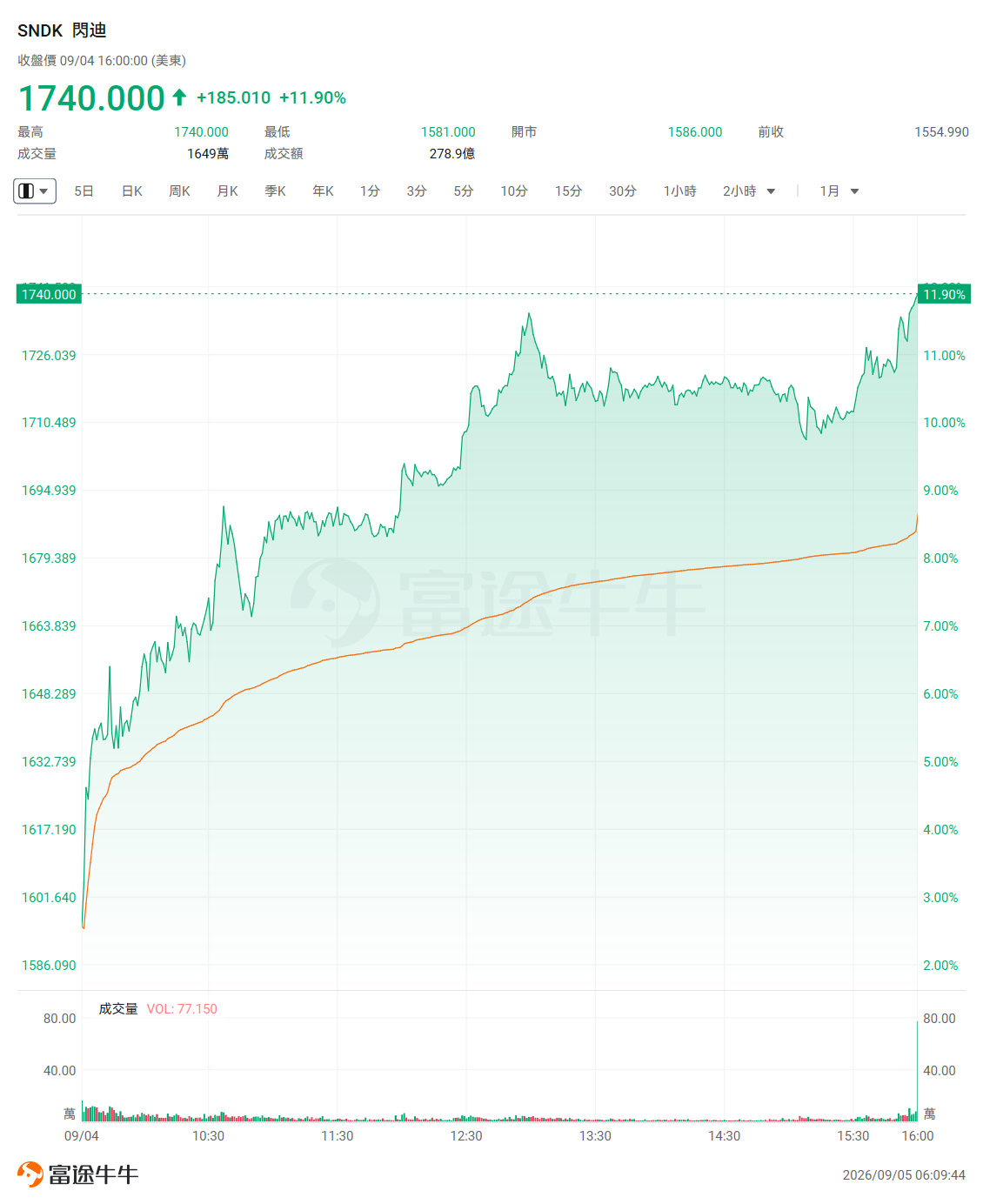
 Sub-sectors such as memory chips, semiconductor equipment, and AI optical communications strengthened collectively, among which$SanDisk (SNDK.US)$closed up nearly 12%, becoming the$S&P 500 Index (.SPX.US)$component stock with the largest gain on Friday,$Marvell Technology (MRVL.US)$ ) rose more than 7%, and$Applied Materials (AMAT.US)$ rose over 4%, $Advanced Micro Devices (AMD.US)$ gained approximately 4.7%.
$SK hynix (SKHY.US)$ 、$Seagate Technology (STX.US)$、$Micron Technology (MU.US)$、$Western Digital (WDC.US)$Shares of storage and data storage companies closed up approximately 8.1%, 6.3%, 6.1%, and 5.9%, respectively. AI-related hardware stocks also surged,$Super Micro Computer (SMCI.US)$rising more than 4.5%.
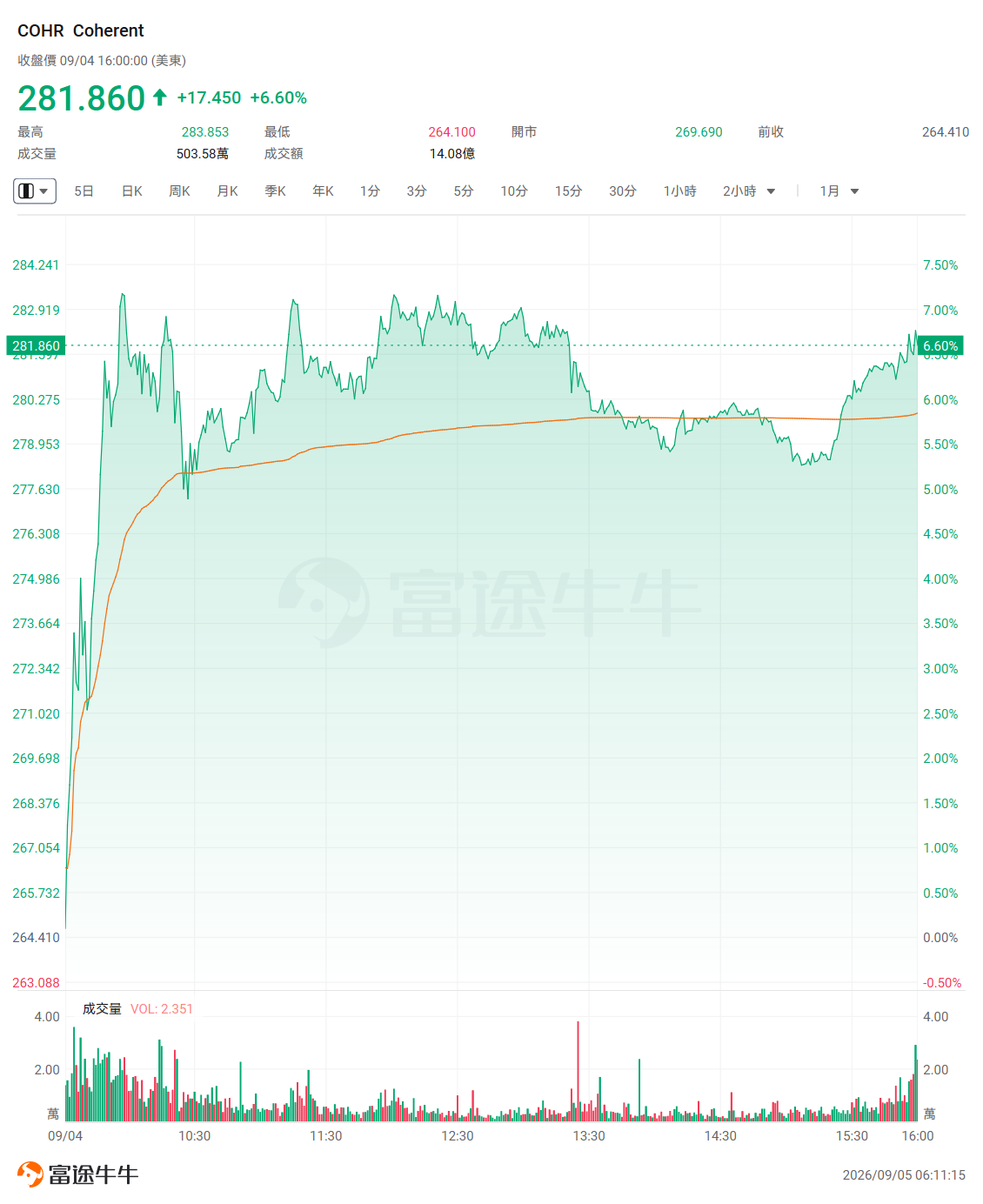
Notably, this counter-trend rally was not limited to traditional chips. Stocks in optical communications and optical hardware, benefiting from the expansion of AI data centers, also strengthened against the trend, with$Coherent (COHR.US)$ )、$Corning (GLW.US)$、$Lumentum (LITE.US)$closing gains of approximately 6.6%, 5.7%, and 4%, respectively.
The market is voting with real money to express an increasingly clear judgment: while potential Federal Reserve rate hikes may suppress overall valuations and certain software growth stocks, the industrial logic underpinning demand for AI computing power, memory, and data center interconnectivity has not yet been undermined by interest rate expectations.
The broader market fears rate hikes, but chip stocks do not: Capital is shifting "from software to hardware."
The most noteworthy aspect of the U.S. stock market on Friday was not the decline in the three major indices, but the extremely pronounced divergence within the technology sector.
The Philadelphia Semiconductor Index rose more than 3% at one point during intraday trading, and the Roundhill Memory ETF also moved significantly higher, whereas the software sector became a major drag on technology stocks.
Barron's noted that Thomas Martin, Senior Portfolio Manager at Globalt Investments, stated explicitly that the strength in chip stocks on Friday had "zero relation" to the non-farm payrolls data, but was primarily driven by the ongoing rotation between semiconductors and software. On the same day, the iShares Expanded Tech-Software ETF fell approximately 2.4%, presenting a sharp contrast.
This actually explains a seemingly paradoxical phenomenon:
Stronger non-farm payrolls → higher probability of Federal Reserve rate hikes → theoretically putting pressure on high-valuation tech stocks; yet capital is flowing out of certain software stocks and into AI hardware.
The reason lies in the shifting pricing logic of AI trades in the market.
In recent years, the AI investment boom has largely focused on software, models, and application layers. However, entering 2026, investors are increasingly focusing on the "shovel sellers"—those truly able to secure orders from AI capital expenditure—including GPUs, memory, networking equipment, optical modules, optical fibers, and data center infrastructure.
This means that for these companies, the core variables determining earnings growth are not just the risk-free interest rate, but also whether capital expenditure on hyperscale data centers continues to grow, whether demand for AI computing power keeps rising, and whether there are supply bottlenecks for related hardware.
Market focus this week on OpenAI’s latest release, GPT-6 Astra, further reinforced this industry narrative. The model’s launch was viewed by the market as a signal of continued upgrades in AI capabilities, while massive infrastructure investment plans by AI companies such as OpenAI and$Microsoft (MSFT.US)$、$Oracle (ORCL.US)$、$CoreWeave (CRWV.US)$AMD,$Broadcom (AVGO.US)$and other giants have once again made the sustainability of AI hardware demand a key focus of market trading.
SanDisk surges 12%: Memory chips become the "most vigorous" segment of AI hardware
If the 3.4% rise in the Philadelphia Semiconductor Index was already eye-catching, SanDisk’s (SNDK) approximate 12% gain stands out even more.
SanDisk was among the top gainers in the S&P 500 Index on Friday; Micron Technology rose about 6%, while Western Digital and Seagate Technology also gained approximately 6% each. The storage sector overall strengthened,$Roundhill Memory ETF (DRAM.US)$with gains approaching 7% at one point.
It is no coincidence that memory chips have become the primary target for concentrated capital inflows.
The rapid expansion of AI data centers not only signals increased demand for GPUs, but also a synchronized rise in demand for storage products such as HBM, DRAM, NAND, and enterprise-grade SSDs. Particularly as AI models grow in scale, inference tasks increase, and data centers continue to expand, storage and data transmission are becoming increasingly critical components of AI infrastructure.
Recently, the market has coalesced around a clear narrative of an "AI memory supercycle." Citing analysis from Dan Kim, an executive at TechInsights, the Financial Times reported that AI data centers are driving a surge in demand for DRAM and NAND, with memory chip prices rising by more than 200%. As new capacity is not expected to scale up significantly until around 2028, supply constraints are further strengthening the bargaining power of memory manufacturers.
Therefore, unlike some software stocks that increasingly face the question of whether AI will disrupt their business models, memory chip companies are positioned more directly on the supply side of AI capital expenditure.
This has led investors to maintain higher earnings expectations for these hardware companies, even amid rising interest rates and a broader market reduction in risk exposure.
From "Computing Power" to "Connectivity": Optical Communication Stocks Also Attract Capital Attention
Another prominent theme defying broader market trends is optical communication and interconnection infrastructure for AI data centers.
Shares of optical communication companies such as Corning, Coherent, and Lumentum rose against the trend on Friday. Although these companies have different specific business lines, the market has assigned them a clear common label: the expansion of AI data centers requires increasingly numerous and higher-speed optical interconnections.
A research report released by Deutsche Bank this week pointed out that the AI industry is entering a new phase, with investment focus gradually shifting from merely increasing computing power to connectivity and networking. The bank believes that as data centers continue to expand, companies involved in "generating and transmitting optical signals" are becoming significant beneficiaries of AI infrastructure development, listing Lumentum and Coherent as key recommended stocks.
This explains why optical communication stocks were able to perform strongly against the trend during Friday's "rate-hike trade."
For the market, improvements in GPU performance mean increased computing power; however, as more GPUs are deployed within the same data center or even across different data centers, data transmission between chips is becoming a new bottleneck.
Consequently, the importance of optical modules, lasers, optical fibers, and high-speed networking equipment continues to rise.
Recent earnings reports from Lumentum and Coherent have already indicated that AI demand is rapidly permeating their business segments. Lumentum’s revenue in the latest fiscal quarter surged by over 100% year-on-year, while Coherent also recorded record quarterly revenue.
Therefore, the market is no longer trading solely on "AI chips," but rather on a more comprehensive AI infrastructure chain: computing chips → storage → networking → optical communications → data center power and cooling.
Shares of AMD and Applied Materials also rose, indicating that the hardware rally is spreading across the industrial supply chain.
This capital preference is not confined solely to flash memory and optical communications.
AMD rose 4.69% on Friday, and Applied Materials gained 4.31%; AI hardware-related stocks such as Marvell and Super Micro Computer also advanced in tandem. According to Reuters, the semiconductor sector climbed 3.4% on the day, significantly outperforming other industries.
The rise in Applied Materials’ stock price is particularly noteworthy. As a leader in semiconductor equipment, its share price increase suggests that investor focus has expanded beyond AI chips themselves to include the equipment required for their manufacture.
In other words, the market is not pricing in isolated positive developments for individual companies, but rather a broader macroeconomic logic: as long as AI capital expenditure does not cool significantly, the entire hardware supply chain—from GPUs and storage to semiconductor equipment, optical communications, and network infrastructure—may continue to benefit.
This also explains why the interest rate shock triggered by strong non-farm payroll data did not impact all high-valuation technology stocks uniformly, as it has in the past.
The "moat" of AI hardware: Earnings growth temporarily outweighs interest rate pressures.
Admittedly, the robust non-farm payrolls data still poses an issue for AI hardware stocks that cannot be ignored: valuation.
U.S. non-farm payrolls increased by 162,000 in August, far exceeding the market expectation of 56,000. Moreover, July's employment figure was significantly revised from a previously reported decrease of 23,000 to an increase of 21,000. Following the release of this data, market bets on a Federal Reserve rate hike in September heated up rapidly, with the probability of a 25-basis-point hike rising from approximately 49.4% to 58.4%, while the yield on the 2-year U.S. Treasury note climbed to around 4.37%.
Generally, higher risk-free rates imply an increased discount rate for future cash flows of growth stocks, suggesting that high-valuation AI stocks should face pressure.
However, the market has seen a different dynamic this time: investors are distinguishing between "valuation stories" and "earnings stories."
Some software companies are grappling with competition driven by AI, shifts in business models, and the digestion of valuations; in contrast, the AI hardware supply chain benefits from more direct order growth and capital expenditure support.
Barron's cited Martin from Globalt as stating that the strength in chip stocks on the day was primarily driven by sector rotation, while sustained enthusiasm for AI remains a key reason for the relative resilience of the technology sector. Meanwhile, signs of market rotation from software to hardware had already emerged previously.
More importantly, some leading AI hardware stocks remain at a certain distance from their historical highs despite previous substantial gains. Although memory stocks such as SanDisk and Micron Technology have surged this year, not all are trading near historic peaks, leaving room for capital to re-embrace this sector. Micron Technology rose about 4.4% on Friday to near $100, and SanDisk gained over 11%; however, Micron remains approximately 20% below its June high.
On one side is the "rate hike trade," and on the other is the "AI trade": internal divergence in the U.S. stock market is accelerating.
Ultimately, the market effectively executed two trades simultaneously on Friday.
The first was a macroeconomic trade: strong non-farm payrolls → increased probability of a Fed rate hike in September → rising U.S. Treasury yields → pressure on the broader market and select growth stocks.
The second theme is industrial transactions: AI model capabilities continue to upgrade → data center capital expenditure remains sustained → demand for chips, memory, networking, and optical communications continues to grow → AI hardware becomes a safe haven for capital.
This explains why the Philadelphia Semiconductor Index rose 3.4% and SanDisk surged approximately 12%, even as all three major indices closed lower. Reuters data shows that the semiconductor sector was one of the market’s clearest winners on Friday; Barron’s noted that the semiconductor index gained about 3%, while software ETFs fell more than 2%.
For AI hardware, the true test ahead is not a single non-farm payrolls report, but whether the high-interest-rate environment will ultimately transmit to corporate capital expenditure.
If future data prove that the economy remains sufficiently robust and AI investment continues to expand, these hardware companies may instead become relative beneficiaries in a "strong economy + high interest rates" environment. However, if rising interest rates eventually begin to suppress corporate financing and data center capital expenditure, this current strong market theme will face dual pressures on valuation and demand.
At least on September 4, the market’s answer was very clear: the broader market was trading on rate hike expectations, while AI hardware was trading on AI fundamentals.
Editor/Stephen