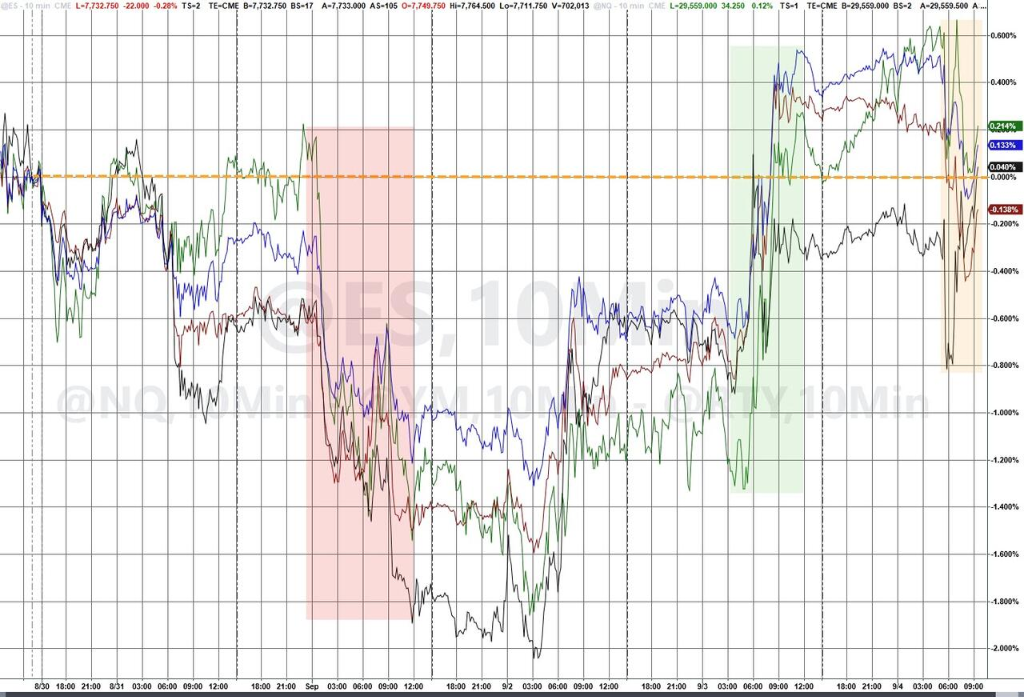
The three major indices ended their two-day winning streak.$S&P 500 Index (.SPX.US)$The S&P 500 fell 0.38%, and the Dow Jones Industrial Average dropped 0.51%.$Philadelphia Semiconductor Index (.SOX.US)$Optical communication stocks rose 3.37%, with all 30 constituent stocks posting gains.$Marvell Technology (MRVL.US)$Rose 7.05%,$Corning (GLW.US)$Storage stocks rose 5.67%.$SanDisk (SNDK.US)$Rose 11.90%. WTI crude oil briefly dipped to $88.72 per barrel during the session, marking an intraday decline of over 2.5%, before nearly recovering all losses. The yield on the 2-year Treasury note rose by 3.4 basis points, reaching a session high of 4.416%, the highest level since January 2025.
US Augustnonfarm payrolls dataThe data significantly exceeded expectations, bringing the possibility of a September rate hike back into focus. This exerted pressure on the short end of the bond market, yet capital did not fully retreat from equity markets. The semiconductor sector strengthened against the trend, with memory chips and optical communications emerging as the strongest themes, while consumer brands and the energy sector declined under their respective pressures.
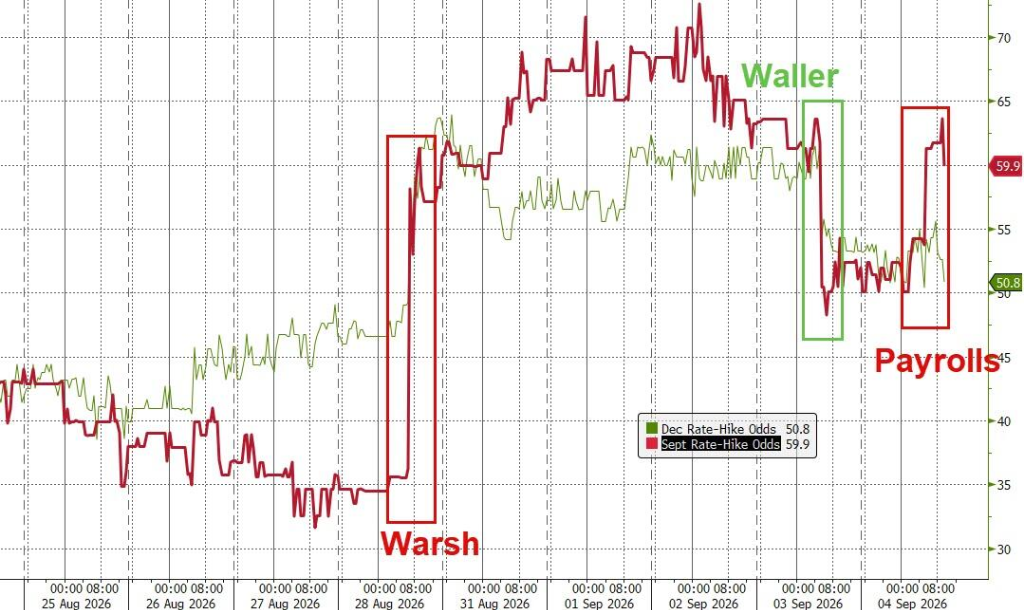
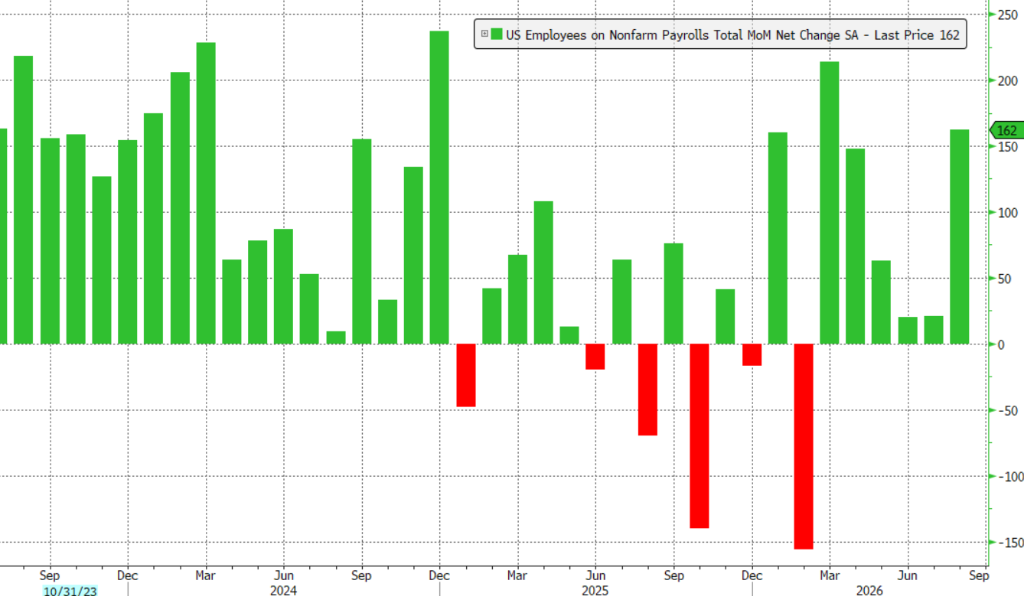
Non-farm payrolls added 162,000 jobs in August, far surpassing the market expectation of 53,000. The unemployment rate remained at 4.1%, data for the previous two months were revised up by a combined 55,000, and wages grew 3.1% year-on-year. This report directly undermined Federal Reserve Governor Waller’s statement from the previous day, which had indicated a inclination to support pausing rate hikes in September.
 The CME FedWatch Tool showed the probability of a September rate hike rising from 49.4% to 58%, while the yield on the 2-year U.S. Treasury note touched 4.416% intraday, its highest level since January 2025.
U.S. Stock Market
The three major indices ended their two-day winning streak. The S&P 500 Index fell 0.38% to close at 7,718.60 points,$Nasdaq Composite Index (.IXIC.US)$The Nasdaq Composite fell 0.29%, while the Dow Jones Industrial Average dropped 0.51%. The Philadelphia Semiconductor Index bucked the trend, rising 3.37%, with all 30 constituent stocks advancing, making it the most notable outlier of the day.
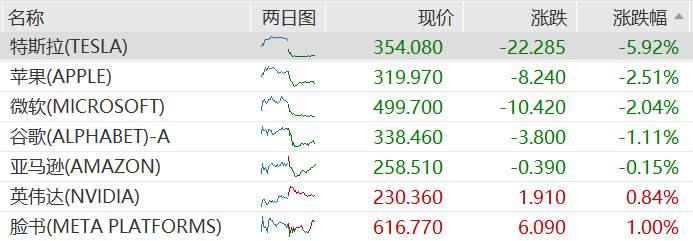
By market capitalization, as of the close of trading,NVIDIA (NVDA.US)Microsoft rose 0.84%, Apple fell 2.51%,$Google-A (GOOGL.US)$down 1.11%,$Microsoft (MSFT.US)$down 2.04%,$Amazon (AMZN.US)$down 0.15%,$Taiwan Semiconductor (TSM.US)$up 2.76%,$SpaceX (SPCX.US)$down 1.2%,$Broadcom (AVGO.US)$up 0.21%, Meta up 1%,$Tesla (TSLA.US)$down 5.92%,$SK Hynix (SKHY.US)$up 8.14%,$Micron Technology (MU.US)$up 6.1%, Berkshire Hathaway Class A down 0.62%.
Sectors related to artificial intelligence and data centers, including memory and CPO, rose against the trend on Friday. In addition to SK Hynix and Micron Technology, SanDisk in the memory sector closed up 11.9%,$Seagate Technology (STX.US)$up 6.34%,$Western Digital (WDC.US)$up 5.86%,$Kioxia ADR (KXIAY.US)$up 10.41%.
Optical communication concept stocks rose: AXT up 9.68%, POET up 8.05%, Marvell Technology up 7.05%, Corning up 5.68%, Applied Optoelectronics up 5.13%, and Lumentum up 4%.
In the semiconductor equipment sector, Aehr Test Systems rose 13.1%,$COHU Semiconductor (COHU.US)$up 10.31%,$KLA Corp (KLAC.US)$up 7.32%,$Entegris (ENTG.US)$up 6.15%,$Lam Research (LRCX.US)$up 5.12%,$ASML Holding (ASML.US)$up 4.17%.
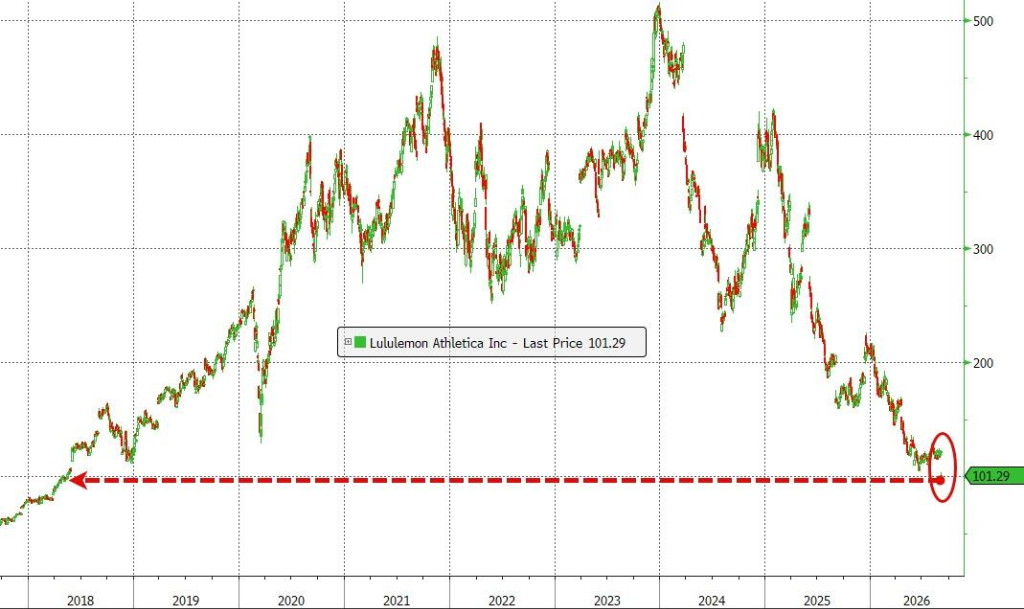
Sports apparel company $Lululemon Athletica (LULU.US)$ Plunged 17.38% on Friday as the company lowered its full-year earnings guidance for the second time this year.
$Nasdaq Golden Dragon China Index (.HXC.US)$Closed up 0.89% on Friday, but down 2.5% for the week. As of the close,$Alibaba (BABA.US)$rose 1.28%,$PDD Holdings (PDD.US)$rose 0.71%,$NetEase (NTES.US)$rose 1.91%, JD.com rose 1.87%,Baidurose 4.07%, Trip.com fell 0.89%,$Li Auto(LI.US)$rose 2.57%,$Bilibili (BILI.US)$fell 1.74%,$Nio (NIO.US)$Down 1.55%.
Non-farm payrolls data reignites rate hike expectations
U.S. job growth in August surprised to the upside, sharply raising market expectations for a Federal Reserve rate hike in September and triggering significant volatility in financial assets.
On Friday, the U.S. Bureau of Labor Statistics released data showing that non-farm payrolls increased by 162,000 in August. This figure not only far exceeded the Wall Street median forecast of 55,000 but also surpassed the upper bound of all institutional predictions, marking the second-largest monthly gain this year. The CPI and PPI data to be released next week will serve as the final hurdle before the September FOMC meeting.
Chris Rupkey, Chief Economist at FWDBONDS, stated that the continued strength in hiring amid high energy prices and persistent cost-of-living pressures was unexpected. The market's primary concern is whether the Federal Reserve will deem economic demand still overheated and consequently raise interest rates again in the coming weeks.
Analysts pointed out that the upcoming inflation reports will be the decisive factor in shaping the Federal Reserve's policy debate. He noted that after Chair Powell signaled a hawkish stance at Jackson Hole, the Fed's inclination to take action remains intact as long as inflation data fails to provide further evidence of easing price pressures.
U.S. equities faced pressure immediately after the open. The S&P 500 Index touched its daily high of 7,750.19 points at the open before declining throughout the session, hitting a low of 7,706.12 points; the Dow Jones Industrial Average fell nearly 400 points intraday, closing down 271.86 points.
$Russell 2000 Index (.RUT.US)$up 0.25%, $Nasdaq 100 Index (.NDX.US)$up 0.21%. The Philadelphia Semiconductor Index rose 3.37% to 11,735.26 points, with none of its 30 component stocks declining. The resilience of small-cap stocks and heavyweight technology shares stood in contrast to the broader market.
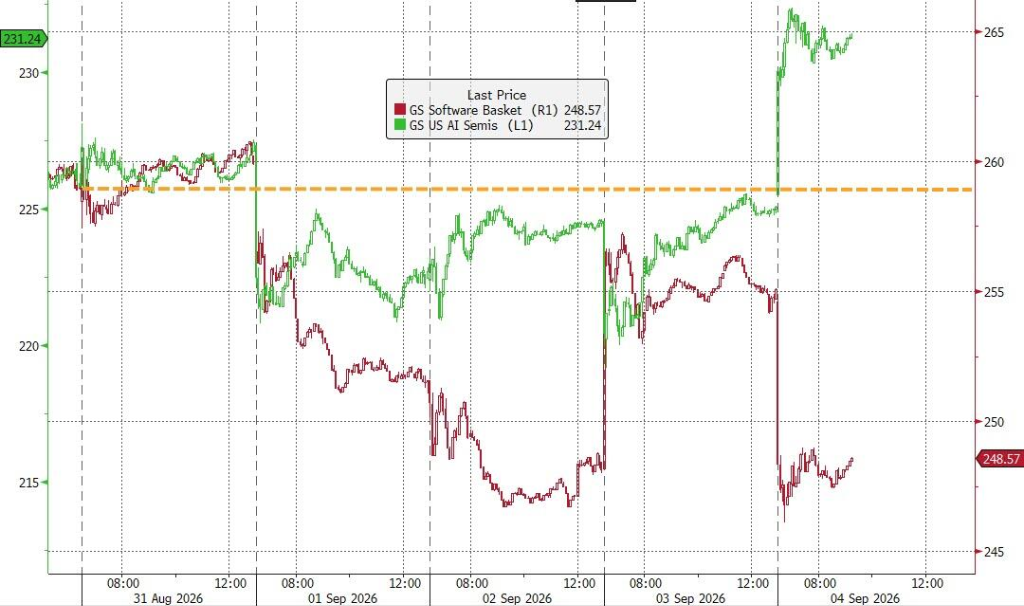
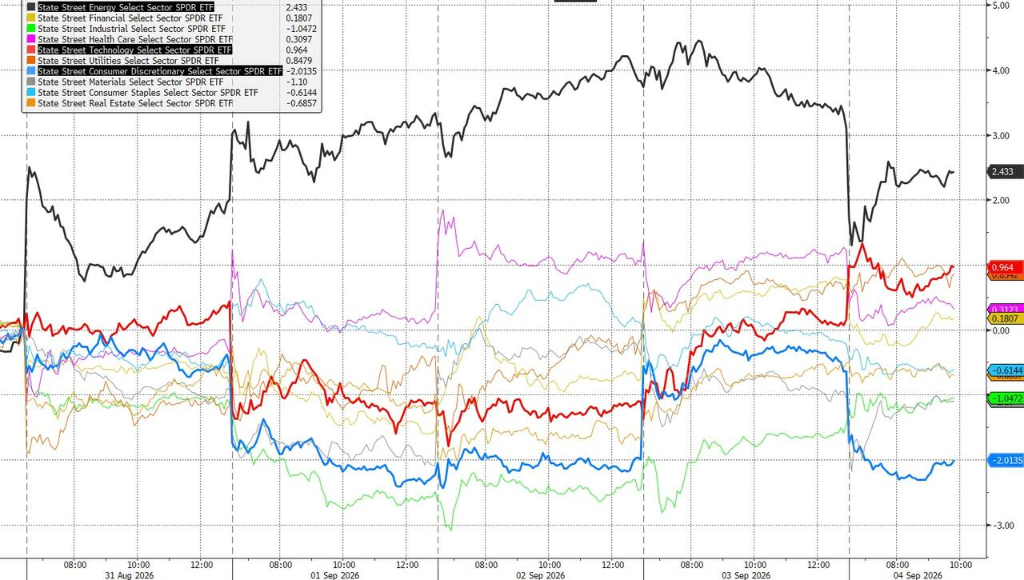
KLA Corporation rose 7.32%, Marvell Technology gained 7.05%, Advanced Micro Devices (AMD) advanced 4.69%, Intel increased 4.51%, ASML Holding rose 4.17%, and Lam Research climbed 5.12%. The S&P 500 Information Technology sector rose 0.23%, in sharp contrast to the Energy sector, which fell 0.98%.
SanDisk surges 12%: Memory chips become the "most vigorous" segment of AI hardware
Memory chips were the strongest subsector of the day. Micron Technology plans to increase its monthly production capacity for high-bandwidth memory to approximately 100,000 wafers by the end of the year, nearly double last year's level, while accelerating the mass production process for 12-layer HBM4.
Mizuho analyst Vijay Rakesh reiterated his outperform rating on Micron Technology, arguing that memory has become a key bottleneck in the entire semiconductor supply chain; UBS Group analyst Timothy Arcuri raised his forecast for the year-over-year growth rate of the average selling price of high-bandwidth memory from 67% to approximately 79%.
It is no coincidence that memory chips have become the primary target for concentrated capital inflows.
The rapid expansion of AI data centers not only signals increased demand for GPUs, but also a synchronized rise in demand for storage products such as HBM, DRAM, NAND, and enterprise-grade SSDs. Particularly as AI models grow in scale, inference tasks increase, and data centers continue to expand, storage and data transmission are becoming increasingly critical components of AI infrastructure.
Recently, the market has coalesced around a clear narrative of an "AI memory supercycle." Citing analysis from Dan Kim, an executive at TechInsights, the Financial Times reported that AI data centers are driving a surge in demand for DRAM and NAND, with memory chip prices rising by more than 200%. As new capacity is not expected to scale up significantly until around 2028, supply constraints are further strengthening the bargaining power of memory manufacturers.
SanDisk rose 11.90%, Micron Technology gained 6.10%, Seagate Technology increased 6.34%, and Western Digital climbed 5.86%.
From "Computing Power" to "Connectivity": Optical Communication Stocks Also Attract Capital Attention
The optical communication sector also strengthened. Marvell Technology rose 7.05%, and Corning gained 5.67%,$Lumentum (LITE.US)$up 4.00%, providing connectivity solutions for AI clusters,$Astera Labs (ALAB.US)$rose 9.75%.
Marvell Technology previously reported second-quarter revenue of $2.739 billion, a 37% year-on-year increase, with its data center business growing by 46%. Management simultaneously raised revenue guidance for both the current and next fiscal years.
Although these companies have different specific business operations, the market has assigned them a clear common label: the expansion of AI data centers requires increasingly numerous and higher-speed optical interconnects.
A research report released by Deutsche Bank this week pointed out that the AI industry is entering a new phase, with investment focus gradually shifting from merely increasing computing power to connectivity and networking. The bank believes that as data centers continue to expand, companies involved in "generating and transmitting optical signals" are becoming significant beneficiaries of AI infrastructure, and it listed Lumentum and$Coherent (COHR.US)$as key recommended stocks. For the market, improved GPU performance means increased computing power; however, as more GPUs are deployed within the same data center or even across different data centers, data transmission between chips becomes a new bottleneck.
Tesla's Cybercab update fell short of expectations, causing its stock price to drop more than 6%, leading the decline among the Mag 7.
Meanwhile, Tesla fell 5.92%, leading the decline among the Mag 7. The company’s Cybercab event held the previous day in Austin, Texas, was invitation-only without a live broadcast, and CEO Elon Musk did not appear. The company only announced that ride-hailing app users could summon Cybercabs within designated geofenced areas around Austin.
Analysts at Royal Bank of Canada Capital Markets noted in a report that the event revealed limited new information, leaving key questions regarding pricing, production ramp-up, and regulatory approval unanswered. The bank maintained its Buy rating.
Wells Fargo & Co issued a report titled "Tesla's Cybercab Launch Event Falls Short of Expectations," pointing out early execution issues with its autonomous taxi service in Austin, such as routing errors and missed destinations.
Lululemon plummeted 17.38% to $100.61, marking its lowest closing price since April 2018, bringing its year-to-date decline to 51.59%. Second-quarter revenue stood at $2.42 billion, down 4% year-on-year and below analysts' expectations of $2.46 billion.
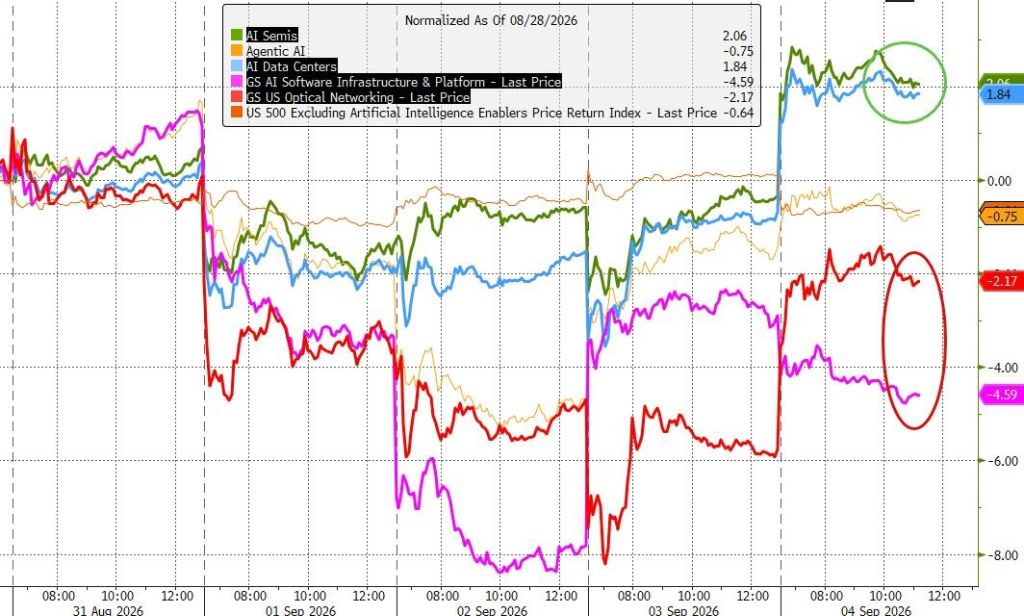
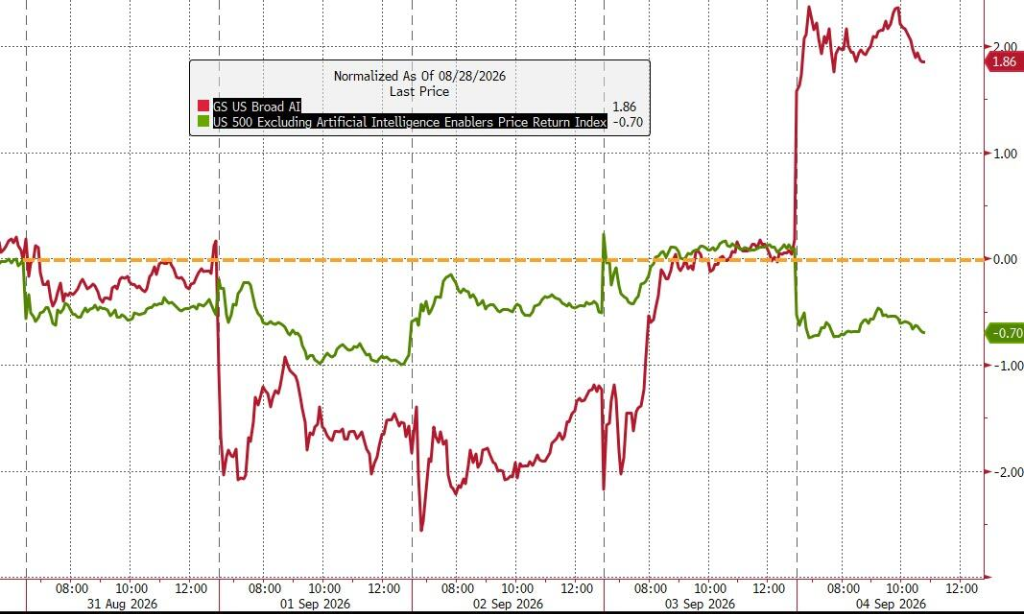
The contrast between earnings reports from AI supply chain companies and consumer brands is stark: excluding AI-enabled stocks, the S&P 500 declined this week, while the broader AI basket advanced. Corporate AI budgets remain robust, whereas discretionary consumer brands face weakening demand, tariff impacts, and rapidly shifting consumer preferences.
Tensions in the Strait of Hormuz push oil prices higher; U.S. retail diesel prices hit record highs.
The October WTI crude oil contract settled at $91.48 per barrel, up $0.18 or 0.20%; the November Brent crude contract settled at $96.28 per barrel, up $0.76 or 0.80%.
Both contracts closed higher but experienced intraday volatility, initially falling before recovering. WTI dipped to as low as $88.72 during the session, representing an intraday drop of over 2.5%, but fully recovered those losses in the afternoon.
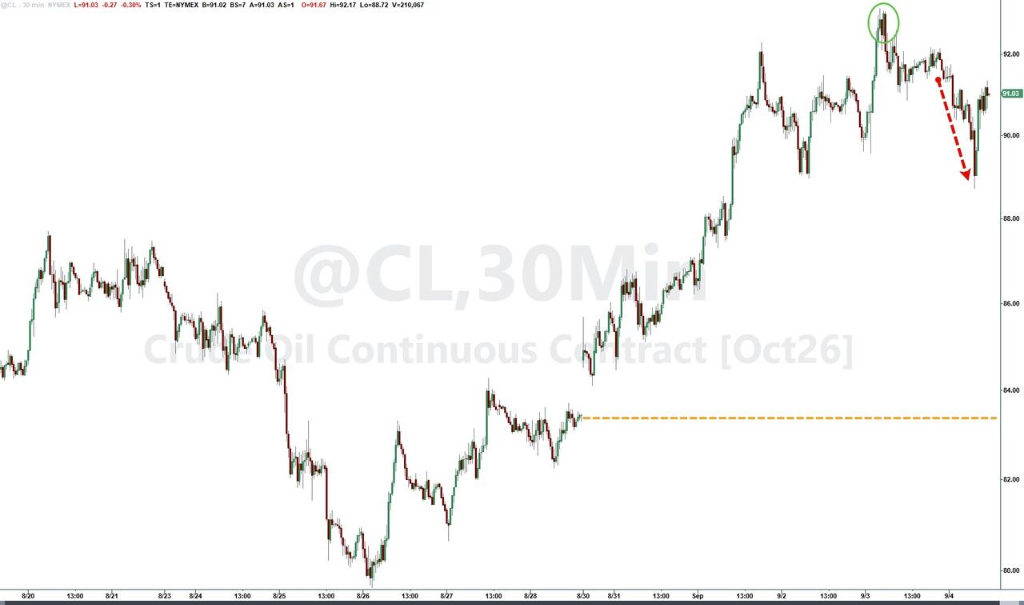
The key variable driving oil prices higher throughout the week was the Strait of Hormuz. The U.S. military struck Iranian targets this week, prompting Iran to retaliate against U.S. military bases in the region and expand its list of designated non-compliant vessels. Shipping data showed that only four bulk carriers passed through the strait on Thursday, down from nine the previous day, compared with a 10-day average of approximately 15.
Both benchmark crude oil prices rose by approximately 9% for the week, marking the largest weekly gain since the week of July 20.
ANZ Bank believes that the energy market is entering a delicate adjustment period. While high inventory levels previously helped absorb the initial supply shock, the true test lies in whether the market can maintain balance once inventories are depleted.
Pressure on refined products is more pronounced. The average U.S. retail price for diesel rose to $5.85 per gallon on the day, surpassing the historical record set in 2022, while the average price for regular gasoline stood at $4.147.
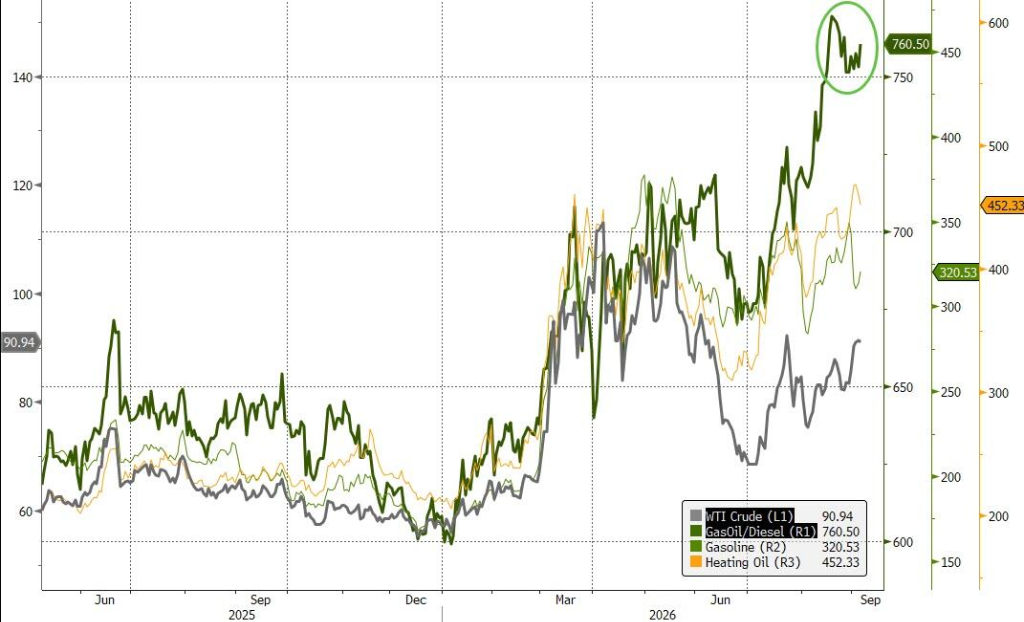
Analysts point out that the U.S.-Iran conflict, coupled with Ukrainian attacks on Russian refining facilities, is cumulatively constraining global refining capacity, pushing diesel crack spreads significantly above conventional levels.
U.S. Treasury Secretary Bessent offered a different perspective, suggesting that oil prices could fall back to $40 per barrel after the end of hostilities involving Iran, thereby driving yields lower.
Short-end yields rose to their highest level in over a year and a half, while gold recovered most of its losses after an initial decline.
Pressure in the U.S. Treasury market on Friday was concentrated at the short end. The two-year yield rose by 3.4 basis points to 4.3703%, hitting an intraday high of 4.416%, the highest level since January 2025.
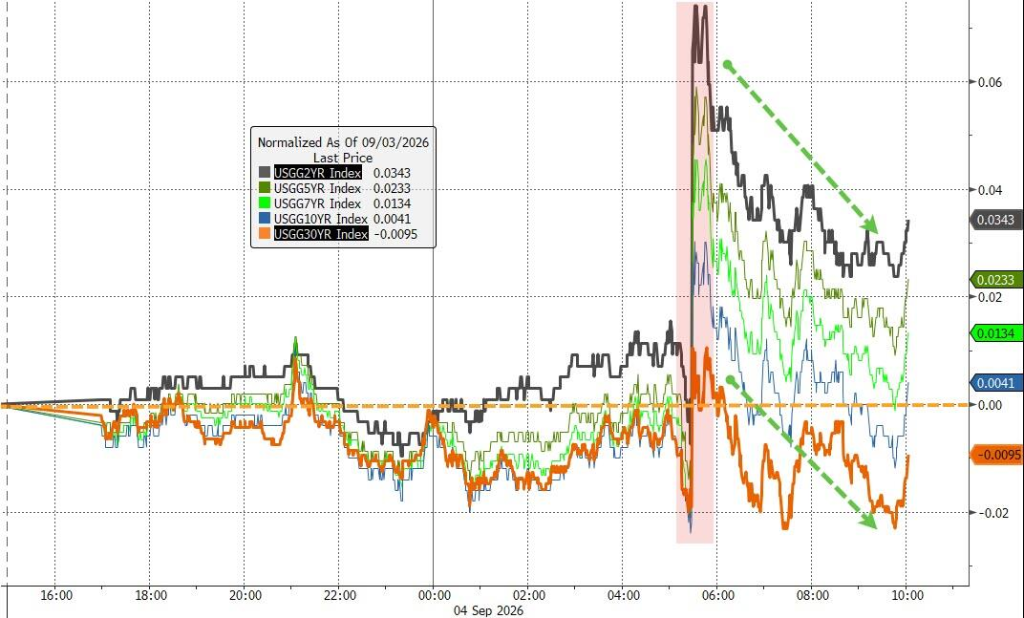
This week, the U.S. Treasury yield curve exhibited a pattern of rising short- and mid-term yields alongside a slight decline in long-term yields. The spread between the two-year and ten-year yields narrowed by 2.2 basis points to 40.58 basis points.
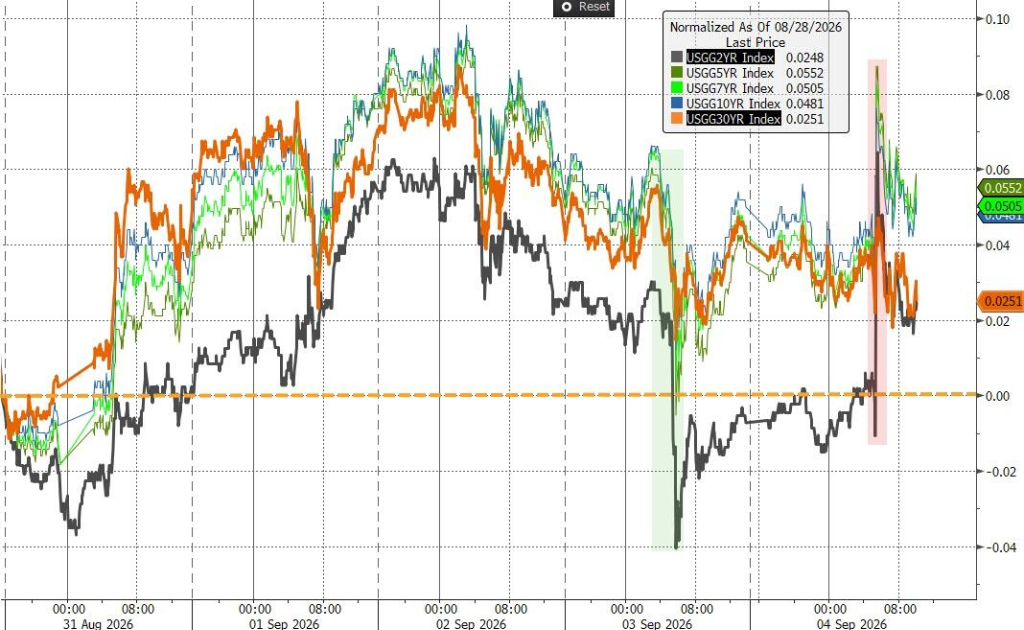
The dynamics driving the long end differ from those at the short end. Peter Cher of Academy Securities attributes long-end movements to supply and demand factors, citing the Norwegian Sovereign Wealth Fund's recommendation to reduce its government bond allocation from 70% to 50% (with the U.S. Treasury share gradually decreasing from 34.1% to 21.9%), Saudi Arabia reducing bond purchases to raise financing, Japan being unable to increase holdings while supporting the yen, and an unusually crowded corporate bond issuance schedule in August.
He remains bullish on corporate bonds over sovereign bonds and believes that the long end of the curve will underperform.
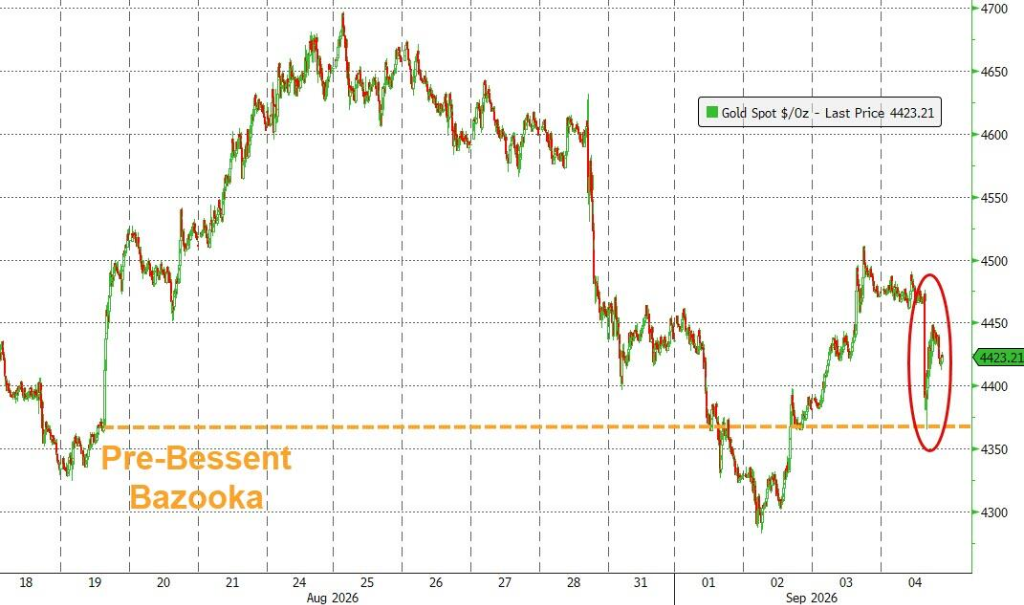
Precious metals moved inversely to yields during the session. Spot silver closed at $66.14 per ounce, down 1.23%. Spot gold initially fell more than 2% after the data release, hitting a low of $4,365.25, before recovering most of its losses as yields retreated, to close at $4,429.29 per ounce, down 0.97%.
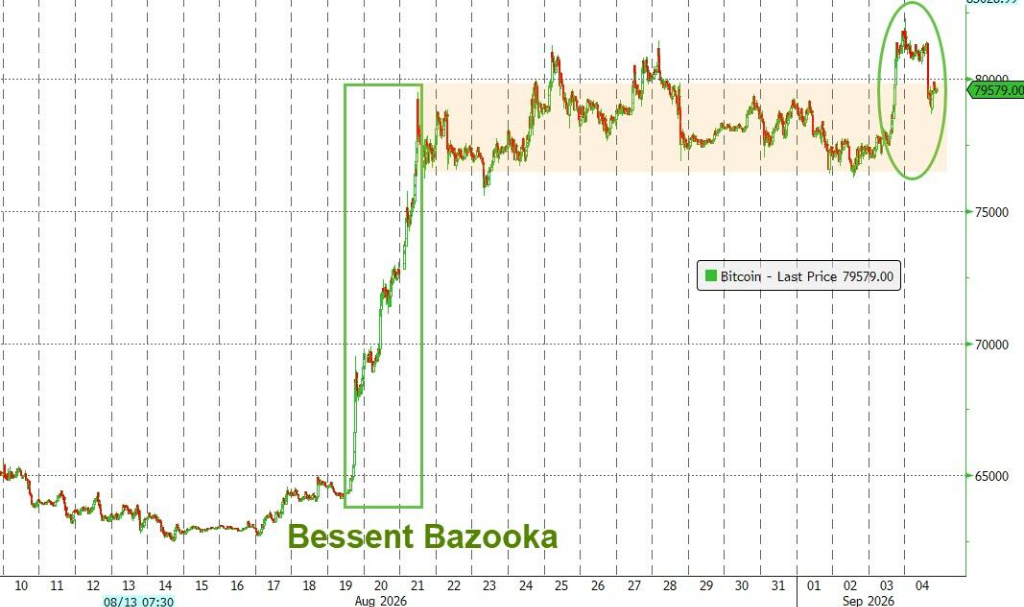
This week$Bitcoin (BTC.CC)$It briefly touched a three-month high, breaking through $82,000, but retreated after the release of U.S. employment data on Friday.
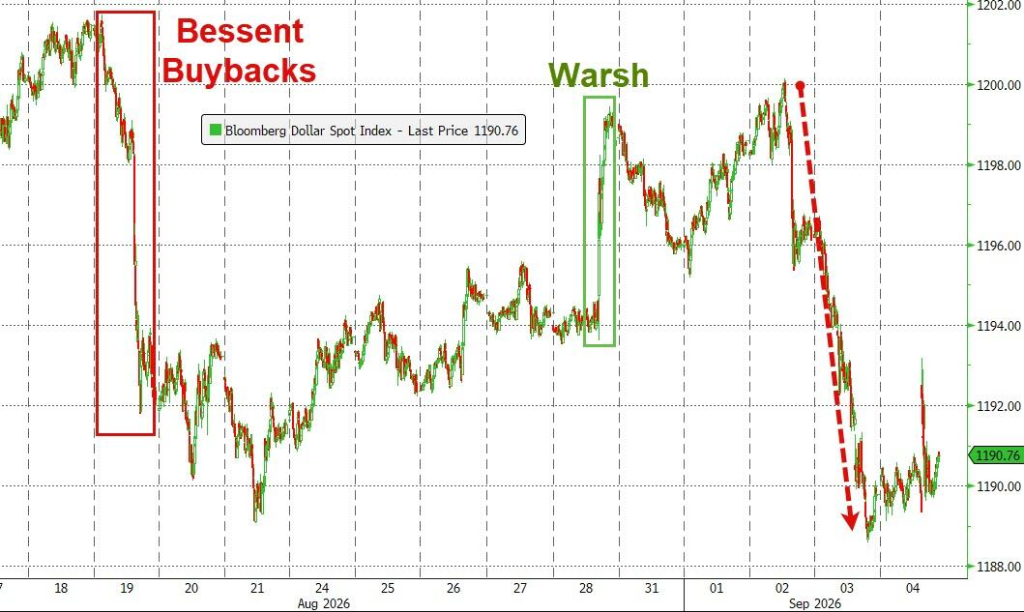
$U.S. Dollar Index (USDindex.FX)$Rose 0.27% to 99.177; the euro fell against the dollar from 1.1635 to 1.1611, while the dollar rose against the yen from 155.50 to 156.22.
Company News
[Sneak Peek at Apple's New Product Roadmap for the Next Three Years]
Renowned tech leaker Mark Gurman stated on Friday that with John Ternus officially assuming the role of CEO this week, the consumer electronics giant is poised to launch the largest wave of device releases in its history. In addition to the foldable iPhone, OLED iPad mini, and touchscreen MacBook scheduled for release next week or in the near term, anticipated new products over the next two years include desktop robots, smart glasses, and 'larger foldable screens.'
[Morgan Stanley and Goldman Sachs Poised to Serve as Core Underwriters for Anthropic's IPO]
The latest news on Friday indicated that Anthropic is close to finalizing its IPO underwriting arrangements. Morgan Stanley is expected to take the lead role as bookrunner, responsible for valuation and share allocation; Goldman Sachs is anticipated to serve as the stabilization agent, while JPMorgan, Citi, and Barclays may also join the underwriting syndicate.
Anthropic could file its public listing documents as early as next week and may list on the New York Stock Exchange in late September or early October, with market expectations valuing the company at or above $2 trillion.
【$Bloom Energy (BE.US)$Added to S&P 500 Index
S&P Dow Jones Indices announced its quarterly rebalancing after the U.S. stock market closed on Friday. Solid oxide fuel cell producer Bloom Energy, gene sequencing equipment leader Illumina, and enterprise all-flash storage provider$Everpure(P.US)$(A.O. Smith) were added to the S&P 500 Index,$The Trade Desk(TTD.US)$、$Builders FirstSource (BLDR.US)$and Molson Coors were removed. The changes to the index constituents will take effect before the market opens on September 21.
[Google Launches Music Generation Model Lyria 3.5]
On Friday, Google launched its latest music generation model, Lyria 3.5, integrating it into the Gemini app and API. The new model supports the generation of tracks in various styles, with or without vocals, based on text descriptions, and allows users to specify track duration. It is designed for scenarios such as video soundtracks, brand music, and personalized ringtones.
Want to select stocks or get a stock diagnosis? Curious about the opportunities and risks in your portfolio? For all your investment questions,Just ask Futubull AI!

Editor/Liam