
OpenAI has announced that GPT-6 Astra is now fully available to high-tier paid users and via API. While Astra’s capabilities have significantly improved, it introduces a new usage paradigm: the model is more sensitive to instructions and more proactive in asking questions. Developers should audit and streamline their AGENTS.md and Skills files to reduce redundancy and conflicting rules.
Multiple practical tests demonstrate its outstanding performance in complex tasks such as programming, 3D modeling, and video production. AI development is shifting from "continuously adding rules" to "removing rules and giving the model more space."
GPT-6 Astra is now fully released!
 Just moments ago, OpenAI officially announced that all Pro, Enterprise, and Business Premium users can now directly access GPT-6 Astra within ChatGPT Work and Codex, with simultaneous API availability.

However, Plus and standard Business users will need to wait a few more days.
On September 3, OpenAI announced the phased rollout of Astra. Two days later, today, access has been fully opened to all high-tier paid users.
First, you are advised to delete your prompts.
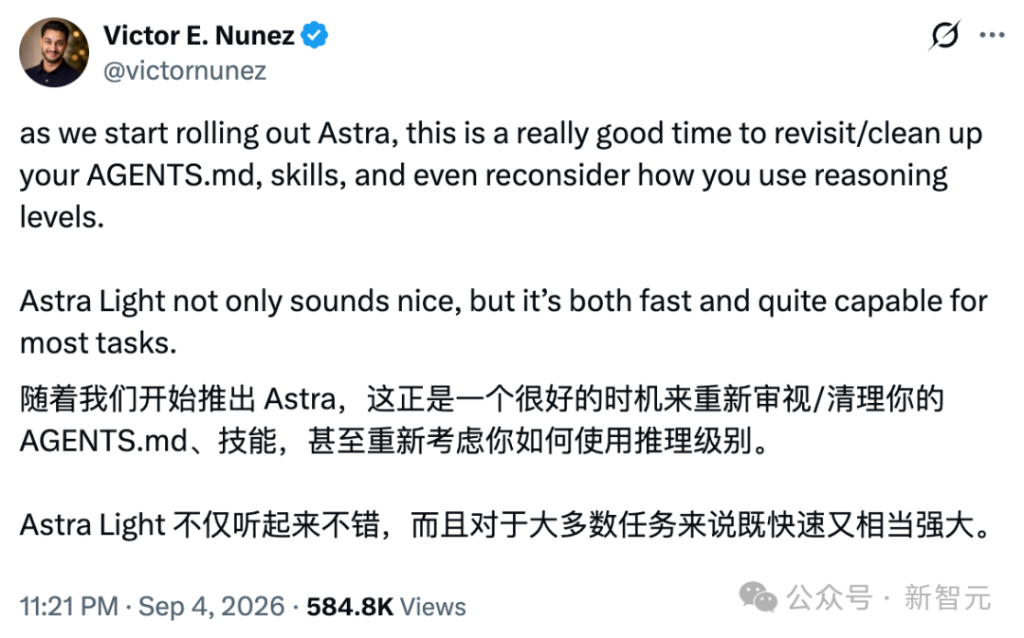
For such a major release, the first piece of advice from OpenAI engineer Victor Nunez was surprisingly to delete your prompts.
He stated: As Astra begins its rollout, take the opportunity to clean up your AGENTS.md and Skills files, and reconsider how to utilize reasoning levels.
AGENTS.md serves as an employee handbook for the AI, defining who it is, what it should do, and what it must not do. Skills act as operational manuals, instructing it on which workflows to follow in specific situations.
In recent years, developers have adopted a blunt and simplistic approach to managing models: continuously adding content to the manual. If the model fails to understand, they add another layer of explanation. If it frequently makes errors, they impose additional constraints. If errors persist, they supplement with more examples.
It is akin to sticking Post-it notes on the desk of a new employee who is prone to forgetfulness. Over time, these notes accumulate until they cover the entire workspace.
However, with the advent of Astra, this desk full of notes has instead become a burden.
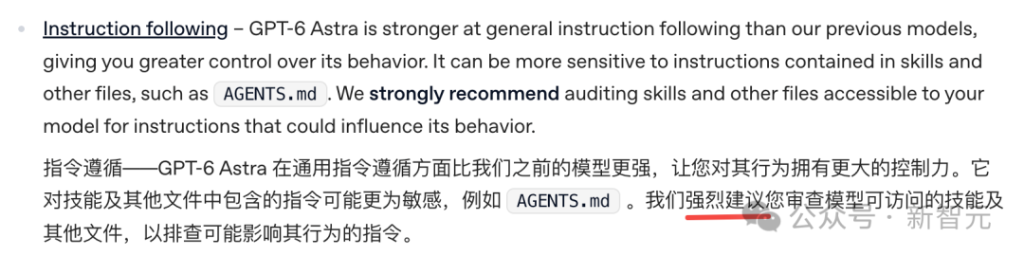
OpenAI states in Astra’s model guidelines that Astra is more sensitive to instructions contained in skill files and AGENTS.md.
Rules that were previously ignored are now executed meticulously. A vague rule will cause it to pause and repeatedly seek confirmation; two conflicting rules will leave it completely confused.
For example, if you previously wrote, “All proposals must be approved,” older models would simply ignore this instruction and proceed as usual.
Astra does not. It will genuinely pause to ask, “Who should approve this proposal?” and then wait.
Consequently, the guidelines use the phrase “strongly recommended” to urge developers to audit every skill file accessible to the model.
Moreover, Astra is more inclined to ask questions than its predecessors.
When assigned a task, it may suddenly stop halfway through and ask, “There are two ways to do this; which one do you prefer?” One might wish it would simply choose a path and proceed. This behavior extends to coding as well: it runs a full suite of tests before writing any code, and even drafts unit tests just to change a button color.
These adjustments rely on prompt engineering, with the general direction being toward greater restraint.
Even more strikingly, the guidelines include a ready-made prompt instructing Astra to avoid clichés such as “delve” and “it is worth noting,” and explicitly ban sentence structures that employ a “negate-then-reframe” pattern (e.g., “This is not about X, but about Y”).
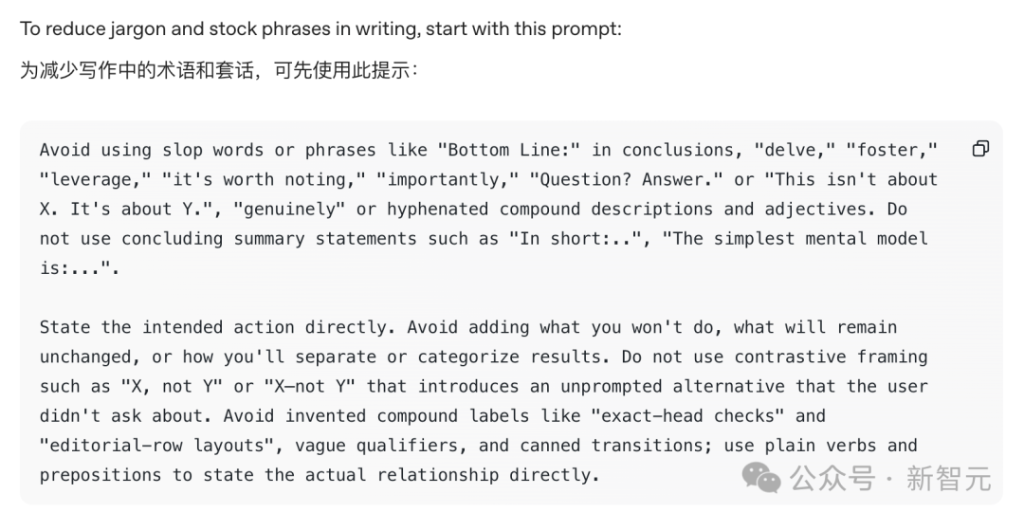
The models generate these clichés, yet it is also the model providers who teach users how to avoid them. This reflects a certain honesty akin to saying, “I dug the hole, and now I will show you how to fill it.”
At this point, some may ask: What does this have to do with me?
It has significant implications.
The shift in Astra’s underlying logic means that your approach to interacting with AI should evolve accordingly.
Previously, when chatting with ChatGPT and finding its responses unsatisfactory, the instinctive reaction was to add more constraints and requirements—adding a second rule if one was insufficient, and five if two were not enough.
This represents an additive mindset: the less capable the model, the more rules you write.
Now, Astra advises against over-specifying instructions.
It can infer your intent from context, proactively seek clarification when instructions are ambiguous, and retain awareness of global objectives across multi-step tasks.
The patchwork-style prompts you write are not only redundant but may also lead the model astray.
Consequently, a key term repeatedly emphasized in OpenAI’s official migration guide is “audit.” Audit all instructions provided to the model, removing any that are outdated, redundant, or conflicting.
The more powerful the model, the fewer rules you should impose.
This principle applies equally to both developers and general users.
To what extent is it powerful?
After discussing so much about “subtraction,” how much capability has Astra actually “added”?
Developers with early access have already delivered their results.
Developer Matt Shumer tasked Astra with building a Manhattan replica in Unreal Engine, constructing it street by street over the course of a week.

He devised a workflow called the “Manager Loop”: one instance of Astra acts as the manager, breaking down the entire task into checklists and phases, while another instance serves as the executor.
The manager assigns only one segment of work at a time, releasing the next segment only upon completion, without providing any advance spoilers. On the execution side, up to 96 sub-agents operate simultaneously, driving the process forward like an assembly line.
Shumer also identified a fascinating nuance in phrasing: instructing the model to perform each stage "extremely well" ensures smooth progress; however, changing the instruction to "perfect" causes it to immediately get bogged down in minutiae. This single-word difference determines whether a project advances or stalls.
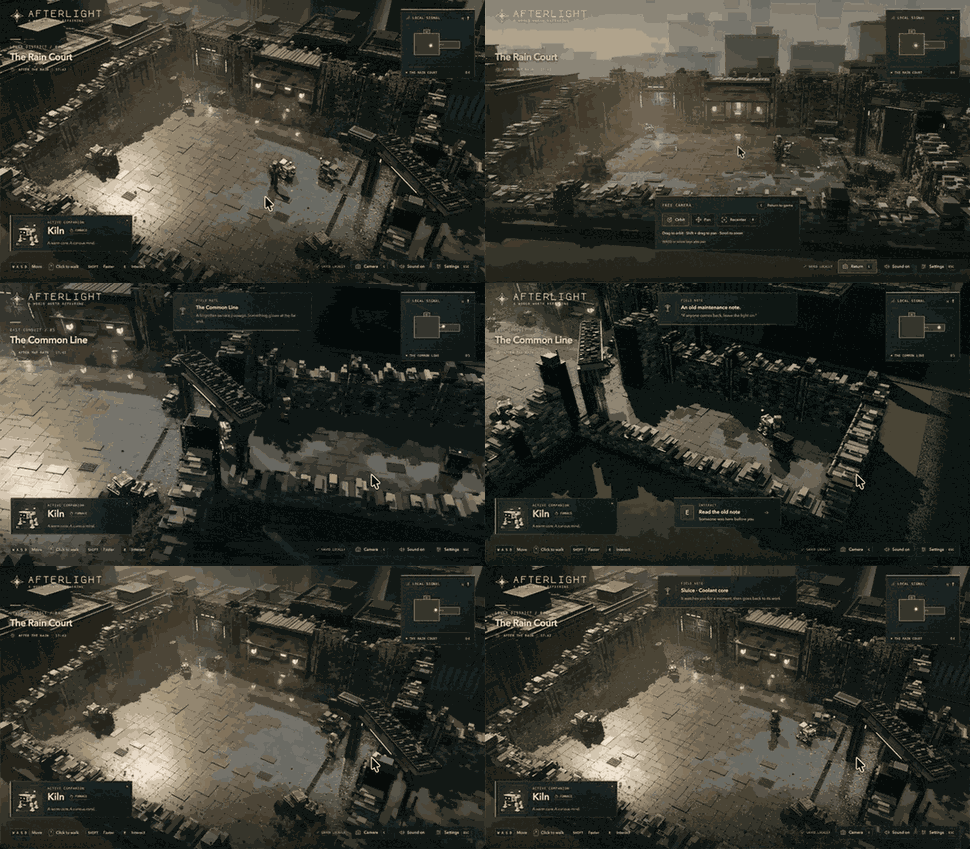
Developer Anshu exclaimed that Astra is essentially a super AGI deity in the realm of 3D gaming.
Astra generated an open-world game environment with stunning graphics in just 45 minutes.
Immunologist Derya Unutmaz entered only a single prompt: "Create a 5-minute educational video on T cells."
Astra independently wrote the narration, created animations using Remotion, generated images with Imagegen, and proactively suggested using HeyGen for voiceover, producing the final video in a single workflow.
After reviewing the output, the scientist, who has studied T cells for 35 years, remarked that he certainly could not have explained it as effectively. He now plans to produce a complete series of immunology video courses for his website.
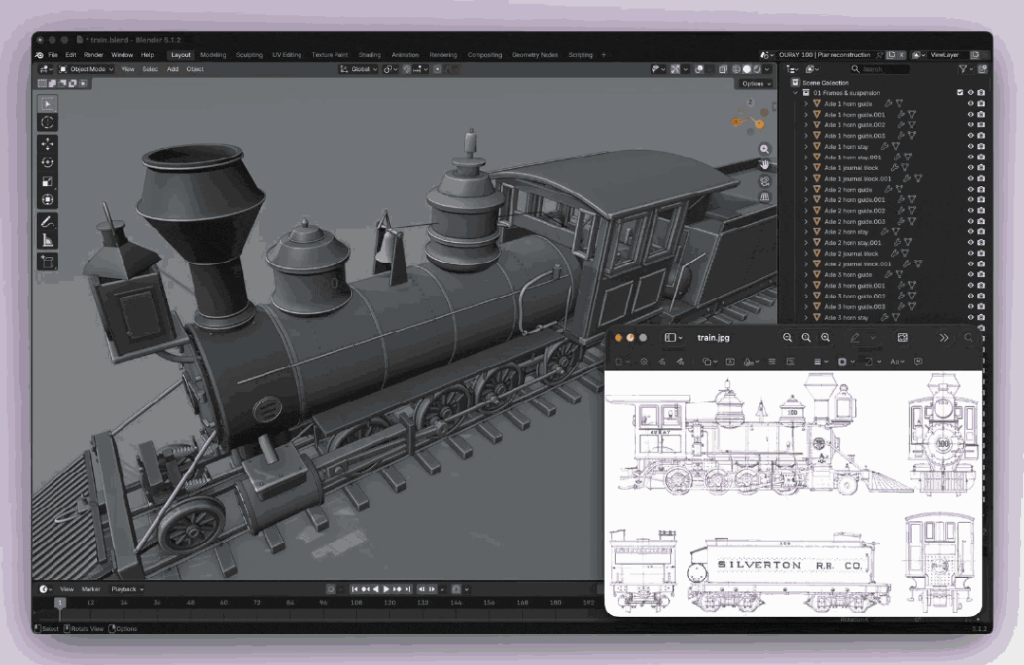
Tom Krcha provided Astra with an old blueprint of a steam locomotive.
Within minutes, Blender generated 3,295 editable objects, with each component capable of being individually disassembled and modified.
This tweet has already garnered over 750,000 views.
He then tested a more obscure model, the Commodore Vanderbilt locomotive. While the curvature of the engine front still required manual adjustment, the starting point was impressively high.
The figures released by OpenAI itself are equally compelling.
On OSWorld 2.0 (a benchmark that evaluates a model’s ability to operate computer desktops like a human), Astra achieved a score of 72.6%, compared to 65.7% for the previous generation, GPT-5.6 Sol. The time required per task was reduced from 75 minutes to 40 minutes—improving both accuracy and nearly doubling speed.
Of course, Astra does not dominate across all metrics. On Artificial Analysis’ independent Comprehensive Intelligence Index, Astra scored 61.2, while Anthropic’s newly released Claude Fable 5.1 scored 65.7 this week.
The rivalry between these two giants remains unresolved.
The Era of Subtraction
In recent years, the narrative of AI development has been one of addition.
When models lacked sufficient intelligence, rules were added to compensate, resulting in increasingly complex rule sets.
Now that these shortcomings have been addressed, the rules themselves have become a new source of errors.
With its model guidelines, OpenAI has quietly reversed the direction of AI engineering: whereas previously the focus was on instructing the model step-by-step, the current approach involves systematically removing obstructive legacy rules to give it more room to operate.
The relationship between humans and models has consequently evolved.
Previously, the approach was to guide it. Now, it is simply: do not obstruct it.
Editor/melody