
Goldman Sachs believes that the correction of the yen's structural undervaluation may have just begun. Rising expectations of interest rate hikes and the potential increase in domestic asset allocation by the Government Pension Investment Fund (GPIF) are expected to generate sustained buying pressure.
Bank of America expects the Bank of Japan to maintain its quarterly pace of interest rate hikes. If the BOJ raises rates in September and signals a hawkish stance, the USD/JPY exchange rate could fall to 149 by year-end; if it breaks below 155, yen buying could accelerate further.
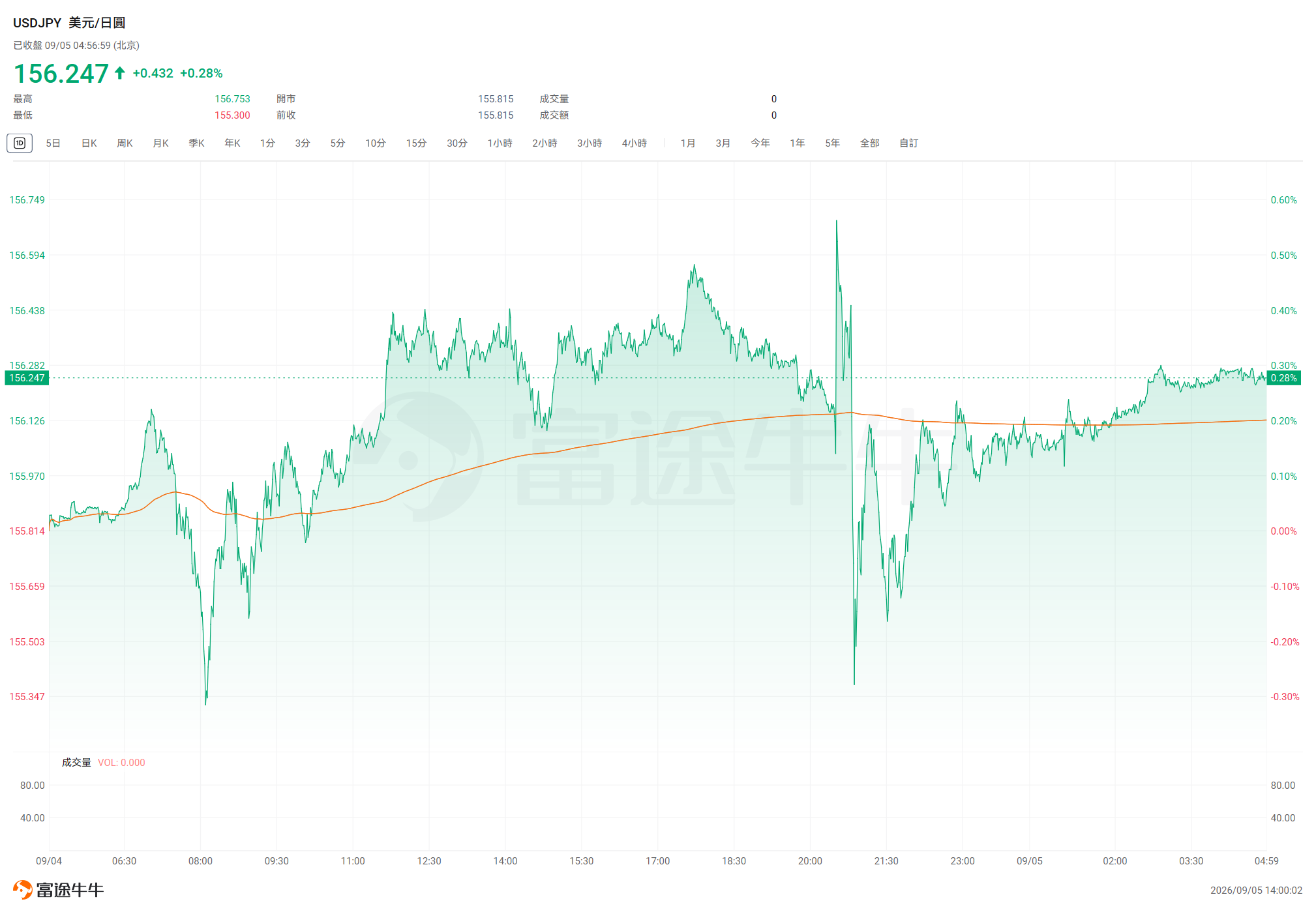
The yen surged approximately 3% within just a few trading days. Rising expectations of interest rate hikes by the Bank of Japan and the potential for the Government Pension Investment Fund (GPIF) to increase its allocation to domestic assets have emerged as the two main drivers of this rally.
 According to Zhuifeng Trading Desk, Goldman Sachs argues that this rally is not driven solely by short-term carry trades but reflects changes in Japan's domestic policy environment: rising expectations of Bank of Japan rate hikes and the potential asset reallocation by the GPIF, which could bring sustained yen buying. This implies that some factors that have long suppressed the yen are gradually transforming into supportive forces. Therefore, Goldman Sachs judges that the correction of the yen's long-term structural undervaluation may have only just begun.
Bank of America's latest report also expresses optimism about the yen, arguing that an accelerated pace of Bank of Japan rate hikes, repatriation of domestic capital, and policy support will continue to provide underpinning. If rates are hiked in September alongside hawkish signals, the USD/JPY exchange rate is projected to drop to 149 by year-end.
In contrast, while JPMorgan is also bullish on the yen's short-term performance, it believes that market expectations regarding Bank of Japan rate hikes and GPIF reallocation are already largely priced in. Once policy implementation falls short of expectations, the yen could retreat rapidly.
The key question at present is whether this yen rally, driven by Japan's policy shift, can evolve into a sustained trend.
Goldman Sachs: Yen Strength "Has Only Just Begun," Policy Shift Is Key
Goldman Sachs believes that this round of yen appreciation is primarily driven by two main factors: rising expectations of interest rate hikes by the Bank of Japan, and market bets that the GPIF may tilt its asset allocation further toward domestic markets.
Among these, the capital flows potentially triggered by the GPIF are particularly noteworthy. Citing experience from 2020, the report points out that although the GPIF officially announced adjustments to its foreign bond allocation targets in late March of that year, related capital flows had already emerged in January and February, suggesting that actual capital adjustments may precede official policy announcements.
Therefore, the report pays special attention to the August International Securities Transactions (ITS) data released on September 7, suggesting that it may contain early signals of asset rotation by the Government Pension Investment Fund (GPIF).
Goldman Sachs believes that the yen's weakness in recent years was largely driven by the resilience of the U.S. economy and the widening interest rate differential between Japan and the United States. Now, with the Bank of Japan's policy shift and potential adjustments in GPIF's domestic asset allocation, the structural headwinds previously facing the yen are easing and may even turn into support.
Bank of America: The yen's upward trend is expected to continue as the Bank of Japan turns hawkish and policy support remains in place.
Bank of America's latest policy assessment suggests that there is still room for the current rise in the yen to continue.
As the Bank of Japan adopts a more hawkish stance, the factors that had previously suppressed the yen are gradually receding. Bank of America expects the BOJ to maintain a pace of quarterly rate hikes, with markets currently pricing in a policy rate of 2% by July 2027. If the BOJ raises rates in September and sends hawkish signals, the rationale for shorting the yen will weaken further.
In this context, Bank of America expects the USD/JPY exchange rate ($USD/JPY (USDJPY.FX)$) to fall back to 149 by year-end, viewing 155 as a key technical level. A break below 155 could accelerate yen buying. Meanwhile, improvements in Japan's economic fundamentals, rising expectations for rate hikes, and potential asset rotation from overseas bonds to Japanese government bonds by Japanese investors could provide further support for the yen.
On the policy front, the Japanese government's willingness to reverse the yen's weakness is strengthening. Bank of America believes that the Ministry of Finance has not yet undertaken aggressive intervention, possibly to create conditions for the Bank of Japan to accelerate rate hikes first. If the rate hike path becomes clearer but the yen continues to weaken, the Ministry of Finance may intervene by buying yen. Therefore, even if the U.S. dollar finds support, the upside for USD/JPY may be constrained by policy measures.
JPMorgan: Bullish in the short term, but the yen's rise faces the test of policy implementation.
However, JPMorgan is significantly more cautious regarding the variable of GPIF's asset reallocation.
The agenda released on August 31 indicated that the Government Pension Investment Fund (GPIF) held a Management Committee meeting on August 21, marking its first August meeting in seven years. Furthermore, the verification of the basic portfolio, which had previously concluded in March with a finding of “no need for review,” has been reopened for discussion.
JPMorgan believes this suggests that GPIF may be reassessing its asset allocation. However, it is more likely that adjustments will remain within the current allocation bands in the near term, rather than involving a formal revision of the basic portfolio.
If the allocation to domestic bonds rises from 26.91% to the upper limit of 31%, this would theoretically correspond to approximately JPY 12.3 trillion in yen buying pressure. If the allocation to Japanese equities increases from 23.81% to 31%, this would correspond to approximately JPY 21.6 trillion, bringing the total to around JPY 33.8 trillion.
Meanwhile, JPMorgan argues that market expectations for a rate hike by the Bank of Japan have become overly aggressive. A September rate hike is now nearly fully priced in, with one-year forward one-year swap rates rising to approximately 2.13%, implying a tightening pace even faster than the bank’s own forecast. If these expectations begin to cool, the yen could instead come under pressure.
JPMorgan Reinstates Long USD Position: Interest Rate Advantage Still Undervalued, September CPI Becomes Key Variable
JPMorgan maintains a positive medium-term outlook for the US dollar. The bank believes the greenback remains undervalued by approximately 3% to 4% relative to interest rate differentials, and that the resilience of the US economy is not fully reflected in the current exchange rate.
$US Unemployment Rate (USUER.EC)$The rate remained at 4.1%, below the Federal Reserve’s year-end forecast of 4.3%. The report projects that, in a scenario where the Fed raises rates only once this year, US dollar yields will still exceed those of more than 50% of global currencies, approaching levels not seen in 25 years. If there are three rate hikes, this proportion would rise to approximately 58%.
Looking ahead, the US CPI data for August will be a key variable. Following the release of CPI data on September 11, the FOMC will meet on September 16, followed by the Bank of England on September 17 and the Bank of Japan on September 18. Market expectations for major central bank policies may undergo intensive repricing within a short period. Divergence in policy views within the Federal Reserve remains evident, and inflation data will further test market bets on the future policy path.
For the US dollar, subsequent movements will depend on changes in US economic data and Federal Reserve policy expectations. If US inflation and employment data continue to demonstrate resilience, the interest rate advantage of the dollar is likely to receive further support. Conversely, if cooling inflation prompts the market to reprice for easing policies, the dollar may come under pressure.
Editor/melody