
BofA Securities projects that the core CPI will rise by 0.22% month-on-month in August, arguing that inflation remains sufficiently elevated to support a rate hike in September. In contrast, Citi forecasts core CPI growth of only 0.18%, with the annual rate declining to 2.3%, suggesting the Federal Reserve is more likely to hold rates steady. The divergence between these two institutions stems from the discrepancy between CPI and PCE trends, as well as Governor Waller’s key tolerance threshold for inflation. Analysts suggest that if the data comes in hotter than expected, the Fed may be forced to adopt a more aggressive tightening path.
The U.S. CPI data for August, scheduled for release next Friday, will directly determine whether the Federal Reserve can resume interest rate hikes at this month's meeting. Major Wall Street institutions hold divergent views on the report: Bank of America Securities believes the data will be strong enough to support a rate hike in September, while Citi expects core inflation to cool further, making it more likely that the Fed will hold rates steady.
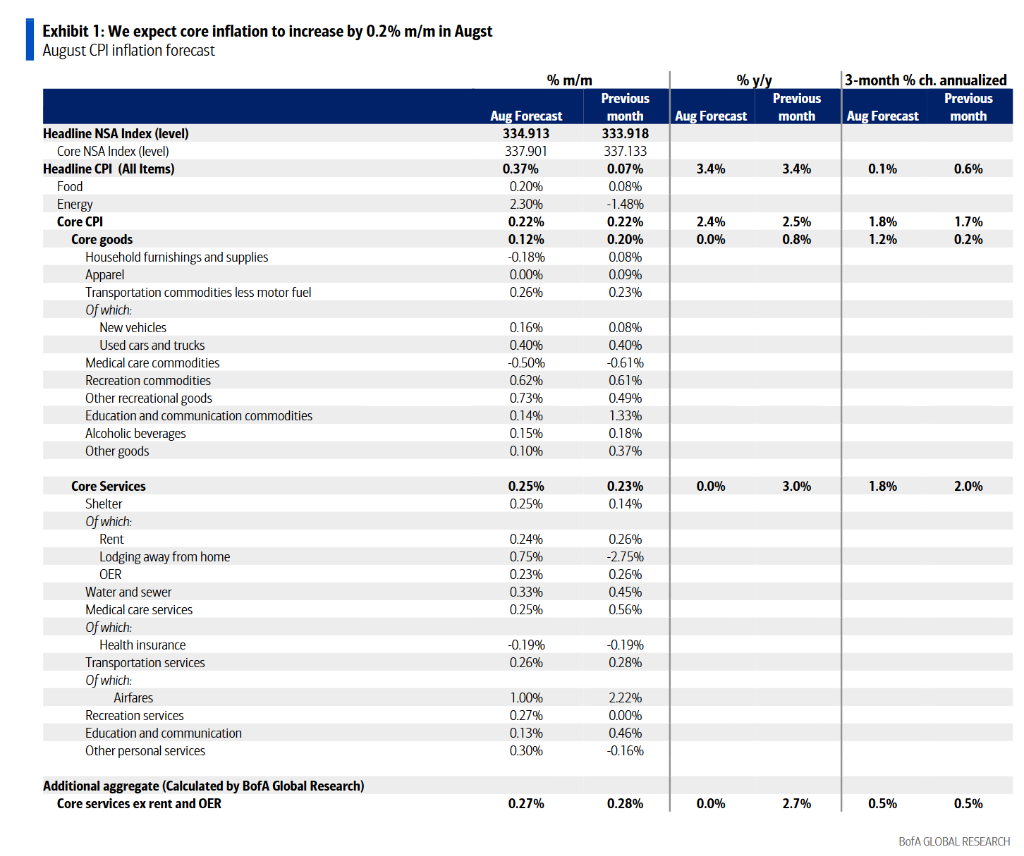
According to Zhuifeng Trading Desk, Bank of America Securities forecasts that the August core CPI will rise by 0.22% month-on-month, corresponding to a core PCE increase of approximately 0.24%, with the annualized rate climbing to 3.4%. The bank believes this level is sufficient to convince Federal Reserve Chair Powell that inflation has not been adequately controlled, thereby supporting another rate hike. Bank of America considers the August CPI data as the "decisive battle" for a September rate hike.
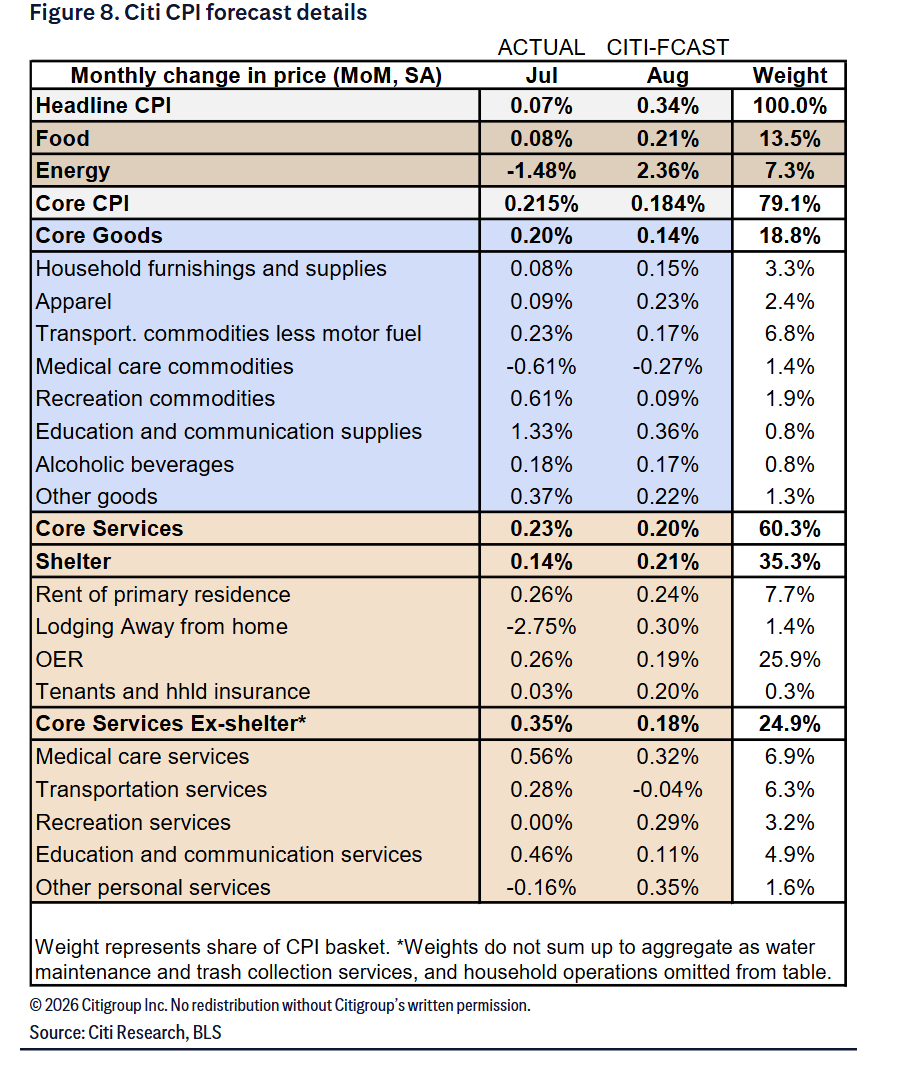
 Citi, on the other hand, predicts that the core CPI will increase by only 0.184% month-on-month, with the annualized rate dropping to 2.3%. If realized, this would be the lowest annualized reading since the core CPI broke above 2% in April 2021, which would be sufficient for most officials to choose to keep interest rates unchanged.
Meanwhile, some analysts warn that if the CPI data comes in hotter than expected, compounded by the core PCE inflation already rising to a high of 3.9% and robust August employment data, the Federal Reserve may be forced to adopt a more aggressive tightening path. This could push interest rates above 5% and actively invert the yield curve, subjecting U.S. equities to significant downward pressure.
Key Threshold: Waller's Vote Holds the Key
The decision on a rate hike at the September meeting depends to a large extent on the voting dynamics within the Federal Reserve. Analysis suggests that the hawkish and dovish factions within the Fed are evenly matched, with Governor Waller viewed as the key swing vote.
Waller previously stated to Reuters, "If inflation continues to make progress toward the 2% target, I am willing to support keeping the current policy rate unchanged," explicitly pointing out that the August inflation data would be a key basis for his decision. A Bank of America report noted that Powell sent clear hawkish signals at the Jackson Hole meeting, seemingly lowering the threshold for another rate hike, while the positions of Williams and Waller remain relatively dovish.
According to Bank of America's analysis, Waller's implicit threshold is that he would only support a rate hike if the August core PCE exceeds 0.30% month-on-month. Bank of America Securities forecasts the core PCE to be around 0.24%, which is below this threshold, but believes that if Powell supports a rate hike and the data largely meets expectations, there may still be a sufficient majority within the committee to support another rate increase.
Citi believes that following Waller's comments this week, the market's threshold for defining "overheated" inflation has shifted upward. Any data showing a month-on-month increase that rounds to 0.2% may be considered sufficiently moderate by most officials to support a pause in rate hikes.
Core Disagreement: CPI and PCE Tell Different Stories
The underlying cause of the current divergence in forecasts lies in the structural differences between the two major inflation indicators, CPI and PCE, which are currently telling markedly different inflation stories.
Analysis shows that housing accounts for approximately one-third of the CPI basket, whereas its weight in the PCE is significantly lower. Over the past year, the cooling of housing inflation has been the primary driver behind the decline in core CPI and the main reason for the widening gap between CPI and PCE. Meanwhile, the PCE assigns a higher weight to healthcare, covering expenditures paid by Medicare, Medicaid, and employers, while the CPI primarily measures out-of-pocket consumer costs. Consequently, rising healthcare costs are pushing up core PCE, particularly supercore PCE.
The Federal Reserve Bank of Cleveland’s Nowcasting model indicates that core CPI is expected to fall further to 2.3% in September, approaching the Federal Reserve’s 2% target, while core PCE is projected to rise to approximately 3.5% during the same period, highlighting a clear divergence in their trends.
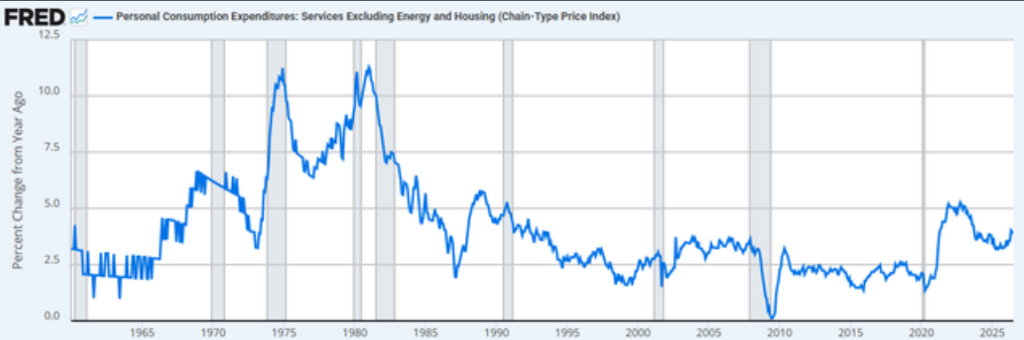
Federal Reserve Chair Waller confirmed in his speech at Jackson Hole that PCE inflation is the Fed’s preferred policy reference indicator, with particular focus on supercore PCE—defined as PCE services inflation excluding energy and housing. This metric has currently risen to 3.9% and continues to climb, reflecting persistent wage-driven inflationary pressures in the services sector.
Energy and Employment: Two Cards Strengthening the Hawkish Stance
Regardless of the final data, the August employment report has already provided strong support for the hawkish camp.
Nonfarm payrolls increased by 162,000 in August, far exceeding the market expectation of 55,000, with annualized wage growth reaching 3.1%. These figures were released after Waller’s remarks, implying that the Federal Reserve needs to re-evaluate the wage-inflation dynamics.
In terms of energy, both Bank of America Securities and Citi expect energy prices to rebound in August after several consecutive months of decline, driving the month-on-month increase in headline CPI to approximately 0.34%–0.37%, and pushing the annual rate further up from around 3.4% in July.
Analysts point out that tensions in the Middle East remain elevated, normal transit through the Strait of Hormuz has not yet resumed, and global oil inventories continue to decline. A sharp surge in energy prices would not only drive up headline inflation but could also transmit to core inflation through a wage-price spiral, thereby intensifying pressure on the Federal Reserve to maintain a tight monetary policy.
Renewed Expectations of Rate Hikes Weigh on Equity Markets
For investors, the market implications of this CPI report are equally impossible to ignore.
The Shiller P/E ratio for the S&P 500 Index has currently exceeded 42x, placing it in bubble valuation territory. Historically, this level typically corresponds to the late stage of the economic cycle and has been further amplified by the surge in AI-related capital expenditure. Analysts believe that if the Federal Reserve is forced to adopt a more aggressive tightening path—pushing interest rates above 5% and actively inverting the yield curve—U.S. equities will face significant risk of P/E multiple compression.
Bank of America Securities believes that even if the composition of August’s inflation data does not raise major alarms, it is unlikely to provide the Committee with sufficient justification to delay rate hikes. The data release on September 11 will serve as the most critical test for the Fed’s recent policy direction.
Following the CPI report, the August PCE data will be released at the end of September, two weeks after the Federal Reserve’s September interest rate decision.
Citi points out that uncertainty surrounding the August PCE data is higher than usual. The Federal Reserve has implemented methodological adjustments to certain key components, meaning the conventional mapping relationship from CPI and PPI data to PCE has become less clear this month. Additionally, historical PCE data for the past five years will undergo revisions, which are expected to lower the annualized core PCE rate by more than 30 basis points to approximately 3.0%. This technical factor increases the difficulty for markets in interpreting the final PCE figures.